The question of who is King Alcinous in the Odyssey? leads us to one of the most memorable and pivotal figures in Homer’s epic, a ruler whose generosity and wisdom serve as a beacon of civilization amidst the chaos of Odysseus’s ten-year journey home. Alcinous (Ἀλκίνοος, meaning “mighty mind”) is the king of the Phaeacians, a wealthy and seafaring people who inhabit the idyllic island of Scheria . He is the son of Nausithous and the grandson of the god Poseidon, making him a figure of divine lineage and royal authority . In the Odyssey, Alcinous plays the crucial role of the gracious host who provides Odysseus with refuge after his harrowing escape from Calypso’s island, offering him not only food and shelter but also a safe passage back to Ithaca . His court, characterized by its wealth, its love of feasting and athletic competition, and its adherence to the sacred code of hospitality (xenia), provides the perfect setting for Odysseus to recount his famous adventures and finally secure his return home . This article will serve as a definitive guide to King Alcinous, exploring his origins, his role in the Odyssey, his family, and his enduring legacy in Greek mythology.
Origins and Historical Background of Alcinous
Alcinous is a figure of royal and divine heritage, firmly rooted in the mythological traditions of the ancient Greek world. His genealogy establishes him as a king of great authority and a descendant of the gods. According to the most widely recognized tradition, Alcinous is the son of Nausithous and the grandson of Poseidon, the god of the sea . This lineage connects him directly to the divine power that both aids and opposes Odysseus, adding a layer of complexity to his role as the hero’s benefactor.
Alcinous’s kingdom, Scheria, was identified in very early times with the island of Corcyra (modern Corfu), where he was revered as a hero . The Phaeacians, his subjects, were a prosperous maritime people blessed with extraordinary ships that required no helmsman and could travel at the speed of thought . They lived in a state of isolation and abundance, enjoying a life of peace and prosperity under their king’s benevolent rule .
It is important to note, however, that the tradition of Alcinous and his people was not monolithic. In the myth of Jason and the Argonauts, Alcinous is represented as living on the island of Drepane, not Scheria, with his queen Arete . This alternative tradition, which predates Homer’s Odyssey in some sources, depicts the Phaeacians as a different people with a different history and geography, suggesting that the Homeric version was one of several competing narratives about this mythical king . The Argonautic tradition portrays Alcinous as a protector of Jason and Medea, further cementing his reputation as a righteous and just ruler .
The Mythological Role of Alcinous
Alcinous’s primary mythological role is as the ultimate exemplar of xenia, the sacred Greek concept of hospitality to strangers. In a world where travelers were often at the mercy of inhospitable hosts, Alcinous stands out as a paragon of generosity and courtesy. His role in the Odyssey is to provide Odysseus with the respite, resources, and passage he needs to finally return to Ithaca.
The Encounter in the Odyssey
Alcinous’s role in the Odyssey begins in Book VI, when Odysseus, shipwrecked and naked, washes ashore on Scheria. He is discovered by Nausicaa, the king’s daughter, who, guided by Athena, provides him with clothing and instructs him to seek her mother, Queen Arete, first when he arrives at the palace . Odysseus, following her advice and with Athena’s divine protection, makes his way to the palace.
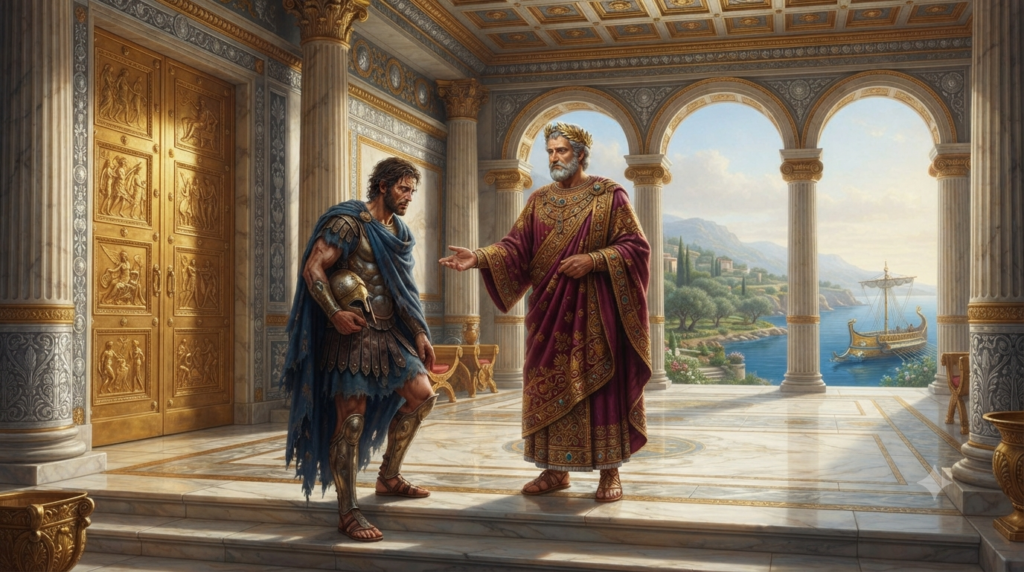
The description of Alcinous’s palace is one of the most famous and elaborate passages in the Odyssey, a testament to his wealth and the divine favor his people enjoy . It features bronze walls, golden doors, silver doorposts, and gold and silver dogs crafted by Hephaestus to guard the threshold. The palace is surrounded by a magnificent orchard that bears fruit year-round, a symbol of the perpetual abundance of the Phaeacian realm .
When Odysseus enters the palace, he is welcomed with extraordinary hospitality. Alcinous, without even knowing the stranger’s identity, offers him food, drink, and a place of honor at his table . He arranges athletic competitions in Odysseus’s honor and, most importantly, creates a safe space for the hero to share his long, tragic tale of wandering since the fall of Troy . This speech, which occupies Books IX-XII, is the only complete first-person account of Odysseus’s adventures in the epic.
Deeply moved by Odysseus’s suffering and impressed by his eloquence, Alcinous’s generosity exceeds even the normal bounds of xenia. He not only promises to provide a ship for his return to Ithaca but also taxes his people to offer Odysseus extraordinary treasures . He arranges for a magical Phaeacian ship and crew to transport the hero, promising to deliver him swiftly and safely, regardless of Poseidon’s opposition . This act of generosity, however, comes with consequences. Poseidon, who had prophesied the Phaeacians would be punished for aiding travelers, turned the returning ship to stone within sight of Scheria, fulfilling his warning that their seafaring assistance would end .
The Encounter in the Argonautica
In the myth of Jason and the Argonauts, Alcinous’s role is that of a protector of the righteous. When the Argonauts arrive at Drepane with Medea, the Colchians pursue them and demand her return. Alcinous declares that if Medea is still a virgin, she must be returned to her people, but if she is already Jason’s wife, he will protect her . Arete, his queen, arranges for Jason and Medea to be married immediately, thereby ensuring their safety. Alcinous then grants them his protection and sends them off with expensive presents . This story highlights his commitment to justice and the sanctity of marriage.
Family and Relationships
Alcinous’s family is central to his character and his role in the Odyssey. His relationships are characterized by harmony, respect, and mutual support.
Parents and Ancestry
Alcinous is the son of Nausithous, who was himself the son of the god Poseidon and the mortal woman Periboea . This lineage makes Alcinous the grandson of Poseidon, a fact that adds a layer of divine significance to his rule. Some accounts name his father as Phaeax, who was also a son of Poseidon, further cementing his connection to the sea god .
Queen Arete
Alcinous’s wife is Queen Arete, who is also his niece, the daughter of his brother Rhexenor . After Rhexenor’s death, Alcinous married Arete, and she became his co-ruler and trusted advisor. Arete is portrayed as a woman of exceptional intelligence, wisdom, and authority, and Athena advises Odysseus to seek her favor first when he arrives at the palace . Their partnership is a model of mutual respect and shared power, a rarity in ancient Greek literature.
Children
Alcinous and Arete have several children. Their daughter, Nausicaa, plays a crucial role in the Odyssey, discovering Odysseus and providing him with the help he needs to reach her father’s court . They also have five sons, including Laodamas, Clytoneus, and Halius, who participate in the athletic contests held in Odysseus’s honor .
Character Traits and Symbolism
Alcinous is a figure of exemplary virtue, embodying the ideals of Greek kingship and hospitality.
- Wisdom and Perceptiveness: His name, meaning “mighty mind,” reflects his intelligence and insight . He recognizes the divine influence in Odysseus’s arrival and perceives the hero’s noble character immediately, without needing to know his identity .
- Generosity: Alcinous practices xenia in its purest form. He offers Odysseus food, shelter, and a place of honor before asking his name, and he provides a ship and treasures beyond what is expected .
- Justice: In the Argonautic tradition, Alcinous demonstrates his commitment to justice by protecting Medea and Jason from the Colchians, upholding the sanctity of marriage and the rule of law .
- Leadership: He rules with a collaborative spirit, consulting with the thirteen regional princes and ensuring the well-being of his people . His palace is a symbol of the prosperity and order of his kingdom.
Worship and Religious Importance
Alcinous was not worshipped as a god, but he was revered as a hero, particularly on the island of Corcyra, which was identified as his kingdom . In the Odyssey, he is depicted as a man who is favored by the gods, as evidenced by the divine gifts bestowed upon his palace and his people . His adherence to the sacred code of xenia is itself a religious act, as hospitality was seen as a duty owed to the gods.
Ancient Sources
Alcinous is mentioned in several key ancient sources, including:
- Homer’s Odyssey (c. 8th century BCE): The most famous and detailed source, depicting Alcinous as the host of Odysseus .
- Apollonius of Rhodes’s Argonautica (c. 3rd century BCE): Describes Alcinous as the protector of Jason and Medea in the Argonautic tradition .
- Pseudo-Apollodorus’s Bibliotheca (c. 1st-2nd century CE): A later compendium of myths that mentions Alcinous in the context of the Argonautic legend .
- Hyginus’s Fabulae (c. 1st century CE): A Roman author who preserves the Greek traditions, including the stories of Alcinous .
Artistic Representations
Alcinous is a subject in ancient Greek and Roman art, often depicted in scenes from the Odyssey. He is shown welcoming Odysseus, presiding over feasts, and hosting the athletic competitions in his honor. His palace, with its extraordinary architecture, was also a popular subject in ancient art, representing the ideal of a wealthy and divinely favored kingdom.
Cultural Influence and Historical Legacy
Alcinous’s legacy is his embodiment of the ideal of hospitality and his role as the facilitator of Odysseus’s homecoming. His story has been a source of inspiration for countless writers and artists, and his name has become synonymous with generosity and wise kingship. The phrase “Alcinous’s palace” is often used to describe a place of incredible wealth and luxury. His role in the Argonautic tradition further cements his place as a figure of justice and protection.
Frequently Asked Questions About Who is King Alcinous in the Odyssey?
Who was King Alcinous in the Odyssey?
King Alcinous was the ruler of the Phaeacians on the island of Scheria. He was the son of Nausithous and the grandson of Poseidon. He is best known for his generous hospitality toward Odysseus, providing him with food, shelter, and a safe passage home to Ithaca .
What role did King Alcinous play in the Odyssey?
Alcinous served as the host to Odysseus in Books VI-XIII of the Odyssey. He offered Odysseus refuge after his shipwreck, listened to his tales of adventure, and arranged for his return to Ithaca using a magical Phaeacian ship .
Where did King Alcinous rule?
Alcinous ruled the island of Scheria, which was identified in very early times with Corcyra (modern Corfu) . His kingdom was a wealthy, isolated, and prosperous maritime society .
Who were the parents of King Alcinous?
Alcinous was the son of Nausithous and the grandson of the god Poseidon . His mother is not explicitly named in the Odyssey, but his lineage establishes his divine heritage.
Who was Queen Arete?
Queen Arete was the wife of Alcinous and the mother of Nausicaa. She was highly intelligent, respected, and influential in royal decisions. Odysseus was instructed by Athena to seek her favor first when he arrived at the palace .
Did Alcinous have any other appearances in Greek mythology?
Yes, Alcinous also appears in the myth of Jason and the Argonauts, where he and Arete protect Jason and Medea from the Colchians .
What is the meaning of the name Alcinous?
The name Alcinous is derived from the Greek elements meaning “mighty mind” or “strong intellect,” reflecting his character as a wise and perceptive ruler .
Conclusion
King Alcinous is one of the most memorable and respected figures in Homer’s Odyssey. The answer to the question of who is King Alcinous in the Odyssey? reveals a ruler of divine lineage, immense wealth, and exemplary virtue, a man whose generosity and wisdom serve as a beacon of civilization amidst the chaos of Odysseus’s journey. He is the perfect host, embodying the sacred code of xenia in its purest form, and his kingdom, Scheria, is a symbol of divine favor and earthly prosperity. His role as Odysseus’s benefactor is pivotal, providing the hero with the final, crucial step on his long journey home. Alcinous’s legacy is a testament to the power of hospitality and the enduring importance of justice and wisdom in leadership.

Orin Vale has spent the better part of two decades tracing the threads that connect the world’s oldest stories — from the halls of Asgard to the banks of the Nile, from Olympus to the jungles of the Maya. What began as a childhood fascination with flood myths and trickster gods grew into years of independent study across comparative mythology and ancient religion, always chasing the same question: what did these stories mean to the people who first told them? Orin writes for readers who want more than trivia — the ones looking for the beliefs, fears, and truths that myths were built to carry.