The question of who is the river god Anigros in Greek mythology? leads us to a unique and fascinating figure associated with healing, myth, and the distinctive geography of the Peloponnese. Anigros (also known as Anigrus) was a minor river god of Elis, a region in the western Peloponnese of Greece . Unlike many of the great, personified rivers of Greek myth, Anigros is notable not for grand epics but for the distinct, pungent character of his waters and the healing cult that grew up around them. His sacred waters were believed to cure skin diseases, and his legacy is preserved through his nymph daughters, the Anigrides, who were worshipped at a cave near the river’s mouth . This article will serve as a definitive guide to the river god Anigros, exploring his mythological origins, the unique properties of his river, his healing cult, and his place in Greek myth and history.
Origins and the Mythological River
The Anigros River, from which the god takes his name, was a small stream in southern Elis. It rose on Mount Lapithas and flowed through the region of Triphylia, emptying into the Ionian Sea near the ancient city of Samikon . The river was known by another name in Homeric times; the poet calls it the Minyeius (or Minueios) in the Iliad . This earlier name connects the river to the Minyans, a legendary prehistoric people, suggesting the river’s ancient significance.
The most remarkable characteristic of the river Anigros, however, was its distinct and unpleasant odor . The water was so foul-smelling, and its fish so inedible, that it earned the name Mavro-potamo, meaning “Black River” . This quality was not a natural phenomenon but was explained in Greek mythology as the result of a traumatic event involving the centaurs.
The Myth of the Centaur’s Wound
According to the myth preserved by the Greek geographer Strabo and the travel writer Pausanias, the noxious properties of the Anigros originated when a centaur, either Chiron or Pylenor, was wounded by Heracles . During the hero’s epic labors, he shot the centaur with an arrow dipped in the poisonous blood of the Hydra. The wounded centaur fled to the Anigros River and washed his wound in its waters . The hydra’s venom, which caused the centaur’s injury, was transferred to the river, giving it its offensive smell and making the fish inedible . This myth effectively transformed the natural properties of the river into a narrative of divine trauma.
Alternative Aetiologies
While the centaur myth was the most common explanation, another legend attributed the river’s special quality to the seer Melampus. According to some accounts, Melampus purified the daughters of Proetus (the Proetides), who had been driven mad by the gods, by washing them in the Anigros . The means of their purification were then thrown into the river, giving it its powerful, healing, but unpleasant characteristics. This alternative aetiology connects the river to the practice of ritual purification, a theme that runs throughout its mythology.
The Mythological Role of Anigros
Anigros was a local river god, a Potamoi, who personified his river . In this role, he was the divine embodiment of the waterway, its properties, and its influence on the surrounding land. The river’s role as a healing agent was directly attributable to the god, with his waters being used in a ritual of purification for those suffering from skin diseases. His mythological role, therefore, was intricately linked to the specific characteristics of his river: a place of both foul odor and potent healing power. The very smell that repelled some was the sign of the curative agents within.
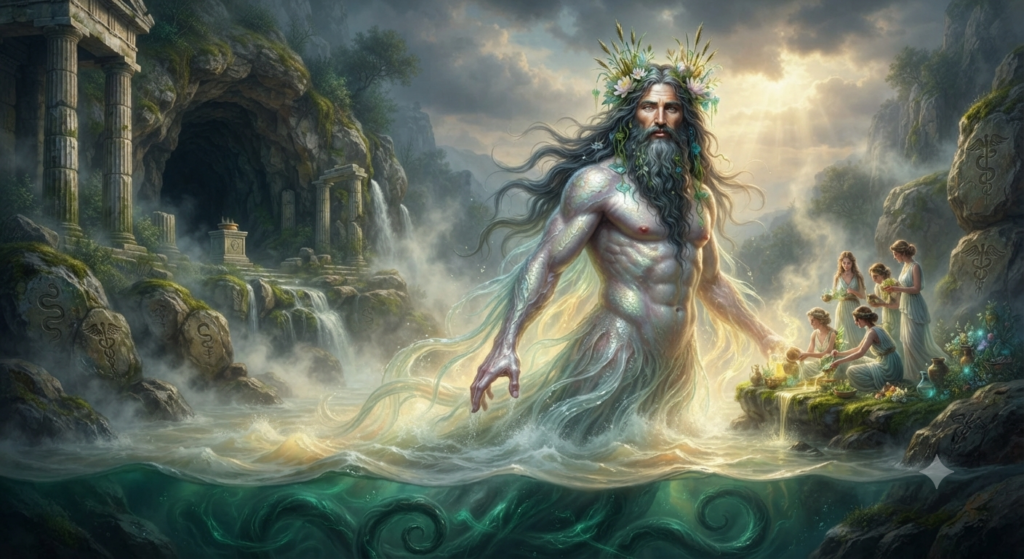
Anigros was primarily known through his association with his daughters, the Anigrides (or Anigriades) . These nymphs were the personifications of the river’s springs and served as the primary focus of the healing cult that thrived at the river’s mouth. The nymphs’ cave was the site of worship, where supplicants prayed and performed sacrifices to the nymphs and, by extension, to their father, the river god, seeking a cure for skin ailments .
Family and Relationships
The river god Anigros, as a Potamoi, was one of the many sons of the Titans Oceanus and Tethys. His specific genealogical lineage places him within the vast, primordial family of river gods who were believed to be the sons of these primordial deities. The Potamoi were the brothers of the Oceanids, the goddesses of springs and clouds.
His most significant descendants were his daughters, the Anigrides. The exact number of these nymphs is uncertain, but they were the local Naiads of the river’s springs . The names “Anigrides” and “Anigriades” are both used to identify the nymphs associated with the river, though “Anigrides” is the more common Greek form . These nymphs were not merely abstract figures but were active participants in the cult of healing that was centered on their father’s river.
The Cave of the Anigrides and the Healing Cult
The most significant aspect of the Anigros myth is the healing cult that developed around his river. On the coast of Elis, near Samikon, there was a cave sacred to the Anigrides, the nymphs of the Anigros . This cave was a site of pilgrimage for those afflicted with skin diseases, who sought a cure through prayer, sacrifice, and ritual bathing.
The specific ritual involved the supplicant entering the cave to pray to the nymphs and make a promise of sacrifice. They would then wipe the diseased parts of their body and swim across the river, leaving their uncleanness in the water . Upon emerging, they were cured, their skin restored to a healthy color. The cave and the river were, in fact, part of a natural sulfurous thermal spring that still exists today as the Kaiafas thermal springs .
This cult is a fascinating blend of myth and practical medicine. The ancient Greeks recognized the therapeutic properties of the sulfurous waters and attributed them to divine intervention. Anigros, as the river god, was the source of this curative power, and his nymph daughters were the intermediaries through whom the cures were dispensed. The earliest attestation of the cult of the Anigrides is from the poet Moero in the 3rd century BCE .
Symbols and Meaning
The symbols associated with Anigros are tied to the physical characteristics of his river and its role as a healing agent.
- The Sulfurous Water: The most potent symbol is the water itself, with its strong odor and curative properties. It represented the paradoxical nature of the myth: something foul could be the source of profound healing.
- The Hydra’s Poison: The poison of the Hydra, which gave the river its smell, symbolizes the transformative power of divine trauma. The venom that poisoned the centaur became the source of healing for mortals.
- The Cave of the Nymphs: The cave was a symbol of the liminal space between the human and divine worlds, a place where mortals could approach the gods and seek their intervention.
- The Spring: The water springing from the earth symbolized the emergence of divine power from the chthonic realm, bringing healing to the surface world.
Powers and Characteristics
As a personification of the river, Anigros’s “power” was the water itself. His most distinctive characteristic was the curative nature of his waters, which could heal skin diseases through a ritual of bathing and prayer. This made him a god of healing, though his domain was specific to the ailments affecting the skin. The malodorous nature of his river, which was a sign of the healing properties, is a key characteristic that distinguishes him from other river gods. Anigros was not a heroic figure with grand adventures; his power was passive, expressed through the natural properties of his river and the cult that honored him.
Worship and Religious Importance
Anigros did not have a separate temple or formal cult outside of the worship of his daughters, the Anigrides. However, his importance was felt through the healing rituals that took place at their cave. The supplicants who came to the cave were effectively honoring the river god by petitioning his daughters and bathing in his waters. The cult of the Anigrides is the primary evidence for the religious importance of Anigros. It demonstrates the ancient Greek belief in the connection between geography, myth, and medicine.
The specific nature of the ritual—the prayer, the promise of sacrifice, the bathing, and the emergence of a healed body—indicates a structured form of worship that combined faith with natural therapy. This practice was not unique to Anigros; many healing springs in Greece were dedicated to nymphs and other minor deities. However, the vivid description by Pausanias and the specific connection to the centaur myth make the cult of the Anigrides a particularly memorable and well-documented example of this ancient tradition.
Ancient Sources
The river god Anigros and his nymph daughters are mentioned in several key ancient sources, providing the foundation for our understanding of the myth:
- Pausanias’ Description of Greece: The most important source for the river, the cave, and the healing cult .
- Strabo’s Geography: Provides the aetiology for the river’s unique properties and connects it to the centaur myth .
- Ovid’s Metamorphoses: The Roman poet mentions the river and its properties .
- Homer’s Iliad: The epic mentions the river under its earlier name, Minyeius, demonstrating its antiquity .
Artistic Representations
Anigros is not a figure who appears in the grand narrative art of vase painting or sculpture. As a local river god, his image was likely tied to the iconography of the region. However, the cave of the Anigrides may have been a site of votive offerings, such as small figurines, representing the supplicants who sought healing. These would have been dedicated to the nymphs and, by extension, to their father. The lack of major artistic representations underscores Anigros’s status as a minor, localized deity whose influence was felt primarily through his river and its specific properties.
Cultural Influence and Historical Legacy
The legacy of Anigros is both mythological and geographical. The river itself still exists, and the thermal springs of Kaiafas, where the ancient cave was located, are still known and visited for their therapeutic properties . This direct link between ancient myth and a modern geographical feature is a powerful testament to the enduring nature of Greek mythology. The story of Anigros is a prime example of how the ancient Greeks used myth to explain the natural world and to give meaning to its peculiarities. The foul odor of the river was not a random fact of nature but a divine sign, a mark of a mythic event that had endowed the water with extraordinary curative powers.
Frequently Asked Questions About Who is the river god Anigros in Greek mythology?
What is the meaning of the name Anigros?
The name Anigros (or Anigrus) is thought to derive from the river itself, which in Greek was called the Ἄνιγρος. The river was also known as the Minyeius in Homeric times . The name “Anigros” may have been a later name, though its specific etymology is not definitively known.
What was the river Anigros known for in Greek mythology?
The river was famous for its foul odor, which made its fish inedible. This was explained by the myth that a wounded centaur had washed the Hydra’s poison from his wound in the river. However, this same unpleasant water was believed to be a powerful cure for skin diseases .
Who were the daughters of the river god Anigros?
The daughters of Anigros were the Anigrides (or Anigriades), a group of Naiad nymphs who personified the springs of the river. They were worshipped at a cave near the river’s mouth and were the specific deities to whom supplicants prayed for healing .
Why was the Anigros River considered healing?
The river’s waters, which were naturally sulfurous, were believed to cure skin diseases such as alphos and leuke. The ritual involved praying to the Anigrides, wiping the affected areas, and swimming through the river to wash away the disease . The sulfurous nature of the water likely contributed to its actual therapeutic properties.
Who was Melampus in relation to the Anigros?
In an alternative myth, the seer Melampus used the waters of the Anigros to purify the daughters of Proetus, who had been driven mad. The means of their purification were then thrown into the river, giving it its healing properties .
Where was the river Anigros located?
The Anigros River was located in Elis, a region in the western Peloponnese of Greece. It rose on Mount Lapithas and flowed into the Ionian Sea near the ancient city of Samikon, where the cave of the Anigrides was situated .
Conclusion
Anigros, the river god of Elis, is a minor but fascinating figure in Greek mythology. His story is a testament to the ancient Greek practice of giving the natural world a mythological narrative. The answer to the question of who is the river god Anigros in Greek mythology? reveals a deity who personified a river of paradoxes—a place of foul odor and powerful healing, a site of divine trauma and human restoration. Though he lacked the epic adventures of gods like Zeus or Poseidon, Anigros’s influence was felt on a local and deeply personal level. Through his nymph daughters, the Anigrides, his waters offered a cure for the physical afflictions of the body, linking faith and medicine in a ritual that has survived for millennia. His legacy is the enduring power of myth to explain the world and to give meaning to its peculiarities.

Orin Vale has spent the better part of two decades tracing the threads that connect the world’s oldest stories — from the halls of Asgard to the banks of the Nile, from Olympus to the jungles of the Maya. What began as a childhood fascination with flood myths and trickster gods grew into years of independent study across comparative mythology and ancient religion, always chasing the same question: what did these stories mean to the people who first told them? Orin writes for readers who want more than trivia — the ones looking for the beliefs, fears, and truths that myths were built to carry.