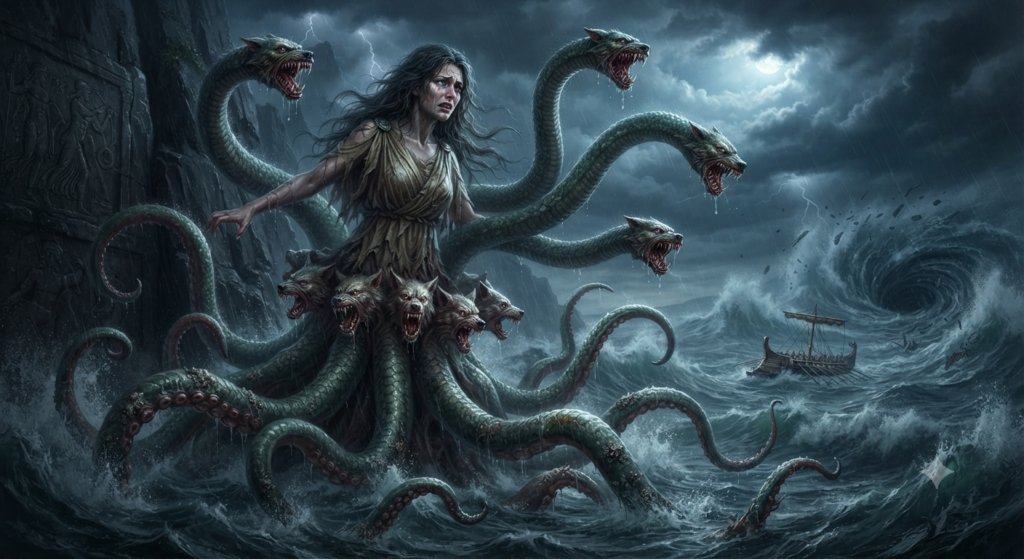
The question of who is Scylla in Greek mythology? leads us into the treacherous waters of ancient seafaring lore, where the line between natural hazard and monstrous predator blurs into a terrifying reality. Scylla (Greek: Σκύλλα, translit. Skýlla) was a legendary, man-eating sea monster who inhabited one side of a narrow strait of water, opposite her counterpart, the sea-swallowing monster Charybdis . She was not merely a creature of myth but a personification of the very real dangers that confronted Greek mariners as they ventured into the uncharted waters of the western Mediterranean . Scylla represents the inescapable perils of the sea, the fear of being snatched from the deck by an unseen force, and the grim choice between two equally devastating fates. This article will serve as a definitive guide to Scylla, exploring her terrifying description in Homer’s Odyssey, her complex origins as a nymph transformed by divine jealousy, her family relationships, and her enduring legacy in language and culture.
Origins and Historical Background of Scylla
Scylla is first attested in the most foundational work of Greek literature, Homer’s Odyssey, which dates to the 8th century BCE . The poet’s depiction of her as a twelve-footed, six-headed monster who feeds on dolphins and sailors set the standard for all later representations . However, Homer does not provide an origin story for her; she simply exists as an elemental force of nature. The tradition of providing a backstory for Scylla seems to have developed later, as Greek authors sought to rationalize or mythologize the monster’s existence . This development transformed her from a pure monster into a figure of tragedy, a beautiful nymph whose beauty became her curse.
The historical importance of Scylla lies in her role as an explanation for the real dangers of navigation in the Strait of Messina, the narrow sea between Italy and Sicily . Ancient sailors navigating these waters faced the threat of dangerous currents, hidden rocks, and whirlpools. Scylla was the mythological embodiment of these hazards, a monster that made the unpredictable and often fatal nature of seafaring tangible and terrifying. The phrase “between Scylla and Charybdis” has come to mean being caught between two equally unpleasant alternatives, a poetic expression of the impossible choices that sailors (and later, all people) sometimes face .
The Mythological Role of Scylla
Scylla’s primary mythological role is to serve as an inescapable peril for Greek heroes, a monster whose existence defines the limits of human bravery and the dangers of the unknown sea. She is the archetypal hazard of the ocean, a creature that is both a physical obstacle and a moral test. Unlike many monsters who are ultimately defeated by heroes, Scylla’s threat is perpetual and unavoidable. She cannot be killed; she can only be endured.
The Encounter in Homer’s Odyssey
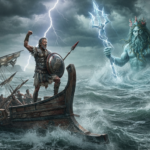
The most famous encounter with Scylla occurs in Book XII of Homer’s Odyssey . After the hero Odysseus and his crew survive the Sirens, they must navigate the narrow strait between Scylla and Charybdis. The goddess Circe advises Odysseus to sail closer to Scylla, for Charybdis could drown his whole ship: “Hug Scylla’s crag—sail on past her—top speed! Better by far to lose six men and keep your ship than lose your entire crew” . She also tells him to call upon Crataeis, Scylla’s mother, to prevent the monster from pouncing more than once.
Odysseus follows Circe’s advice and steers the ship away from the whirlpool of Charybdis and toward Scylla’s rock. Scylla strikes, snatching six of his men, the “six best” crew members, off the deck. Homer’s description is a vivid and horrifying image of loss:
“…they writhed gasping as Scylla swung them up her cliff and there at her cavern’s mouth she bolted them down raw—screaming out, flinging their arms toward me, lost in that mortal struggle” .
This moment is one of the most powerful in the epic, a testament to Odysseus’s leadership and his ultimate inability to protect his men from the dark forces of the world.
The Encounter in the Argonautica
According to Greek legend, the hero Jason and his Argonauts also sailed past Scylla and Charybdis on their voyage home from Colchis with the Golden Fleece . Their encounter, however, was less tragic. The goddess Hera, who had aided Jason on his quest, asked the Nereid Thetis to ensure safe passage for his ship, the Argo. Thetis and her sister nymphs navigated the ship through the strait, allowing the Argo to emerge unscathed from the perilous passage .
Heracles and the Death of Scylla
In a late Greek myth, recorded in the commentary of Eustathius on Homer, the hero Heracles encountered Scylla during a journey to Sicily and slew her . According to this account, she had stolen some of the cattle of Geryon, which Heracles was transporting back to Greece. Her father, the sea-god Phorcys, then applied flaming torches to her body and restored her to life . This story serves to rationalize her existence and demonstrates the cyclical nature of her monstrous nature. She is a being whose death is only temporary, an eternal hazard that must be faced again and again.
The Complex Origins of Scylla
The parentage of Scylla varies according to the author, with several conflicting traditions existing in the ancient sources .
Homer’s Account: Crataeis
In the Odyssey, Homer names Crataeis as the mother of Scylla, but he does not mention a father . Circe instructs Odysseus to call upon Crataeis to prevent Scylla from pouncing more than once . The name Crataeis, meaning “the mighty one,” may have been a title for Hecate or another ancient sea goddess .
Later Traditions: Phorcys, Hecate, and Others
The parentage of Scylla becomes more elaborate in later sources. The most common and widely accepted genealogy makes her the daughter of Phorcys, the ancient sea god and father of monsters, and Ceto, the sea goddess of sea monsters . This lineage places Scylla firmly within a family of monsters, including the Graeae, the Gorgons, and Echidna .
The Hesiodic Megalai Ehoiai gives Hecate and Phorbas as the parents of Scylla, while Acusilaus says that Scylla’s parents were Hecate and Phorkys . Apollonius of Rhodes attempts to reconcile these conflicting accounts by saying that Crataeis was another name for Hecate, and that she and Phorcys were the parents of Scylla .
The mythographer Hyginus gives a different genealogy, making Scylla the offspring of Typhon and Echidna, two of the most fearsome monsters in all of Greek myth . Other authors, such as Stesichorus, name Lamia as the mother of Scylla .
The Lovers and Jealousy of the Gods
While the older tradition described Scylla as a pure monster, later classical writers provided a tragic backstory that explained her transformation from a beautiful nymph into a terrible beast . These stories often involve divine jealousy and romantic rivalry.
Glaucus and Circe (Ovid’s Metamorphoses)
The most famous version of Scylla’s origin is told by the Roman poet Ovid in his Metamorphoses (Books XIII–XIV) . In this account, Scylla was a beautiful nymph loved by the sea god Glaucus. However, Scylla, repulsed by his fish-like form, fled from him onto the land where he could not follow . Despair filled Glaucus’s heart, and he went to the sorceress Circe to ask for a love potion to win Scylla’s heart. As he told his tale of love to Circe, she herself fell in love with him .
Glaucus would have none of Circe, and the enchantress was furious—but not with him. Circe prepared a vial of powerful poison and poured it into the pool where Scylla regularly bathed . As soon as the nymph entered the water, she was transformed into a frightful monster with twelve feet and six heads, each with three rows of teeth. Angry, growling wolf heads grew from her waist, and she tried to brush them off . In this form, she stood in utter misery, loathing and destroying everything that came into her reach .
Poseidon and Amphitrite
Another tradition relates that Scylla was beloved by Poseidon, the king of the sea, and that his jealous wife, the Nereid Amphitrite, transformed her into a monster . According to this account, Amphitrite poisoned the spring in which Scylla bathed, causing her terrible metamorphosis . This version of the story is preserved in the writings of Tzetzes and Servius’ commentary on the Aeneid .
Poseidon and Scylla (A Different Tradition)
In a separate, albeit related account, Scylla is said to have claimed to have been loved by Poseidon . However, this is likely a variation on the Amphitrite story, where the claim of Poseidon’s love is the cause of the jealous wife’s retribution.
The Trojan Princess Scylla: A Different Figure
It is important to note that there is another, entirely distinct figure in Greek mythology also named Scylla . This Scylla was a princess of Megara, the daughter of King Nisus. She possessed a single lock of purple hair which granted her father and the city invincibility. When King Minos of Crete invaded Megara, Scylla fell in love with him and decided to win his heart by removing the lock from her father’s head and presenting it to Minos . Disgusted with her lack of filial devotion, Minos left Megara immediately. Scylla swam after his boat but was drowned by a sea eagle, into which her father had been metamorphosed after death . She was then transformed into a seabird. This story is a close parallel to that of Comaetho and is sometimes confused with the sea monster, most notably by Virgil in his Eclogues .
Symbols and Meaning
Scylla’s primary symbol is the dangerous rock or reef that was believed to be her lair . She was often rationalized in antiquity as a rock outcropping that posed a threat to shipping . The image of Scylla herself is a composite of sea, dog, and woman, representing anxieties about the sea, the predatory nature of dogs, and the fearsome power of aggressive women . The six heads of the monster, each with three rows of teeth, symbolize her insatiable and omnipresent hunger, capable of striking in multiple directions at once.
Powers and Characteristics
Scylla’s defining characteristic is her predatory and inescapable nature. Her power lies in her ability to strike without warning and to snatch sailors from the decks of passing ships. As a monster, she is described as having four eyes, six long necks equipped with grisly heads, each of which contained three rows of sharp teeth . Her body consisted of twelve tentacle-like legs and a cat’s tail and with four to six dog-heads ringing her waist . Her voice was likened to the yelping of dogs . She was immortal and “not born for death,” a creature of terror who could not be defeated in a conventional fight . The inability to fight her directly is a key part of her terror; the only way to survive is to endure her attack and accept the loss.
Worship and Religious Importance
Scylla did not have a formal cult of worship in the ancient Greek world. She was not a goddess to be prayed to for favor but a monster to be avoided. Her religious importance was primarily as a figure of the dangers of the sea and as a subject of rationalization in the works of geographers and philosophers. Writers like Palaephatus and Heraclitus Paradoxographus sought to explain her existence as a misinterpretation of historical events, identifying her with a swift ship or a dangerous courtesan . These rationalizations demonstrate the ancient desire to make sense of the monstrous and to find a logical explanation for the terrifying aspects of the world.
Ancient Sources
Scylla appears in numerous ancient sources, reflecting her prominence in Greek and Roman thought.
- Homer’s Odyssey (c. 8th century BCE): The earliest and most influential source, depicting Scylla as a six-headed monster .
- Hesiod’s Theogony (c. 8th-7th century BCE): While not mentioning Scylla herself, it establishes the genealogy of the sea gods and their monstrous offspring, which provides a framework for her later origins .
- Ovid’s Metamorphoses (1st century CE): The primary source for the story of her transformation by Circe .
- Pseudo-Apollodorus’ Bibliotheca (c. 1st-2nd century CE): A comprehensive compendium of myths that provides details on her parentage .
- Hyginus’ Fabulae (c. 1st century CE): A Roman mythographer who provides a different genealogy for her .
- Virgil’s Aeneid (1st century BCE): Associates the strait where Scylla dwells with the Strait of Messina .
- Pausanias’ Description of Greece (2nd century CE): A travel writer who mentions the identification of Scylla with a rock on the Italian coast .
Artistic Representations
Scylla is a popular subject in ancient Greek and Roman art, appearing on coins, vase paintings, and mosaics . In classical art, she is typically portrayed as a type of mermaid with a fish-tail and a cluster of canine fore-parts surrounding her waist . She appears on 5th-century BCE coins of both Cumae and Acragas (modern Agrigento on Sicily) and on numerous red-figure pottery vessels during the 5th and 4th century BCE . Her image is a powerful and enduring symbol of maritime danger.
Cultural Influence and Historical Legacy
The influence of Scylla extends far beyond the ancient world. The phrase “between Scylla and Charybdis” is still used in modern English to describe being caught between two equally unpleasant alternatives . This phrase, popularized in the 12th-century poem Alexandreis by Gautier de Lille, is a testament to the enduring power of the myth to encapsulate a profound human dilemma . Scylla has also been adapted into modern literature, music, and opera. The story of Scylla and Glaucus was adapted into a five-act tragic opera, Scylla et Glaucus (1746), by the French composer Jean-Marie Leclair . The coastal town of Scilla in Calabria, Italy, takes its name from the mythological figure and is said to be the site of her home .
Frequently Asked Questions About Who is Scylla in Greek mythology?
Who were the parents of Scylla?
The parentage of Scylla varies according to the author. Homer names Crataeis as her mother, but does not mention a father. Other traditions make her the daughter of Phorcys and Ceto, Hecate and Phorkys, or Typhon and Echidna .
What did Scylla look like?
Homer describes Scylla as a creature with twelve dangling feet, six long necks, and six grisly heads, each lined with a triple row of sharp teeth. Her voice was likened to the yelping of dogs . In later depictions, she is shown with dog heads ringing her waist and a fish tail .
Who turned Scylla into a monster?
The most famous version is from Ovid’s Metamorphoses, where the sorceress Circe, jealous of Scylla’s love for Glaucus, poisoned the water in which Scylla bathed, transforming her into a monster . In another account, the jealous Amphitrite, wife of Poseidon, performed the transformation .
What is the story of Scylla and Charybdis?
Scylla and Charybdis were two monsters located on opposite sides of a narrow strait . Scylla was a rock-dwelling monster who snatched sailors, while Charybdis was a whirlpool who swallowed ships whole. The phrase “between Scylla and Charybdis” means being caught between two equally dangerous options .
What happened to Odysseus’s men when they encountered Scylla?
Odysseus lost six of his best men to Scylla when she snatched them from the deck of his ship and devoured them alive . This occurred while attempting to navigate the narrow strait between Scylla and Charybdis.
Is Scylla mentioned in any other myths?
Yes, Scylla also appears in the story of the Argonauts, who were guided safely past her by the Nereids . There is also a myth that Heracles killed her before she was resurrected by her father .
What does the name “Scylla” mean?
Her name likely derives from the Greek verb skyllō, meaning “to rend” or “to tear,” reflecting her nature as a creature who rips apart her victims. It may also be connected to skylax, meaning “dog,” referencing her dog-like features .
Conclusion
Scylla is one of the most enduring and terrifying figures in all of Greek mythology. The answer to the question of who is Scylla in Greek mythology? is not a simple one. She is both a pure monster, an elemental force of nature that threatens all who venture into the unknown sea, and a tragic figure, a beautiful nymph transformed into a beast by the cruel machinations of jealous gods. She is a warning, a symbol, and a lesson. Her encounter with Odysseus is a testament to the hero’s leadership and his inability to protect his men from the horrors of the world. Her place in the strait opposite Charybdis is a metaphor for the impossible choices that all humans must sometimes face. Scylla endures as a powerful symbol of inescapable danger and the limits of human power, a reminder that even the bravest heroes must sometimes accept the loss of what they hold most dear.

Orin Vale has spent the better part of two decades tracing the threads that connect the world’s oldest stories — from the halls of Asgard to the banks of the Nile, from Olympus to the jungles of the Maya. What began as a childhood fascination with flood myths and trickster gods grew into years of independent study across comparative mythology and ancient religion, always chasing the same question: what did these stories mean to the people who first told them? Orin writes for readers who want more than trivia — the ones looking for the beliefs, fears, and truths that myths were built to carry.