The question of who is Nephele in Greek mythology? leads us into the ethereal realm of cloud nymphs, where the boundaries between divine creation and mortal transgression blur into a single, compelling narrative. Nephele (Greek: Νεφέλη, translit. Nephélē, lit. ‘cloud, mass of clouds’) was a cloud nymph, a minor goddess of clouds and rain created by Zeus in the image of his wife, Hera . Her story is one of deception, punishment, and maternal devotion, woven into two of the most famous tales in Greek myth: the punishment of the impious king Ixion and the rescue of her children, Phrixus and Helle, from a cruel stepmother . This article will serve as a definitive guide to Nephele, exploring her dual role in myth, her complex relationships, her symbolic significance, and her enduring legacy in the ancient world and beyond.
Origins and Historical Background of Nephele
Nephele’s origins are unique in Greek mythology, as she was not born of a divine lineage like most gods and goddesses, but rather was a crafted creation of Zeus himself. The myth, as recounted by the Greek historian Diodorus Siculus and the Roman mythographer Hyginus, describes how Zeus, seeking to test the moral integrity of King Ixion, created a cloud that he shaped into the exact likeness of his wife, Hera . This “false Hera” was then sent to Ixion, who had boasted of his lust for the queen of the gods. The cloud, now personified as Nephele, was an immortal creation, a “beauteous bane” that would bring about Ixion’s downfall .
The name “Nephele” itself, derived from the ancient Greek word nephele (νέφελος), simply means “cloud” or “mass of clouds,” and is the root of the Latin word “nebula” . This etymological connection emphasizes her nature as an ethereal being, a creature of vapor and mist, who was both a divine trap and a living entity. Her creation marked her as a distinct figure from the Nephelai, the Okeanid nymphs of the clouds, who were the daughters of the Titans Oceanus and Tethys . While the Nephelai were natural cloud spirits, Nephele herself was a singular divine creation with a specific purpose.
The Mythological Role of Nephele
Nephele’s primary mythological role is twofold, reflecting the two distinct narratives in which she figures: the punishment of Ixion and the story of Phrixus and Helle. In the first, she serves as an instrument of divine justice, a trap set by Zeus to expose the hubris of a mortal who dared to covet the queen of the gods. In the second, she is the embodiment of maternal love and protection, a mother who uses divine means to save her children from a brutal sacrifice.
The Trap for Ixion and the Birth of the Centaurs
The most ancient version of Nephele’s origin is preserved in the works of Pindar, the Greek lyric poet of the 5th century BCE. Pindar tells how Ixion, the king of the Lapiths, was purified by Zeus for the murder of his father-in-law but then attempted to force himself on Hera . To test Ixion, Zeus created a cloud in the form of Hera, “a phantom… a beauteous bane,” which he sent to the king . Ixion, unable to resist, lay with the cloud, and from this union Nephele became pregnant.
According to the myth, Nephele gave birth to a monstrous son named Centaurus, who later mated with the Magnesian mares on Mount Pelion, giving rise to the race of the Centaurs (or Hippocentaurs) . As a result of his transgression, Ixion was punished by Zeus by being bound to a fiery wheel that rolled through the heavens for all eternity . This tale establishes the centaurs as the offspring of a divine deception, their wild, half-human nature stemming from their cloud-born mother and their horse-like form from their later ancestry.
The Wife of Athamas and the Rescue of Her Children
In a separate tradition, Nephele is the first wife of Athamas, king of Boeotia, and the mother of twins: a son, Phrixus, and a daughter, Helle . When Athamas divorced Nephele and married Ino, the new stepmother grew jealous of the twins and plotted to kill them. Ino devised a scheme to cause a famine by roasting all the town’s crop seeds so they would not grow . When the desperate farmers consulted an oracle for assistance, Ino bribed the messengers to falsely report that the oracle demanded the sacrifice of Phrixus and Helle .
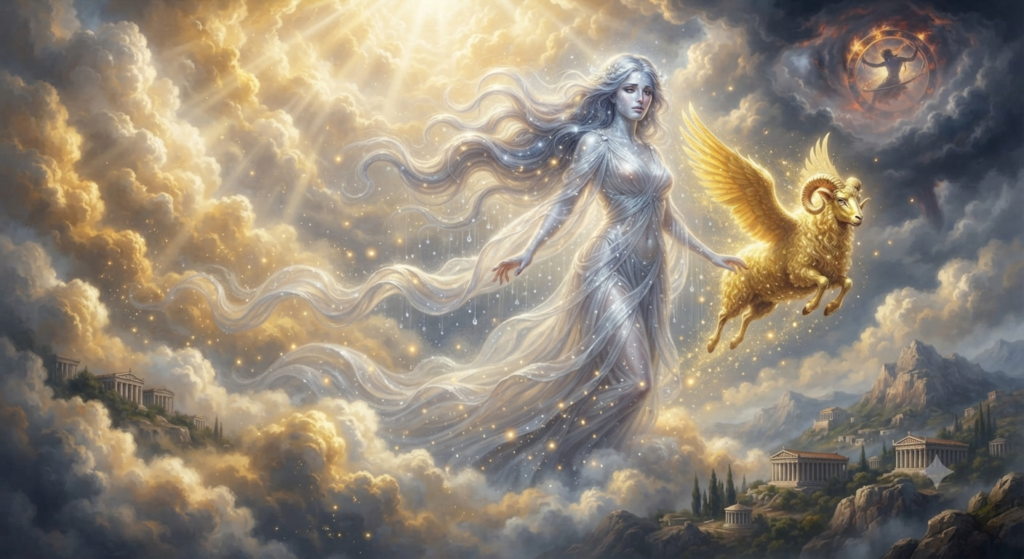
Before the sacrifice could be carried out, Nephele, who had ascended into the sky, descended to rescue her children. She sent a flying golden ram, which had been given to her by Hermes, to carry Phrixus and Helle away to safety in Colchis . During their flight over the sea, Helle looked down, became dizzy, and fell into the strait that was thereafter named the Hellespont (“Sea of Helle”) in her memory . Phrixus survived the journey to Colchis, where he sacrificed the ram to Zeus and gave its Golden Fleece to King Aeëtes, who hung it in a sacred grove . The Golden Fleece would later become the object of the quest of Jason and the Argonauts.
Family and Relationships
Nephele’s relationships are central to her two myths, linking her to some of the most significant figures in Greek mythology.
Consorts and Offspring
- Ixion: In the myth of the centaurs, Nephele’s consort is the impious King Ixion. Their union produced a child, usually named Centaurus, who in turn mated with mares to father the race of the Centaurs .
- Athamas: In the Phrixus and Helle tradition, Nephele is the wife of Athamas, a king of Boeotia, and the mother of Phrixus and Helle .
Parentage
Unlike most Greek gods, Nephele does not have a traditional parentage. She was formed from a cloud by Zeus, making her a divine creation rather than a born goddess. This is her origin in both of her main myths. Some sources may conflate her with the Nephelai, the Okeanid cloud nymphs, and assign her parentage to Oceanus and Tethys, but the primary tradition emphasizes her crafted nature .
Symbols and Meaning
The symbols associated with Nephele reflect her nature as a cloud nymph and her role in mythology.
- The Cloud: The most fundamental symbol of Nephele is the cloud itself. It represents her essence, her ethereal and formless nature, and her ability to shift and change. It also symbolizes the deception of Zeus and the divine trap set for Ixion.
- The Flying Ram: The golden ram sent by Nephele to rescue her children is a powerful symbol of maternal love, deliverance, and divine intervention. It is also the origin of the legendary Golden Fleece, a symbol of kingship, power, and the quest for greatness.
- The Hellespont: The strait named after her daughter, Helle, is a lasting geographical reminder of Nephele’s story and its tragic outcome.
Powers and Characteristics
Nephele’s “powers” are intrinsic to her nature as a cloud nymph. Her primary power is her ability to shift and transform, as she was created from a cloud and could descend from the sky to aid her children. As a divine being, she possesses the power to create and bestow magical gifts, such as the flying golden ram. Her characteristics are defined by her dual role: she is both an instrument of divine punishment (as the false Hera) and a protective and loving mother (to Phrixus and Helle).
Worship and Religious Importance
Nephele did not have a formal cult or temples dedicated to her worship. Her religious importance is primarily mythological and narrative. Her stories served as etiologies, explaining the origins of the centaurs, the Golden Fleece, and the name of the Hellespont. The myth of her creation also served as a cautionary tale about the consequences of hubris and the power of the gods to enact justice through divine deception.
Ancient Sources
Nephele appears in several key ancient sources, including:
- Pindar’s Pythian Ode 2 (c. 5th century BCE): The earliest source for the story of Ixion and the cloud .
- Pseudo-Apollodorus’ Bibliotheca (c. 1st-2nd century CE): A comprehensive summary that includes both of her myths .
- Hyginus’ Fabulae (c. 1st century CE): A Roman compilation that preserves the stories of her creation and her rescue of Phrixus and Helle .
- Ovid’s Metamorphoses (1st century CE): The Roman poet retells the story of Phrixus and Helle, mentioning Nephele’s role .
- Diodorus Siculus’ Library of History (c. 1st century BCE): A Greek historian who provides a rationalized account of the centaur myth .
Artistic Representations
Nephele is a subject in ancient Greek and Roman art, often depicted in scenes related to the myth of Ixion and the birth of the centaurs. A famous Roman fresco in the House of the Vettii in Pompeii depicts Nephele as a seated cloud nymph at the feet of Mercury, representing the deception of Ixion . She is also sometimes depicted in scenes of the flight of Phrixus and Helle, where she appears descending from the sky on a cloud or sending the golden ram.
Cultural Influence and Historical Legacy
The influence of Nephele extends far beyond the ancient world. Her name has been used in modern science and technology. The National Institutes of Health (NIH) in the United States has developed a web-based platform for microbiome data analysis named “Nephele,” which is described as a “powerful scientific tool created from a cloud-based environment,” directly referencing her mythological origin . Her story also continues to inspire writers and artists, who draw upon her dual role as both a divine trap and a maternal savior.
Frequently Asked Questions About Who is Nephele in Greek mythology?
Who is Nephele in Greek mythology?
Nephele is a cloud nymph in Greek mythology. She was created by Zeus in the image of Hera to deceive King Ixion. She later became the wife of Athamas and the mother of Phrixus and Helle, whom she rescued from sacrifice by sending a golden ram .
What is the meaning of the name Nephele?
The name Nephele is derived from the ancient Greek word nephele, which means “cloud” or “mass of clouds.” It is the root of the Latin word “nebula” .
Why did Zeus create Nephele?
Zeus created Nephele in the image of Hera to test the impious King Ixion, who had boasted of his lust for Hera. When Ixion assaulted the cloud, he was punished by being bound to a fiery wheel for eternity .
Who were the children of Nephele?
Nephele had two sets of offspring. With Ixion, she gave birth to Centaurus (or the Centaurs). With her husband Athamas, she had Phrixus and Helle .
What is the story of Phrixus and Helle?
Phrixus and Helle were the children of Nephele and Athamas. Their stepmother, Ino, plotted to have them sacrificed. To save them, Nephele sent a flying golden ram, which carried the twins away. Helle fell off the ram into the sea (the Hellespont), but Phrixus survived and reached Colchis .
Conclusion
Nephele, the cloud nymph of Greek mythology, is a figure of profound duality and enduring significance. She is both a divine trap, crafted by Zeus to punish the hubris of Ixion, and a maternal savior, sent to rescue her beloved children from a cruel fate. The answer to the question of who is Nephele in Greek mythology? reveals a figure whose essence is as shifting and ethereal as the clouds she personifies. Her story, woven into the origins of the centaurs and the quest for the Golden Fleece, is a testament to the power of myth to explain the world and the complex nature of divine justice and motherly love. Her legacy continues to resonate in modern science and literature, ensuring that her name and her story remain a part of the human imagination.

Orin Vale has spent the better part of two decades tracing the threads that connect the world’s oldest stories — from the halls of Asgard to the banks of the Nile, from Olympus to the jungles of the Maya. What began as a childhood fascination with flood myths and trickster gods grew into years of independent study across comparative mythology and ancient religion, always chasing the same question: what did these stories mean to the people who first told them? Orin writes for readers who want more than trivia — the ones looking for the beliefs, fears, and truths that myths were built to carry.