In the shadowy and terrifying depths of the Greek underworld, beyond the realm of familiar gods and heroic shades, dwelled a host of minor but fearsome spirits whose purpose was to remind the living of the grim fate awaiting their mortal remains. Among these chthonic beings, one figure stands out for his macabre specialization and his unique, enigmatic presence in ancient art and literature. The question of who is Eurynomos in Greek mythology? leads us to a singular and gruesome entity: a flesh-devouring daimon of the underworld, a spirit whose sole purpose was to strip the rotting flesh from the corpses of the dead, leaving only their bare bones . Known only from a single, vivid description by the 2nd-century CE traveler Pausanias, Eurynomos (Greek: Εὐρύνομος) is a figure of profound mystery and haunting imagery, a demon whose very existence challenges our understanding of Greek mythological tradition . This article will serve as a definitive guide to Eurynomos, exploring his unique origins, his terrifying appearance, his role in the underworld, and his enduring legacy in popular culture.
Origins and Historical Background of Eurynomos
The origins of Eurynomos are shrouded in a degree of mystery unusual even for a minor figure in Greek mythology. Unlike many gods and spirits whose genealogies are meticulously recorded by Hesiod or Homer, Eurynomos appears in no early epic tradition . The sole piece of evidence for his existence comes from a single passage in the Description of Greece by Pausanias, a travel writer of the 2nd century CE .
In his account, Pausanias describes a monumental painting of the Underworld by the renowned 5th-century BCE painter Polygnotus, which decorated the Lesche (a type of clubhouse) at Delphi . It is in this painting that Eurynomos is depicted. This has led to scholarly debate: was Eurynomos a genuine, albeit obscure, figure of Greek folklore whose associated literature is lost to time, or was he possibly an invention by the painter Polygnotus himself, a creative addition to a well-known mythological scene ?
Pausanias himself notes the ambiguity, stating that while the Delphian guides identified the figure as Eurynomos, the works of Homer, the epic Minyad, and the Nostoi (the “Returns”) make no mention of any such daimon . This lack of earlier attestation suggests that Eurynomos was, at the very least, a highly localized and minor figure, perhaps a personification of a specific fear associated with corpse decay, whose memory was preserved only in the oral traditions of Delphi . His name, meaning “Wide-Ruling” (from eurys “wide” and nomos “law” or “ruling”), is a grim inversion of royal power, applied to the dominion of decay.
The Mythological Role of Eurynomos
The primary, and indeed sole, mythological role of Eurynomos was to personify the gruesome process of decomposition. He was a daimon, a spirit or lesser deity, of the underworld specifically tasked with consuming the flesh of the dead . This function associates him with the carrion-eaters of the natural world, such as vultures and meat-flies, whose “work” he was the supernatural embodiment of .
Eurynomos was a part of the vast and terrifying machinery of the Greek underworld, a place not just for the judgment of souls, but also for the physical disposal of the mortal body. He was one of the many chthonic spirits who served Hades, enforcing the finality of death by ensuring that nothing remained of the corpse but the bones. This role was deeply unsettling to the ancient Greeks, who placed great importance on proper burial rites and the preservation of the body. Eurynomos represented the ultimate insult to the dead: the complete and utter consumption of their physical form by a hungry, cadaverous spirit.
Physical Appearance and Iconography
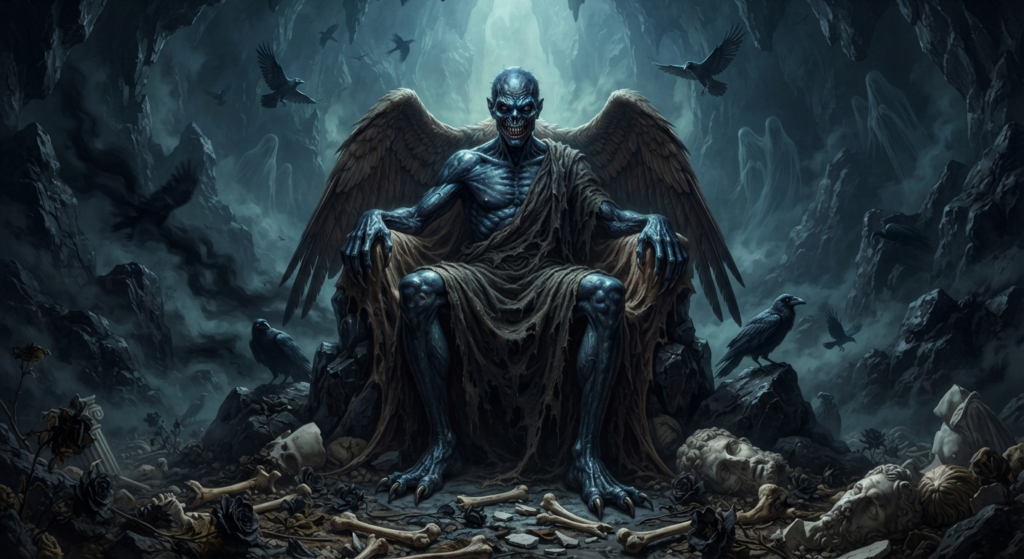
The physical appearance of Eurynomos is one of the most vivid and memorable in all of Greek mythological art, thanks to the detailed description provided by Pausanias. He was depicted by Polygnotus in a specific, chilling way:
- Color: His skin was of a color “between blue and black, like that of meat flies” . This specific comparison to the iridescent, dark sheen of carrion flies directly links him to his role as a consumer of decaying flesh. It is a uniquely unpleasant and vivid description that sets him apart from the more abstract or heroic figures of Greek art.
- Posture: He was shown seated . This is a striking detail, as it suggests a patient, perhaps even gluttonous, readiness, rather than the active pursuit of a hunter. He sits waiting for his prey to arrive.
- Expression: He was “showing his teeth” . This is a detail that conveys a sense of menace and appetite. The bared teeth of a grinning predator is a universally recognized sign of aggression and hunger.
- Attribute: He was seated on the spread skin of a vulture . The vulture, a carrion bird, was an appropriate throne for a daimon of rotting corpses. It reinforces his connection to the process of decay and the consumption of dead flesh.
This image—a blue-black, grinning, toothy figure sitting on a vulture’s skin—is a masterwork of macabre imagery, a single artistic creation that has haunted the imagination for centuries .
Family and Relationships
Unlike most Greek deities, Eurynomos has no established genealogy in the surviving mythological texts. His parents are not explicitly stated by any ancient author. However, due to his chthonic nature and his role as a daimon of the underworld, it is generally presumed by mythographers that he would be a child of the primordial deities of darkness: Erebus (the personification of deep darkness and shadow) and Nyx (the goddess of Night) . This lineage would make him a brother to other powerful and often terrifying spirits of the underworld, such as Thanatos (Death), Hypnos (Sleep), and the Keres (the spirits of violent death). This presumed genealogy places him among the very oldest and most fundamental forces of the cosmos.
Powers and Characteristics
The power of Eurynomos is singular and grotesque. His primary ability is the consumption of the flesh from the rotting corpses of the dead in the underworld, leaving only the bones . He is a personification of decomposition, a being who represents the final, physical disintegration of the human body after death. His “power” is not one of magic or combat, but of a slow, inevitable, and disgusting process of consumption. He is the physical manifestation of one of the most primal human fears: the complete dissolution of the self.
His characteristics are defined by his connection to the dead and the process of decay. He is a chthonic being of the underworld, associated with carrion-eaters, and his entire existence is defined by his macabre diet. He is a silent, seated figure, patient and hungry, waiting for the endless supply of corpses that the underworld provides.
Worship and Religious Importance
Eurynomos had no formal cult, temples, or priests dedicated to his worship. He was not a god to be petitioned or placated; he was a terrifying force of nature, a personification of a process that every dead body must endure. His religious importance was not in the form of ritual, but in the form of art and mythology.
His sole appearance, in a monumental painting at Delphi, suggests that his image was meant to serve as a moral and existential lesson. Viewers of Polygnotus’s painting were confronted with the grim reality of death in all its physical horror. Eurynomos was a reminder that death was not just a spiritual transition, but a physical process of corruption. He was a symbol of the limits of human vanity and the inevitable decay of the flesh.
Ancient Sources
Eurynomos is a figure whose entire existence in the ancient record rests on a single, pivotal source.
- Pausanias’ Description of Greece (2nd century CE): This is the only ancient text that mentions Eurynomos. In Book 10, he describes a painting by Polygnotus in the Lesche of the Cnidians at Delphi, which included the figure of Eurynomos. Pausanias notes that the guides at Delphi identified the figure as a daimon of Hades who devours the flesh of corpses, leaving only the bones, but also notes that earlier epic poetry knows of no such figure .
While other figures share the name, they are unrelated:
- Other Figures Named Eurynomos: The Greek name “Eurynomos” was borne by several other figures in mythology, causing potential confusion. There was a centaur who fought in the battle of the Lapiths and Centaurs , a son of Magnes who was the father of a man devoured by the Sphinx , a defender of Troy killed by Ajax , and a suitor of Penelope from Ithaca who was killed by Odysseus . However, none of these are the underworld spirit. The name’s multiple occurrences highlight its use as a generic name meaning “Wide-Ruling” .
Artistic Representations
The only known ancient artistic representation of Eurynomos is the one described by Pausanias in Polygnotus’s painting at Delphi. This painting, which is now lost, was the sole source of our knowledge of his appearance and his name. There are no known surviving vase paintings, sculptures, or mosaics that depict him.
However, due to the vividness of Pausanias’s description, the image of the blue-black, grinning daimon has had a significant afterlife. His macabre appearance has been a source of inspiration for later artists and writers, who have adapted his image for their own purposes.
Cultural Influence and Historical Legacy
The legacy of Eurynomos is a testament to the power of a single, vivid image to capture the imagination. Despite being a figure of obscure origin and limited attestation, he has secured a place in the modern cultural consciousness, primarily through his adaptation in popular culture.
- Literature and Media: Eurynomos has appeared in various forms of modern fiction. He has been adapted into the Percy Jackson universe by Rick Riordan, where he appears as a species of ghouls called “eurynomoi” who devour corpses and raise skeleton warriors . He has also been referenced in Umberto Eco’s novel Foucault’s Pendulum .
- Gaming and Music: The name and concept of Eurynomos have been used in role-playing games and music. The Swiss extreme metal band Hellhammer recorded a track titled “Eurynomos” .
- The Satanic Bible: Interestingly, the name of the underwood spirit is also referenced in The Satanic Bible, where it is misspelled as “Euronymous” . This connection to modern occultism further demonstrates how the ancient myth has been recontextualized to fit new spiritual and cultural frameworks.
Frequently Asked Questions About Who is Eurynomos in Greek mythology?
What is the origin of Eurynomos in Greek mythology?
Eurynomos is known only from a single mention by the 2nd-century CE writer Pausanias, who described a 5th-century BCE painting by Polygnotus at Delphi . His origins are debated; he may be a genuine, albeit obscure, underworld spirit, or he may have been an invention by the painter .
Who were the parents of Eurynomos?
His parents are not stated in any ancient text, but because of his chthonic nature, it is presumed that he was a son of the primordial deities Erebus (Darkness) and Nyx (Night) .
What does Eurynomos look like?
According to Pausanias, Eurynomos was depicted with a dark skin color “between blue and black, like that of meat flies,” showing his teeth, seated on the skin of a vulture . This is the only surviving description of his appearance.
What is the role of Eurynomos in the underworld?
Eurynomos is a daimon of the underworld whose specific function is to consume the flesh of the dead, leaving only their bones . He represents the process of decomposition and the final physical dissolution of the corpse.
Is Eurynomos mentioned in any other ancient sources?
No. The only surviving mention of Eurynomos in ancient literature is in Pausanias’s Description of Greece. Pausanias himself notes that the figure is not mentioned in Homer, the Minyad, or the Nostoi .
What does the name Eurynomos mean?
His name is derived from the Greek words eurys meaning “wide” and nomos meaning “law” or “ruling,” thus translating to “Wide-Ruling” . It is an ironic title for a daimon of decay.
How is Eurynomos used in modern popular culture?
Eurynomos has appeared in various forms of modern media. In Rick Riordan’s The Trials of Apollo, they are a species of ghouls that devour corpses . He has also been referenced in Umberto Eco’s Foucault’s Pendulum and in the music of Hellhammer .
Conclusion
Eurynomos, the flesh-devouring daimon of the Greek underworld, occupies a unique and haunting place in mythology. Unlike the grand figures of the Olympian pantheon, he is a being of singular purpose and terrifying imagery, known to us only from a single, vivid description. The question of who is Eurynomos in Greek mythology? leads to a figure of profound mystery, a spirit who personifies the grim process of decay and the final, physical dissolution of the human body. As Pausanias himself noted, he was a figure unknown to the great epic poets, yet he was given a prominent place in one of the most famous paintings of the ancient world. His legacy is a testament to the power of art to create and preserve a myth, and to the enduring human fear of the decomposition that awaits us all.

Orin Vale has spent the better part of two decades tracing the threads that connect the world’s oldest stories — from the halls of Asgard to the banks of the Nile, from Olympus to the jungles of the Maya. What began as a childhood fascination with flood myths and trickster gods grew into years of independent study across comparative mythology and ancient religion, always chasing the same question: what did these stories mean to the people who first told them? Orin writes for readers who want more than trivia — the ones looking for the beliefs, fears, and truths that myths were built to carry.