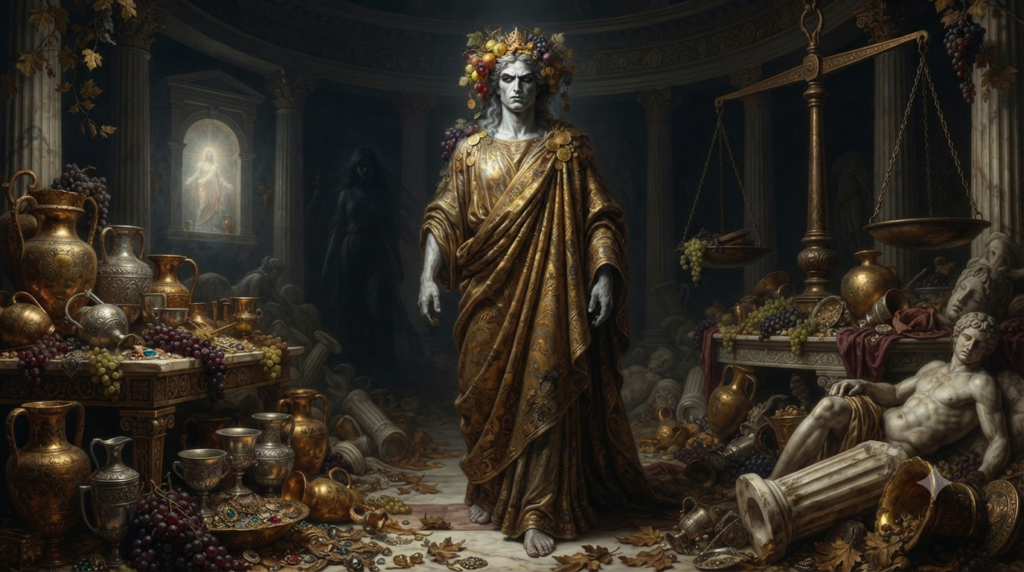
In the intricate tapestry of Greek mythology, alongside the well-known Olympian gods and heroic figures, exists a host of personified spirits known as daimones, who embody abstract concepts fundamental to human experience. Among these, one figure stands as a stark warning against the dangers of unchecked desire. The question of who is Koros, the Greek personification of excess? leads us to a lesser-known but deeply significant deity, a spirit whose very name encapsulates the peril of satiety and the arrogance it breeds. Koros (Κόρος) was the divine personification of surfeit, disdain, insolence, and excess . He was not a god of abundance or prosperity, but rather the embodiment of the destructive consequences of having too much—the arrogance that arises from plenty and the disdain for restraint that leads to ruin . This article will serve as a definitive guide to Koros, exploring his origins, his role in Greek thought, his family, and his enduring legacy as a symbol of the dangers of excess.
Origins and Historical Background of Koros
The origins of Koros are firmly rooted in the ancient Greek moral and philosophical tradition. Unlike the primordial deities who emerged at the dawn of creation, Koros is a later personification, a daimon that embodies a specific ethical concept: the danger of excess and the arrogance it produces . His name derives directly from the ancient Greek word “koros” (κόρος), which means “satiety,” “surfeit,” or “disdain” .
The earliest and most important source for Koros is the Greek lyric poet Pindar, writing in the 5th century BCE. In his Nemean Ode 13, Pindar refers to Hybris (Insolence) as the “fierce-hearted mother of full-fed Koros” . This poetic fragment establishes the core genealogy of Koros and places him within a moral framework that would resonate throughout Greek literature. Pindar’s description of Koros as “full-fed” emphasizes his connection to satiety and the arrogance that comes from abundance.
The historian Herodotus, writing in the 5th century BCE, also references Koros in a fragment of a Delphic oracle: “Divine Dike (Justice) will extinguish mighty Koros (Greed) the son of Hybris (Insolence) lusting terribly, thinking to devour all” . This prophecy establishes Koros as a force that must be overcome by justice, a cosmic principle that restores balance and punishes excess. The oracle’s warning that Koros “thinks to devour all” portrays him as an insatiable, consuming force, a spirit whose hunger is never satisfied.
The Mythological Role of Koros
Koros’s primary mythological role is to personify the negative consequences of excess and the arrogance it breeds. He is not a god who causes abundance, but rather the spirit that emerges when abundance is taken to its extreme—the disdain for moderation, the contempt for others, and the reckless pride that leads to downfall. In this role, Koros serves as a moral warning, a cautionary figure who reminds mortals of the dangers of hubris.
Koros is closely associated with his mother, Hybris, who personifies reckless pride and insolence . While Hybris represents the active, arrogant behavior that violates the boundaries of proper conduct, Koros represents the passive state of satiety and disdain that results from excessive indulgence. Together, they form a destructive pair that threatens the moral and social order. The Delphic prophecy quoted by Herodotus makes this relationship explicit: Koros, the son of Hybris, is destined to be extinguished by Dike, the goddess of justice . This suggests that while excess and arrogance may flourish for a time, they will ultimately be punished by the cosmic forces of justice and order.
In some traditions, Koros is also associated with the god Dionysus, serving as one of his secondary divine companions . This connection is significant, as Dionysus is the god of wine, festivity, and ecstasy—experiences that, when taken to excess, can lead to the very arrogance and disdain that Koros personifies. The presence of Koros in the retinue of Dionysus suggests a recognition that the pleasures of the god, if indulged without restraint, can lead to moral and social decay.
Family and Relationships
Koros’s family is defined by its association with the darker aspects of human behavior and the consequences of moral transgression.
Parents
The primary and most widely attested genealogy of Koros makes him the son of Hybris, the personification of insolence, reckless pride, and outrageous behavior . Pindar’s fragment explicitly states: “Far from their path they [Dike and Eirene] hold proud Hybris (Insolence) fierce-hearted mother of full-fed Koros (Corus, Disdain)” . This parentage places Koros at the heart of a mythological family that embodies the dangers of moral transgression.
In some traditions, however, the genealogy is reversed, and Koros is said to be the son of Dyssebeia (Impiety), with Hybris as his sister . This alternative genealogy suggests a different emphasis: while the primary tradition links Koros directly to arrogance, this variant connects him more directly to impiety, the rejection of the gods and their laws. Both genealogies, however, place Koros within a family of negative moral forces.
Siblings
The primary tradition identifies Koros as the son of Hybris, with no siblings explicitly mentioned. However, the alternative genealogy that makes Dyssebeia his mother and Hybris his sister creates a direct family link between Koros and the very spirit of insolence . This close relationship between Koros and Hybris, whether as mother and son or as siblings, emphasizes their interconnected nature: excess breeds arrogance, and arrogance breeds disdain.
Symbols and Meaning
Koros’s symbols are conceptual and literary rather than physical. As a personification, he does not have a specific iconography like the Olympian gods. Instead, his symbols are found in the literary and philosophical tradition that surrounds him.
- Satiety and Surfeit: The most fundamental symbol of Koros is the concept of satiety itself—the state of having too much. This is not a positive abundance, but a dangerous excess that breeds contempt and disdain .
- Disdain and Insolence: Koros represents the arrogance that comes from excess, the contempt for others and for the moral order that results from having too much .
- The Consuming Force: The Delphic oracle quoted by Herodotus describes Koros as “lusting terribly, thinking to devour all” . This image of an insatiable, consuming force symbolizes the destructive nature of unchecked desire and the way it can overwhelm everything in its path.
- The Son of Hybris: The relationship between Koros and Hybris is itself a powerful symbol. It represents the cycle of excess: arrogance leads to excess, and excess breeds further arrogance and disdain, until the cycle is broken by divine justice .
Powers and Characteristics
Koros’s “powers” are not magical abilities but rather the moral and psychological forces he personifies. His primary characteristic is the state of satiety and the disdain that accompanies it. He is “full-fed,” a spirit who has consumed so much that he has become arrogant and contemptuous .
Koros is a daimon, a lesser spirit who embodies a specific concept or force . He is not a god with a personal narrative or heroic adventures, but rather a personification of a negative moral state. His power lies in his ability to influence human behavior, to encourage excess and disdain, and to contribute to the downfall of individuals and societies.
The Delphic oracle’s description of Koros as one who “lusts terribly, thinking to devour all” suggests that he is not satisfied with mere abundance but seeks complete domination . He is a consuming force that, if unchecked, will destroy everything in its path. This power is ultimately limited, however, as the oracle also states that Dike (Justice) will extinguish him . This suggests that while Koros’s influence is powerful, it is not absolute and will ultimately be defeated by the forces of cosmic order.
Worship and Religious Importance
Koros did not have a formal cult, temples, or priests dedicated to his worship. Unlike the Olympian gods, he was not invoked in prayers or honored with sacrifices. His religious importance was philosophical and literary, rather than ritualistic.
Koros represented a deeply held belief in Greek thought: that excess leads to arrogance and downfall. The concept of sophrosyne (moderation, self-control) was central to Greek ethics, and Koros served as the negative example, the figure who embodied the consequences of its opposite. He was a cautionary figure, a reminder that having too much is not a blessing but a danger.
The association of Koros with Dionysus suggests that his influence was felt in the context of festivals and celebrations, where the pleasures of wine and ecstasy could lead to excess . The presence of Koros in the retinue of Dionysus was a recognition that even divine pleasures must be enjoyed in moderation, and that the abandonment of restraint could lead to moral and social ruin.
Ancient Sources
Koros appears in several key ancient sources, each providing a piece of the puzzle that defines his character.
- Pindar’s Nemean Ode 13 (c. 5th century BCE): The earliest and most important source, establishing Koros as the son of Hybris . Pindar describes Hybris as the “fierce-hearted mother of full-fed Koros” .
- Herodotus’s Histories (c. 5th century BCE): The historian quotes a Delphic oracle that refers to “mighty Koros the son of Hybris” and declares that Dike will extinguish him .
- Theoi Project (Modern Compilation): A modern website that compiles ancient sources and provides a summary of Koros’s mythology .
- Wikipedia: Modern encyclopedia entries that summarize the ancient sources on Koros .
Artistic Representations
Koros is not a figure who appears in the grand narrative art of vase painting or sculpture. As a personification, he lacks the specific iconography and narrative scenes that characterize the Olympian gods. His influence is found in literary and philosophical texts rather than visual art. The absence of physical representations underscores his nature as an abstract moral concept, a force that exists in the mind and in society rather than in the physical world.
Cultural Influence and Historical Legacy
The legacy of Koros is primarily philosophical and literary. He represents a concept that is central to Greek ethical thought: the danger of excess. The idea that abundance leads to arrogance, and that arrogance leads to ruin, is a recurring theme in Greek literature, from the works of Hesiod to the tragedies of Aeschylus and Sophocles.
The relationship between Koros and Hybris is a powerful expression of the Greek belief in the cycle of excess and punishment. The Delphic oracle’s declaration that Dike will extinguish Koros reinforces the idea that justice is the ultimate arbiter of human behavior, and that those who give in to excess will eventually face divine retribution . This concept has influenced Western thought for millennia, informing the moral and ethical traditions that emphasize the importance of moderation, self-control, and the avoidance of hubris.
Frequently Asked Questions About Who is Koros, the Greek personification of excess?
What is the meaning of the name Koros?
The name Koros comes from the ancient Greek word koros (κόρος), which means “satiety,” “surfeit,” “disdain,” or “insolence” . His name is a direct reflection of his divine function: he is the personification of the arrogance and contempt that arise from having too much.
Who were the parents of Koros?
The primary tradition makes Koros the son of Hybris, the goddess of insolence and reckless pride . However, some sources reverse this genealogy, making Dyssebeia (Impiety) his mother and Hybris his sister .
What is the difference between Koros and Hybris?
Hybris personifies the active, arrogant behavior that violates the moral order—the reckless pride that leads to transgression . Koros personifies the passive state of satiety and disdain that results from excessive indulgence, and the arrogance that arises from having too much . They are closely related, with Koros being the offspring of Hybris in the primary tradition .
What is Koros’s role in Greek mythology?
Koros is the personification of excess, disdain, and the arrogance that comes from satiety. He serves as a moral warning against the dangers of having too much and the contempt that it breeds. In the Delphic oracle, he is described as a consuming force that will ultimately be extinguished by Dike, the goddess of justice .
Is Koros associated with any other gods?
In some traditions, Koros is associated with Dionysus, serving as one of his secondary divine companions . This connection reflects the recognition that the pleasures of Dionysus—wine, festivity, ecstasy—can, if taken to excess, lead to the arrogance and disdain that Koros personifies.
What is the significance of Koros in Greek philosophy?
Koros represents a central concept in Greek ethics: the danger of excess. He embodies the idea that having too much leads to arrogance, and that arrogance leads to downfall. This concept is closely related to the virtue of sophrosyne (moderation, self-control), which was considered essential for a good life .
Conclusion
Koros, the Greek personification of excess, is a powerful figure of moral warning and philosophical insight. The answer to the question of who is Koros, the Greek personification of excess? reveals a spirit whose influence is felt not in grand myths or epic adventures, but in the daily struggle between moderation and indulgence. As the son of Hybris, he represents the arrogance that arises from satiety, the disdain that comes from having too much . His story, preserved in the fragments of Pindar and the oracle quoted by Herodotus, is a timeless cautionary tale: those who give in to excess will ultimately be consumed by their own arrogance, until justice restores the balance. In a world where the temptations of abundance are ever-present, the warning of Koros remains as relevant today as it was in ancient Greece.

Orin Vale has spent the better part of two decades tracing the threads that connect the world’s oldest stories — from the halls of Asgard to the banks of the Nile, from Olympus to the jungles of the Maya. What began as a childhood fascination with flood myths and trickster gods grew into years of independent study across comparative mythology and ancient religion, always chasing the same question: what did these stories mean to the people who first told them? Orin writes for readers who want more than trivia — the ones looking for the beliefs, fears, and truths that myths were built to carry.