The question of who is Calypso in Greek mythology? leads us to one of the most captivating and complex figures in Homer’s epic, the Odyssey. Calypso was a nymph of extraordinary beauty and power who inhabited the mythical island of Ogygia, where she detained the Greek hero Odysseus for seven long years, offering him immortality in exchange for eternal companionship . Her name, derived from the ancient Greek word kalyptō meaning “to conceal” or “to hide,” is a direct reflection of her reclusive nature and her island’s hidden location . As the daughter of the Titan Atlas, she was a figure of immense divine lineage, yet her story is one of loneliness, longing, and the painful conflict between immortal desire and mortal destiny . This article will serve as a definitive guide to Calypso, exploring her origins, her central role in the Odyssey, her complex relationship with Odysseus, and her enduring legacy in art and literature.
Origins, Family, and the Island of Ogygia
Calypso is most frequently described as the daughter of the Titan Atlas, who was condemned to hold up the heavens for eternity as punishment for his role in the Titanomachy, the war between the Titans and the Olympian gods . This parentage places her among the most ancient and powerful of divine beings, a nymph of the Titan race. However, some later sources offer alternative genealogies, naming her as one of the Oceanids (daughters of Oceanus and Tethys) or one of the Nereids (daughters of Nereus and Doris) . The variation in her parentage reflects the fluid nature of Greek myth, where a figure could be adapted to different local traditions.
Her island home, Ogygia, was a place of breathtaking, untamed beauty, described in the Odyssey as a hidden paradise covered in dense forests, fragrant meadows, and vines heavy with grapes . Calypso’s grotto-palace, entwined with vegetation and filled with the song of birds, was a place of sensual delight and isolation . According to some accounts, Calypso was exiled to Ogygia by the Olympian gods as punishment for siding with her father, Atlas, in the Titanomachy . This exile transformed her from a powerful Titan’s daughter into a lonely figure, isolated from the divine society of Olympus and starved of companionship .
The Central Myth: Calypso and Odysseus in the Odyssey
The most significant myth involving Calypso is her extended interaction with the Greek hero Odysseus, as recounted in Homer’s Odyssey.
The Arrival and the Promise of Immortality
After Odysseus’s ship was destroyed and his companions perished, he was washed ashore on the island of Ogygia, the sole survivor of his crew . Calypso found him, nursed him back to health, and quickly fell in love with him . She offered him refuge, pleasure, and the ultimate prize: immortality and eternal youth if he would stay with her as her husband . For seven years, she kept him on the island, promising him a life free from the trials and mortality that awaited him in the mortal world.
A Prisoner of the Heart
Despite the allure of eternal life and Calypso’s enchanting presence, Odysseus could not forget his homeland of Ithaca, his wife Penelope, and his son Telemachus. Homer’s text reveals the profound conflict of his captivity: by day, he would sit on the shore, weeping and longing for home; by night, he was compelled to sleep with Calypso in her cave, his heart not in it . He was a prisoner, trapped not by chains, but by the goddess’s will and her overwhelming desire .
The Divine Intervention and Release
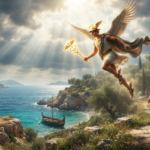
The hero’s captivity finally ended when his patron goddess Athena pleaded with her father, Zeus, to intervene . Zeus decreed that Odysseus must be released, for it was not his fate to remain with Calypso forever . He dispatched the messenger god Hermes to Ogygia to deliver the command .
Upon receiving the order, Calypso was furious. She railed against the hypocrisy of the gods, accusing them of being jealous and hard-hearted, allowing male gods to take mortal lovers while punishing goddesses who did the same . Despite her anger, she knew she could not defy the will of Zeus . She reluctantly agreed to release Odysseus, even offering him one final chance to stay as her immortal husband, which he declined .
The Departure and the Tragedy of Calypso
Accepting her loss, Calypso helped Odysseus prepare for his journey. She provided him with an axe to cut timber, guided him to the best trees, and supplied him with provisions, wine, and the materials to build a sturdy raft . She then summoned a fair wind to carry him on his way . The scene of his departure is one of quiet tragedy: a powerful goddess, condemned to loneliness, forced to let go of the only man she had loved for years.
Children and Later Myths
Homer’s Odyssey does not mention any children born from the union of Odysseus and Calypso. However, later Greek writers and mythographers filled this gap. According to Hesiod’s Theogony, Calypso bore Odysseus two sons, Nausithous and Nausinous . Other sources, such as the mythographer Apollodorus, name a son Latinus, who in other traditions is a son of Circe . A fragment from the Catalogue of Women also mentions that Calypso bore the Cephalonians to Hermes, suggesting a different, older, and possibly more ambiguous relationship with the messenger god .
Legacy and Interpretations
Calypso’s story has resonated through the ages, inspiring countless artistic and literary works. She appears in Botticelli’s Primavera, is the subject of paintings by Angelica Kauffman, and has been adapted into operas and novels. The character of Calypso in the Pirates of the Caribbean film series is derived from this mythological figure .
She is often interpreted as a symbol of the temptation to abandon one’s duty and home for a life of ease and pleasure . Her character has also been examined as a complex figure of female agency, a woman who, despite being powerful and divine, is ultimately trapped by the patriarchal structure of both the divine and mortal worlds . Her famous speech to Hermes remains a powerful expression of female frustration at the double standards of the gods .
Frequently Asked Questions About Who is Calypso in Greek mythology?
What is the meaning of the name Calypso?
The name Calypso is derived from the ancient Greek word kalyptō, meaning “to cover,” “to conceal,” or “to hide.” Her name translates to “she who conceals” and perfectly reflects her role as the hidden nymph of a secret island .
Who were the parents of Calypso?
Calypso is most famously the daughter of the Titan Atlas . However, some later sources also name her as an Oceanid (daughter of Oceanus and Tethys) or a Nereid (daughter of Nereus and Doris) .
Where was Calypso’s island?
Calypso lived on the mythical island of Ogygia, a place of incredible beauty located in the middle of the sea. Its exact location was never specified in classical sources, adding to its air of mystery and isolation .
How long did Calypso keep Odysseus?
According to Homer’s Odyssey, Calypso kept Odysseus on the island of Ogygia for seven years, detaining him against his will as she tried to convince him to become her immortal husband .
Did Odysseus have children with Calypso?
While Homer’s Odyssey does not mention any children, later Greek authors and mythographers filled this gap. According to Hesiod, she bore Odysseus two sons, Nausithous and Nausinous. Other sources name their son as Latinus .
What was Calypso’s relationship with the other gods?
Calypso was exiled to Ogygia by the Olympian gods, likely for siding with her father Atlas in the Titanomachy . Her relationship with them was one of resentment, and she famously criticized them for their hypocrisy in the treatment of divine love affairs with mortals .
Why is Calypso’s story important?
Calypso’s story is a powerful exploration of themes such as temptation, duty, and the conflict between mortal desire and immortal will. She represents the temptation to abandon one’s responsibilities for a life of ease and pleasure and serves as a complex symbol of female agency and loneliness in a patriarchal world .
Conclusion
Calypso, the nymph of Ogygia, remains one of the most captivating figures in Greek mythology. The answer to the question of who is Calypso in Greek mythology? is not simply a nymph or a minor goddess, but a powerful symbol of longing, temptation, and the ultimate power of human destiny. She was a daughter of the great Titan Atlas, a being of immense power, yet she was condemned to a life of profound loneliness on a hidden island . Her story is defined by her passionate and ultimately tragic love for Odysseus, a love so strong that it led her to offer him immortality and to defy the will of the gods . Her struggle against the divine decree and her famous speech to Hermes have echoed through the centuries, making her a powerful symbol of female resilience and a critic of divine hypocrisy . From Homer’s epic to modern interpretations, Calypso endures as a figure of profound complexity, a goddess trapped by love, exile, and the inescapable currents of fate.

Orin Vale has spent the better part of two decades tracing the threads that connect the world’s oldest stories — from the halls of Asgard to the banks of the Nile, from Olympus to the jungles of the Maya. What began as a childhood fascination with flood myths and trickster gods grew into years of independent study across comparative mythology and ancient religion, always chasing the same question: what did these stories mean to the people who first told them? Orin writes for readers who want more than trivia — the ones looking for the beliefs, fears, and truths that myths were built to carry.