The question of who is Apollo in Greek mythology? opens the door to one of the most complex, multifaceted, and revered figures in the entire ancient pantheon. Apollo was not merely a god of a single domain; he was a deity of manifold function and meaning, embodying the Greek ideals of beauty, reason, balance, and civilization . As the son of Zeus and Leto and the twin brother of Artemis, he was a central figure among the Twelve Olympians, presiding over a vast array of domains including music, poetry, prophecy, healing, archery, the protection of the young, and the light of the sun . Considered the most Greek of all the gods, Apollo represented the pinnacle of youthful male beauty, the kouros, and was the embodiment of the rational and controlled self-image that the Greeks and later Romans aspired to . This article will serve as a definitive guide to Apollo, exploring his origins, his central myths, his diverse functions, his symbols, and his enduring legacy.
Origins and Family
Apollo’s origins are a subject of scholarly debate, with evidence suggesting a complex prehistory. While he is considered the most Hellenic of all gods, his worship may have derived from a type of god that originated in Anatolia and spread through Syria, Palestine, and Egypt . Some scholars discern three components in his prehistory: a Dorian-northwest Greek element, a Cretan-Minoan component, and a Syro-Hittite component .
His birth story, however, is definitively Greek. Apollo was the son of Zeus, the king of the gods, and Leto (Latona in Roman), a Titaness . Hera, Zeus’s jealous wife, forbade Leto from giving birth on any solid land or island. Leto found refuge on the floating island of Delos, which was not considered solid ground, and there she gave birth to her twins. First, Artemis was born, who then assisted in the delivery of Apollo . The birth of Apollo on Delos established the island as one of his most important sanctuaries .
Apollo’s epithet “Phoebus,” meaning “bright” or “pure,” reflects his association with light and purity . As a youth, he embodied the ideal of male beauty, often depicted as a beardless, athletic, and handsome figure with long, flowing hair, symbolizing his eternal youth .
The Establishment of the Oracle at Delphi
Arguably Apollo’s most significant act was the establishment of his oracle at Delphi. In his youth, he traveled to Pytho, a site guarded by a monstrous serpent named Python, which was the child of Gaia, the earth goddess . Apollo slew Python with his bow and arrows, an act that allowed him to take possession of the sanctuary and its prophetic powers .
The location was renamed Delphi, a name derived from delphis, the Greek word for dolphin. According to myth, Apollo took the form of a dolphin, leaped aboard a Cretan ship, and forced the crew to serve him, thus establishing his cult at the site . The Delphic oracle became the most famous and influential oracle in the ancient world, consulted by individuals and city-states alike on matters of personal and political importance . The medium of the oracle was the Pythia, a local woman over 50 who, under Apollo’s inspiration, would deliver prophecies that were then interpreted by priests . The location was also considered the center of the earth, marked by the sacred stone called the Omphalos .
Because Python was a child of Gaia, Apollo had to make amends for killing him. As punishment, he was forced to serve King Admetus of Pherae as a herdsman for nine years .
Apollo’s Many Domains and Functions
Apollo was a god of remarkable scope, with a bewildering array of responsibilities that often seemed contradictory.
The God of Prophecy
The Delphic Oracle made Apollo the supreme prophetic deity. He was the god who communicated the will of his father, Zeus, to mortals . His ability to see the future was both a gift and a source of power, and he was consulted for guidance in all aspects of life, from the founding of cities to personal decisions.
The God of Healing and Disease
Apollo was the god of both healing and disease. He could bring plague and sudden death with his arrows, as seen in the opening of Homer’s Iliad, where he sends a plague upon the Greek army . Yet he was also the god of religious healing and ritual purification, known by epithets such as Alexikakos (Averter of Evil) . This duality was central to his nature. He was the father of Asclepius, the god of medicine, who inherited his healing abilities .
The God of Music and Poetry
As the leader of the Muses, Apollo was the god of music, poetry, and dance . He is frequently depicted holding his lyre, and the invention of stringed music is credited to him . He was the god of mousike, a term that encompassed all the arts and intellectual pursuits. In a famous myth, the satyr Marsyas challenged Apollo to a musical contest. Apollo won and, to punish Marsyas for his hubris (arrogance), had him flayed alive . The story highlights the contrast between Apollo’s rational, controlled music and the wild, untamed nature of Marsyas’s aulos (flute) .
The God of Archery
Apollo was an expert archer, with his silver or golden bow and arrows being one of his primary attributes . He was the god of archery, though not of hunting—that was the domain of his sister Artemis. His arrows were the source of both disease and sudden death, striking from afar with unerring accuracy .
The God of Light
In Hellenistic times, Apollo became increasingly identified with the sun god Helios, taking on the epithet “Phoebus” (the bright one) . While the conflation was not absolute in early periods, Apollo Helios became a common figure, symbolizing the life-giving and illuminating power of the sun .
The God of the Young and the City
Apollo was the protector of the young and presided over their passage into adulthood . He was also a god of the city, concerned with establishing laws, founding new towns, and protecting public spaces . His oracles were often consulted before setting laws, making him a patron of civic order.
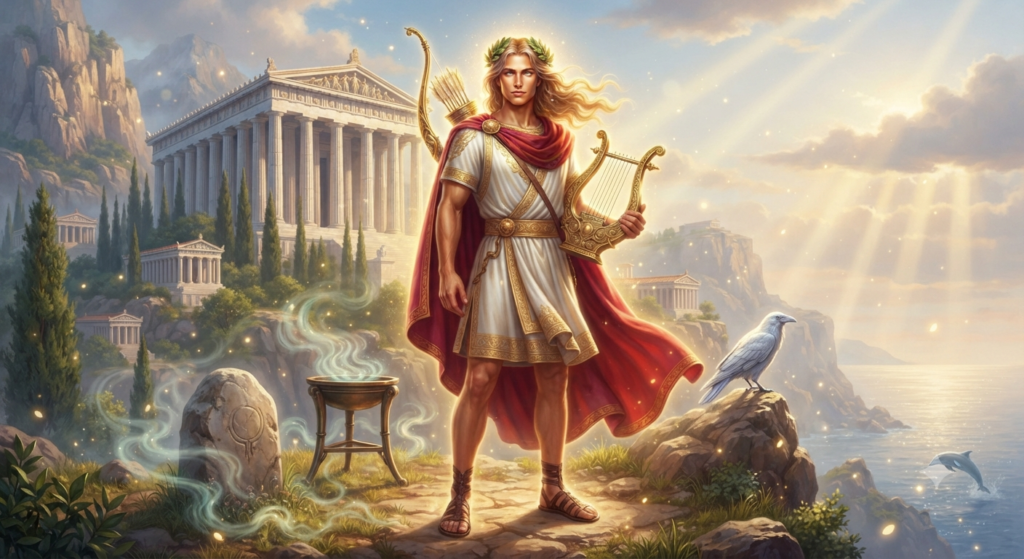
Symbols and Iconography
Apollo’s symbols reflect his wide-ranging functions:
- The Lyre: Represents his dominion over music and poetry.
- The Bow and Arrows: Represent his role as a far-shooting god, capable of bringing disease or death.
- The Laurel Wreath: Sacred to him, and a symbol of victory and honor.
- The Tripod: A symbol of prophecy and the Delphic oracle.
- The Raven and the Dolphin: The raven was his messenger, and the dolphin symbolized his arrival at Delphi .
Famous Myths of Apollo
Apollo’s mythology is rich with tales of love, tragedy, and conflict.
Apollo and Daphne
Eros, the god of love, was angered by Apollo’s mockery of his archery skills. He shot Apollo with a golden arrow, making him fall madly in love with the nymph Daphne. He shot Daphne with a lead arrow, making her repulsed by the god. As Apollo pursued her, Daphne called out to her father, the river god Peneus, who transformed her into a laurel tree . Apollo made the laurel his sacred tree, wearing a wreath of its leaves in her memory.
Apollo and Coronis
Coronis was a mortal princess loved by Apollo, who was pregnant with his son Asclepius. While Apollo was away, Coronis fell in love with another man. Apollo was informed of the infidelity by a white crow he had set to watch over her. Enraged, he turned the crow’s feathers from white to black and commanded his sister Artemis to kill Coronis . As she lay on the funeral pyre, Apollo rescued the unborn Asclepius from her womb and gave him to the centaur Chiron to be raised .
Apollo and Cassandra
Apollo fell in love with Cassandra, the daughter of King Priam of Troy. He granted her the gift of prophecy in exchange for a tryst. When Cassandra rejected him, Apollo punished her by cursing her so that her true prophecies would never be believed . This is famously illustrated in her role in the Trojan War.
Frequently Asked Questions About Who is Apollo in Greek mythology?
Who were the parents of Apollo?
Apollo was the son of Zeus, the king of the gods, and Leto, a Titaness. He was the twin brother of Artemis, the goddess of the hunt .
What is Apollo the god of?
Apollo was the god of many things, including music, poetry, prophecy, healing, archery, the Sun, the protection of the young, and herds and flocks. He was a deity of manifold function, representing the ideal of reason, order, and beauty .
What is the story of the Delphic Oracle?
Apollo established his famous oracle at Delphi after slaying the serpent Python. The oracle was the most important in the ancient world, where the Pythia, a local woman, would deliver prophecies under Apollo’s inspiration, which were then interpreted by priests .
What are Apollo’s symbols?
Apollo’s primary symbols include the lyre (for music and poetry), the bow and arrows (for archery and bringing plague), the laurel wreath (for victory and honor), and the tripod (for prophecy) .
Who was Apollo’s twin sister?
Apollo’s twin sister was Artemis, the goddess of the hunt, wild animals, and childbirth .
What is the difference between Apollo and Helios?
Originally, Helios was the Greek god of the sun, while Apollo was a god of prophecy, music, and healing. However, from the 5th century BCE onwards, Apollo was increasingly identified with Helios, taking on the sun’s attributes and the epithet Phoebus. By the Hellenistic period, Apollo Helios was a common syncretism .
What happened to Apollo’s son Asclepius?
Asclepius was the son of Apollo and Coronis. He was rescued from his mother’s funeral pyre and raised by the centaur Chiron, who taught him the art of medicine. Asclepius became so skilled that he could bring the dead back to life. This angered Hades, who convinced Zeus to kill Asclepius with a thunderbolt. He was later made a god .
Conclusion
Apollo is one of the most important and enduring figures in Greek mythology. The question of who is Apollo in Greek mythology? reveals a god of profound complexity, a figure who embodied the Greek ideal of the cultivated, rational, and beautiful man, yet who was also capable of immense wrath and destruction. He was the divine musician, the far-shooting archer, the healer and the bringer of plague, the giver of prophecies, and the patron of the young and the law. As the leader of the Muses and the guardian of the Delphic oracle, he was the source of inspiration and divine knowledge for the ancient world. His legacy is immense, influencing art, literature, and thought from antiquity to the present day. The Apollonian ideal—of reason, order, and harmony—continues to resonate as a counterpoint to the chaos and passion represented by his counterpart, Dionysus. Apollo remains a testament to the enduring power of Greek myth to capture the complexities of the human and divine.

Orin Vale has spent the better part of two decades tracing the threads that connect the world’s oldest stories — from the halls of Asgard to the banks of the Nile, from Olympus to the jungles of the Maya. What began as a childhood fascination with flood myths and trickster gods grew into years of independent study across comparative mythology and ancient religion, always chasing the same question: what did these stories mean to the people who first told them? Orin writes for readers who want more than trivia — the ones looking for the beliefs, fears, and truths that myths were built to carry.