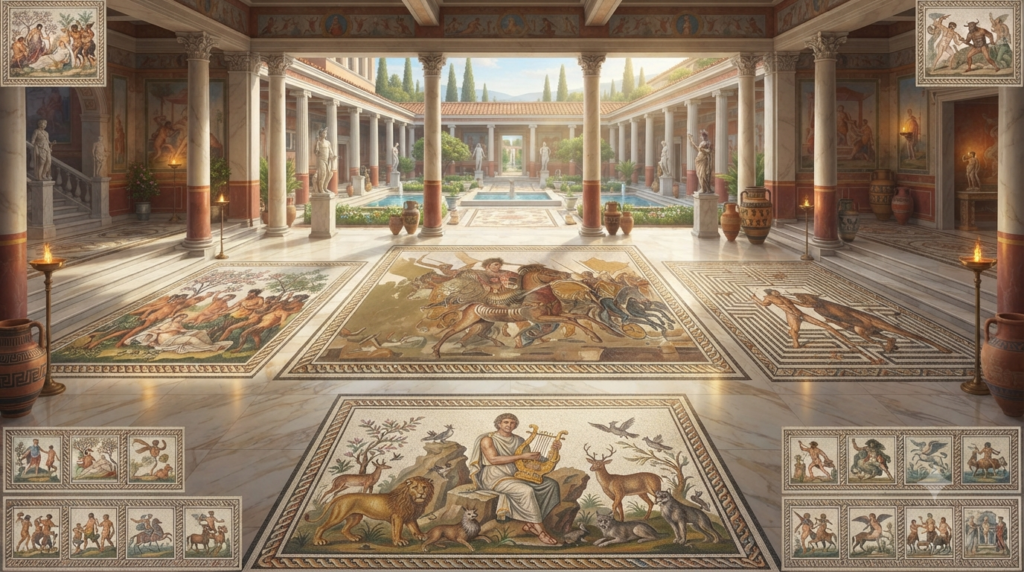
The art of mosaic, a painstaking craft of assembling small pieces of colored stone, glass, or marble to create intricate images, served as a magnificent canvas for the stories of Greek mythology. From the grand villas of Roman elites to the private homes of Hellenistic Greece, these durable and vibrant floor decorations brought the pantheon of gods, the exploits of heroes, and the tragedies of mortals into the daily lives of the ancient world. To understand what ancient mosaics depict scenes from Greek mythology is to explore a rich tapestry of surviving artworks that span centuries and empires, each piece offering a unique window into the enduring power and cultural significance of these ancient tales. This comprehensive guide examines some of the most significant surviving mythological mosaics, exploring their subjects, historical contexts, and the messages they conveyed about identity, civilization, and the relationship between the divine and mortal realms.
The Hellenistic Foundations: Early Greek Mosaics
The tradition of creating figural mosaics in Greece reached a high point during the Hellenistic period (c. 323-31 BCE). The capital of Macedonia, Pella, has yielded some of the most famous examples of this early art form. These mosaics, created using natural pebbles, often depicted grand mythological scenes and hunting motifs, demonstrating the wealth and cultural sophistication of their patrons .
The Stag Hunt Mosaic from Pella
One of the most remarkable surviving mosaics from this era is the Stag Hunt Mosaic, discovered in the “House of the Abduction of Helen” at Pella . Dating to the late 4th century BCE, this signed masterpiece by an artist named Gnosis displays extraordinary skill. It depicts two nude hunters, a dog, and a stag in a dynamic composition filled with movement. The artist used different colored pebbles to create shading and a strong illusion of three-dimensionality. While the figures are not explicitly identified by an inscription, scholars have debated whether the figure on the right might be Alexander the Great due to its distinctive upswept hair . The scene captures the dynamism and drama of a hunt, a popular subject that connected mortal heroes to the feats of myth and established a link between the ruler’s power and divine favor .
The Roman Embrace of Myth
The Romans inherited and expanded upon the Greek mosaic tradition with immense enthusiasm. For the Roman elite, adorning their villas and houses with mosaics depicting Greek myths was a powerful expression of paideia—a sophisticated education and cultural refinement that signaled their high status . However, the Romans were not merely passive imitators; they consciously and deliberately selected and reinterpreted these myths as symbols that reinforced Roman values and the concept of Roman civilization in opposition to barbarism .
The Alexander Mosaic from the House of the Faun
Perhaps the most iconic mosaic from the Roman world is the Alexander Mosaic, discovered in the House of the Faun at Pompeii. This magnificent floor mosaic, created in the late 2nd century BCE, is a masterwork of emulation, depicting the decisive battle between Alexander the Great and the Persian king Darius III. The composition, likely copied from a famous Greek painting, is a tour de force of illusionistic and narrative art. It was placed in the most important room of the house, serving as the spectacular finale of a grand path for visitors . The mosaic not only depicts a key historical event but also, through its Hellenistic themes and style, associates the Roman patron with the world of Hellenistic kingship and military triumph. The House of the Faun itself was a microcosm of this “art of the senses,” with other mosaics in the house featuring scenes of satyrs and maenads, and the young Dionysus riding a tiger, all connecting the domestic space to the realms of the gods .
The Dionysus and Ariadne Mosaic from Syria
A stunning example of mythological mosaic art’s longevity and adaptability is a 3rd-4th century CE panel from Syria, now in the Miho Museum . This mosaic depicts the moment the god Dionysus first discovers the sleeping princess Ariadne, who had been abandoned on the island of Naxos by Theseus . The scene is framed by a hilly landscape, and each figure is conveniently identified by an inscription, including Maron (a follower of Dionysus), Eros, and the members of the god’s retinue—Bakche, Pan, and Lyde . The mosaic is signed by an artist named Pamphilos, a rare occurrence.
What makes this piece exceptionally fascinating is its later history. At some point, a bloody wound was added to Dionysus’s side, and a flat, vessel-like object was placed in his hand. Scholars believe this was a conscious effort to transform the pagan image into one with Christian overtones, with the wound recalling Christ’s injury and the vessel symbolizing the wine or bread of the Eucharist . This dramatic re-semantization demonstrates how the power of Greek mythological imagery was so potent that it was later adapted to serve the new faith, illustrating the profound and lasting influence of these ancient narratives.
Mosaics of Heroes and Monsters
Beyond the Olympian gods and grand battles, Roman mosaics frequently depicted the adventures of heroes and their encounters with legendary monsters. These stories provided powerful moral and didactic exempla for the Roman patrons and their guests .
The Theseus Mosaic from Austria
The “Theseus Mosaic,” discovered in a Roman villa near Salzburg, Austria, and now in the Kunsthistorisches Museum in Vienna, is a remarkable cycle depicting the life of the Athenian hero Theseus . Dating to around 300-400 CE, the mosaic’s central image shows the hero slaying the Minotaur in the heart of the Labyrinth, a symbolic and confusing maze that occupies a large part of the composition . Smaller scenes around it illustrate key episodes: Theseus receiving the thread from Ariadne, his escape with her, and her eventual abandonment on Naxos, where she is found by the god Dionysus . This mosaic brings the entire tragic and heroic story into a single visual narrative, displaying the patron’s knowledge of Greek myth and offering a rich source of conversation and contemplation.
The Zeugma Mosaics
The ancient city of Zeugma in modern-day Turkey has produced a spectacular collection of well-preserved mosaics dating to the 2nd and 3rd centuries CE . These mosaics, now housed in a dedicated museum, display a strong affinity with the better-known works from Antioch and were perhaps created by master artisans from that city . Many of them depict scenes from Greek mythology. One famous mosaic from Zeugma shows the architect Daedalus and his son Icarus standing alongside Queen Pasiphae, the wife of King Minos . This scene illustrates the story of the creation of the Minotaur, with Pasiphae having mated with a bull, leading to the monstrous birth that would require the building of the Labyrinth .
Another significant mosaic from Zeugma depicts the moment when Odysseus discovers Achilles on the island of Skyros. To prevent him from joining the Trojan War, Achilles had been hidden by his mother and was living in disguise among the king’s daughters. This theme, known as “Achilles on Skyros,” was a popular subject for mosaic art across the Roman Empire, with approximately 15 examples surviving from regions as far-flung as Spain, North Africa, and Gaul . The scene symbolically represents themes of duty, identity, and the call to heroic action.
The Orpheus Mosaic from North Africa
The figure of Orpheus, the legendary poet and musician, was another immensely popular subject for Roman mosaics, especially in the North African provinces. A beautiful example from the 3rd century CE, now in the Museum of Fine Arts in Budapest, shows the hero seated on a rock, wearing a Phrygian cap and playing a lyre . Orpheus’s power to charm wild beasts with his music was a symbol of civilization, harmony, and the power of culture. The mosaicist used a rich variety of colored tesserae and even glass pieces to achieve a painterly effect . In a time of imperial crisis during the 3rd century CE, the image of Orpheus, who successfully journeyed to the underworld to reclaim his wife, offered a potent message of hope and salvation. It is no coincidence that his figure was later adopted by early Christianity as an allegory for Christ, the Good Shepherd who tames the world and triumphs over death .
Frequently Asked Questions About What ancient mosaics depict scenes from Greek mythology?
Which Greek myths were most commonly depicted in Roman mosaics?
The most popular Greek myths depicted in Roman mosaics include the adventures of heroes like Theseus slaying the Minotaur, Achilles on Skyros, and the Labors of Hercules . Stories of divine love, such as Dionysus discovering Ariadne, and the power of Orpheus, were also frequently represented, alongside myths involving the sea, such as battles between Amazons and centaurs .
What is the most famous ancient mosaic depicting a Greek myth?
The Alexander Mosaic from Pompeii is arguably the most famous. While depicting a historical battle, its style and subject matter are deeply rooted in Hellenistic Greek artistic tradition, making it a monumental example of a mythological-style mosaic that celebrates a Greek hero .
Why did the Romans create so many mosaics of Greek myths?
The Romans used Greek myths in their mosaics as powerful symbols of civilization, learning, and cultural refinement . They were a way for wealthy patrons to display their paideia (education). Furthermore, the myths were consciously reused to promote Roman values, such as heroism, virtue, and the triumph of civilization over barbarism .
Where in a Roman house would you find mythological mosaics?
Mosaics depicting Greek myths were primarily used as floor decorations in the main rooms of Roman villas and houses, such as the triclinia (dining rooms), atria, and exedrae . These were the spaces where the owner would receive guests, and the mosaics provided a visual spectacle and a demonstration of the patron’s wealth and sophistication .
Were all Greek mythological mosaics made in Greece?
No. While the tradition originated in Greece and the Hellenistic world, the vast majority of surviving mythological mosaics were produced during the Roman Empire, across its vast territories . Many of the most famous examples come from places like Italy, North Africa, Turkey (Zeugma), Austria, and Syria . They were a pan-Mediterranean art form.
Do any ancient mosaics show artists’ signatures?
Yes, a few are signed. The Stag Hunt Mosaic from Pella is signed by an artist named Gnosis . The Dionysus and Ariadne mosaic from Syria is signed by Pamphilos, who left a rare inscription “Pamphilos made this” . These signatures are exceptional and provide valuable insight into the artists’ status.
What is the significance of mythological mosaics found in tombs?
Mythological scenes also appear in Roman funerary contexts, such as on sarcophagi and tomb walls . In these settings, myths of love and death, like the story of Orpheus, and heroic tales of courage, were used as rhetorical and didactic exempla. They offered consolation, praise for the deceased, and a message of rebirth or hope, mirroring the belief that a blessed life could be rewarded, a concept that had parallels in the myth of Dionysus and Ariadne .
How can I see these mosaics today today?
You can see many of these mosaics in museums around the world. The Alexander Mosaic is at the National Archaeological Museum in Naples. The Theseus Mosaic is in Vienna’s Kunsthistorisches Museum. The Zeugma mosaics are in the Zeugma Mosaic Museum in Turkey, and the Dionysus and Ariadne mosaic is at the Miho Museum in Japan. Many more remain in situ at archaeological sites like Pompeii.
Conclusion
The ancient mosaics that depict scenes from Greek mythology are far more than beautiful decorations; they are profound visual documents of cultural transmission, identity, and belief. To ask what ancient mosaics depict scenes from Greek mythology is to journey from the pebble floors of Hellenistic Pella to the grand villas of the Roman Empire, encountering the gods, heroes, and monsters that shaped the classical imagination. These intricate works of art served as powerful statements of their patrons’ education and status, while also functioning as didactic tools that reinforced Roman values of civilization and heroism. The stories they tell—of love, loss, triumph, and tragedy—were so resonant that they were adapted for centuries, even acquiring new Christian meanings as the world changed. Ultimately, these mosaics provide a vivid and enduring testament to the timeless power of Greek mythology, immortalized in stone and glass for generations to admire and interpret.

Orin Vale has spent the better part of two decades tracing the threads that connect the world’s oldest stories — from the halls of Asgard to the banks of the Nile, from Olympus to the jungles of the Maya. What began as a childhood fascination with flood myths and trickster gods grew into years of independent study across comparative mythology and ancient religion, always chasing the same question: what did these stories mean to the people who first told them? Orin writes for readers who want more than trivia — the ones looking for the beliefs, fears, and truths that myths were built to carry.