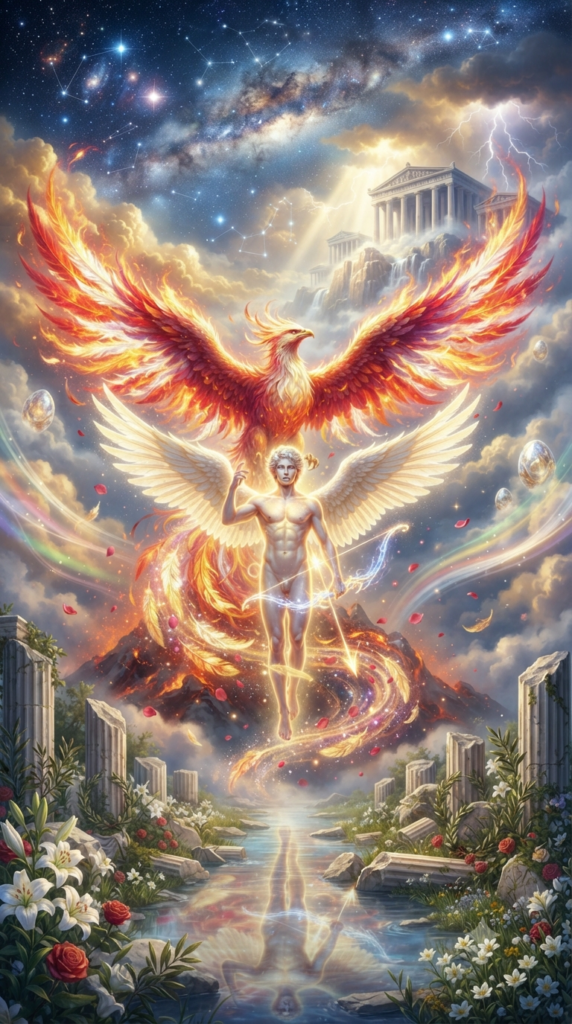
In the vast and intricate tapestry of Greek mythology, connections between deities and symbols often reveal deeper truths about the ancient Greek worldview. The question what is the connection between Eros and the phoenix in Greek mythology invites us to explore a fascinating intersection of love, death, rebirth, and primordial cosmic forces. While Eros, the god of love, and the phoenix, the mythical bird of resurrection, do not share a direct mythological narrative in classical Greek sources, their symbolic connection emerges through shared themes of regeneration, the transformative power of desire, and the liminal space between life and death. This connection, forged in later literary and artistic traditions, reveals how the Greeks and their cultural inheritors understood love as a force capable of transcending mortality itself. This comprehensive guide explores the mythological identities of Eros, the origins of the phoenix myth, and the symbolic bridges that link these two powerful figures in the Western imagination.
Eros: The Primordial God of Love
To understand the connection between Eros and the phoenix, one must first understand the complex nature of Eros himself. In Greek mythology, Eros was far more than the playful, winged child of later Roman tradition. His origins and identity varied significantly across different sources, revealing a god of immense power and cosmic significance.
The Two Faces of Eros
Greek mythology presents two distinct traditions regarding Eros. In the earliest and most profound conception, found in Hesiod’s Theogony, Eros was one of the primordial forces of creation. He emerged from Chaos alongside Gaia (Earth) and Tartarus, making him one of the oldest and most fundamental deities in the Greek pantheon . This Eros was not a playful boy but a cosmic principle, the force of desire that brought order and generation to the universe. He was the “most beautiful of the gods” who “unbends the wearied limbs” of mortals and immortals alike .
In later tradition, particularly from the classical period onward, Eros became more commonly known as the son of Aphrodite, the goddess of love, and either Ares, the god of war, or Hermes, the messenger god . This later Eros was depicted as a mischievous, winged youth who shot arrows of desire at gods and mortals, causing them to fall in love. This is the Eros familiar from countless works of art and poetry, but he represents only a later development of the god’s identity.
Eros as a Primordial Force
The primordial Eros was not merely a god of romance but a force of cosmic creation. In some traditions, Eros was born from an egg laid by Nyx (Night), a motif that connects him to the creation of the cosmos and the generation of life from primal darkness . This egg, described as “wind-eggs” (hypenemia) by Aristotle, was associated with the west wind Zephyros, which was believed to impregnate birds and bring the spring season .
A lesser-known but significant tradition, preserved in a fragment of the poet Alcaeus, identifies Eros as the son of Iris (the rainbow) and Zephyros (the west wind) . This genealogy is crucial for understanding the connection between Eros and the phoenix. Iris and Zephyros belong to a lineage of primordial beings who predate the cosmic order established by Zeus. Iris, the messenger of the gods, was the daughter of Thaumas, a monstrous sea-god whose name means “wonder” or “prodigy” . Zephyros was a wind god, a force of nature associated with spring and fertility .
This lineage establishes Eros as a being of the air and the wind, a creature of the liminal spaces between heaven and earth, order and chaos. In the Orphic tradition, Eros was “generated by Chronos along with all the breaths” (pneuma), further associating him with the winds and the vital forces of life . The Greek lyric poet Sappho famously described Eros as shaking her soul “like a wind on the mountain falling on the oaks,” capturing the god’s power as an irresistible, elemental force .
The Wings of Eros
Eros’s wings are a defining feature of his iconography, and they connect him to the broader category of winged beings in Greek mythology. In the Wings of Eros, a visual poem by Simias of Rhodes, the god speaks in the first person, presenting himself as the son of Chaos and emphasizing his swift, flying nature . His wings link him to his mother Iris, who is described in Nonnus’s Dionysiaca as the “golden-winged bride” of Zephyros, and to the Harpies, his aunts on his mother’s side, who are “snatchers” of prey . The root of the word Harpy (harpyiai) is connected to the verb “to seize” (harpazein), and the same epithet harpys is sometimes applied to Eros, as he has the power to seize human hearts .
The Phoenix: The Bird of Rebirth
The phoenix, unlike Eros, is not a Greek deity but a mythical bird whose legend originated in ancient Egypt and was adopted and adapted by Greek and Roman writers. Its connection to Greek mythology is therefore more complex and indirect.
Origins of the Phoenix Legend
The phoenix was most famously described by the Greek historian Herodotus in the 5th century BCE, who claimed to have heard the story in Egypt. According to Herodotus, the phoenix was a magnificent bird, with feathers of red and gold, that lived for 500 years. At the end of its life, it would build a nest of spices and myrrh, and from the nest, a new phoenix would arise. The new bird would then carry its parent’s body to the Temple of the Sun at Heliopolis in Egypt .
This cycle of death and rebirth made the phoenix a powerful symbol of resurrection, renewal, and eternal life. In the ancient world, the phoenix was often associated with the sun, the cycle of the seasons, and the idea of regeneration after destruction. It was a symbol of hope, endurance, and the triumph of life over death.
The Phoenix in Greek and Roman Literature
While the phoenix was not a native Greek myth, it was adopted and integrated into the Greek and Roman cultural imagination. By the Roman period, the phoenix had become a symbol of Rome’s eternal power, appearing on coins and in imperial propaganda. The poet Ovid included the story of the phoenix in his Metamorphoses, a work that collected and transformed Greek and Roman myths. In his account, the phoenix is a unique creature that lives for a thousand years and is reborn from its own ashes, a symbol of the cycle of life and death .
The phoenix also appears in the context of the myth of Caenis, a woman loved by Poseidon who was transformed into the invulnerable man Caeneus. After Caeneus was crushed by tree trunks, Ovid tells us that he emerged from the pile “in the form of the phoenix, the mythic bird in which all opposites coincide, including those of masculinity and femininity” . This story reveals the phoenix as a symbol of transformation, transcendence, and the reconciliation of apparent opposites, a figure that exists beyond the normal categories of existence.
The Connection: Eros and the Phoenix
The connection between Eros and the phoenix is not a matter of a shared myth, but of shared symbolic themes that became increasingly prominent in later Greek and Roman literature, and especially in the medieval and Renaissance periods.
The Phoenix as a Symbol of the Transformative Power of Love
Eros, as the god of desire, is the driving force behind creation, transformation, and renewal. The phoenix, as a symbol of rebirth, embodies the idea that destruction and death can lead to new life. When these two figures are brought together, they create a powerful metaphor for the transformative power of love. Love can consume and destroy, but it can also give birth to something new and more beautiful.
In the poetry of John Donne and other early modern writers, the phoenix becomes a symbol of spiritual love and the union of two souls. The phoenix’s ability to rise from its own ashes is used to describe the nature of true love, which is both death and rebirth, a union of two becoming one in a state beyond normal human existence . While this is a later development, it is rooted in the ancient conception of Eros as a force of cosmic generation and transformation.
Shared Themes: The Wind and the Egg
A more direct connection between Eros and the phoenix can be found in the shared symbolism of the wind and the egg. In Aristotle’s History of Animals, “wind-eggs” (hypenemia) are described as eggs produced without copulation, and they are also called “zephyria” because they were believed to be impregnated by the west wind (Zephyros) in the spring . In the Orphic tradition, Eros is born from a “wind-egg” delivered by Nyx, the goddess of night .
This motif of the wind-egg connects Eros to the phoenix, as the phoenix is also associated with the sun, the wind, and the process of spontaneous generation. Both figures emerge from the union of air and a creative force, and both embody the idea of life arising from apparent emptiness or destruction. The phoenix’s nest of spices and myrrh, which is ignited by the sun, can be seen as a kind of cosmic egg, from which new life emerges.
Eros and the Phoenix as Liminal Beings
Both Eros and the phoenix exist on the margins of the cosmic order. Eros, as the son of Iris and Zephyros, belongs to a lineage of beings that predate or oppose the rule of Zeus . He is an “un-cosmic” god, a force of desire that operates outside of the rational order of the Olympian pantheon . The phoenix is also a liminal creature, a unique being that exists outside of the normal cycles of reproduction and death.
The connection between Eros and the phoenix lies in their shared status as figures of transcendence. Both represent the power of life to overcome destruction, of desire to create order from chaos, and of the individual to transcend the limitations of mortality.
The Phoenix of Love
In the late antique and medieval periods, the connection between Eros and the phoenix became a literary and artistic convention. The phoenix came to symbolize the experience of love itself, which was seen as a kind of death and rebirth. The lover was “consumed” by desire, only to be reborn into a higher state of being. This was particularly true in the poetry of the troubadours and in the allegorical traditions of the Middle Ages, where the phoenix became a symbol of both earthly and divine love .
This symbolic connection was given further expression in the idea of the “phoenix woman,” a figure who embodied the ideal of love and beauty, and in the association of the phoenix with the palm tree, a symbol of victory and resurrection . The phoenix and the dove, another bird sacred to Aphrodite and Eros, were also paired in later iconography, reinforcing the connection between the bird of rebirth and the god of love .
Frequently Asked Questions About What is the connection between Eros and the phoenix in Greek mythology?
Is there a Greek myth that directly links Eros to the phoenix?
No, there is no single Greek myth that directly tells a story featuring both Eros and the phoenix. The connection between them is symbolic and thematic, emerging from shared associations with death, rebirth, transformation, and the creative power of desire .
How is Eros connected to the concept of rebirth?
Eros, in his earliest form as a primordial god, is a force of creation and generation. He emerges from Chaos and represents the desire that brings order and life to the cosmos . In later traditions, Eros is born from a “wind-egg,” linking him to the life-giving force of the wind and the cycle of the seasons .
What is the significance of the “wind-egg” in the myth of Eros?
The “wind-egg” (hypenemion) is an egg produced without fertilization. In Aristotle’s writings, such eggs are called “zephyria” and were believed to be impregnated by the west wind (Zephyros) in the spring . In the Orphic tradition, Eros is born from a wind-egg laid by Nyx, connecting him to the generative power of the air .
What is the phoenix and what does it symbolize?
The phoenix is a mythical bird that is reborn from its own ashes after a cycle of 500 or 1,000 years . It symbolizes resurrection, renewal, and eternal life. In the ancient world, it was associated with the sun and the cycle of the seasons, and in later traditions, it became a symbol of love and spiritual transformation .
How are the phoenix and the wind connected?
The phoenix is connected to the wind through the concept of the “wind-egg” and through its association with the sun and the air. In the myth of Caenis, the phoenix emerges from the earth, and in the broader tradition, the bird is reborn through the power of the sun, which is also a source of wind and breath .
What is the connection between Eros and Zephyros?
Zephyros is the west wind, a force of spring and fertility. In a lesser-known tradition, Eros is the son of Iris and Zephyros . This genealogy links Eros to the winds and to the generative power of the air. In Aristotle, wind-eggs are called “zephyria,” further connecting Zephyros to the creation of life .
Why is the phoenix associated with love in later literature?
The phoenix became a symbol of love in later literature because its ability to rise from its own ashes was seen as a metaphor for the transformative power of love. Love could be a kind of death and rebirth, consuming the lover and then raising them to a higher state. The phoenix was a perfect symbol for this experience .
How does Eros’s winged nature connect him to the phoenix?
Eros is frequently depicted with wings, linking him to the air and to the power of flight. His mother, Iris, is also winged, and his aunts are the Harpies, bird-women of prey . The phoenix is also a winged creature, and its connection to the sky and the sun aligns it with the same elemental forces that define Eros.
Conclusion
The connection between Eros and the phoenix in Greek mythology is not a simple narrative link but a profound symbolic relationship that evolved over centuries of cultural exchange and reinterpretation. To ask what is the connection between Eros and the phoenix in Greek mythology is to explore the ancient Greek understanding of love as a cosmic and transformative force. Eros, the primordial god of desire, is a being of the air and the wind, a force of generation that emerges from Chaos and creates order from disorder . The phoenix, a mythical bird adopted from Egyptian tradition, embodies the principle of rebirth and renewal, rising from its own ashes to live again . Their shared themes of life, death, and regeneration make them natural symbolic partners in the Western imagination, creating a powerful metaphor for the consuming and redemptive nature of love that has resonated through literature and art from antiquity to the present day. The phoenix becomes a perfect emblem for the power of Eros, representing the idea that love, even in its most destructive forms, can lead to a kind of transcendence and new life.

Orin Vale has spent the better part of two decades tracing the threads that connect the world’s oldest stories — from the halls of Asgard to the banks of the Nile, from Olympus to the jungles of the Maya. What began as a childhood fascination with flood myths and trickster gods grew into years of independent study across comparative mythology and ancient religion, always chasing the same question: what did these stories mean to the people who first told them? Orin writes for readers who want more than trivia — the ones looking for the beliefs, fears, and truths that myths were built to carry.