In the Odyssey, Odysseus does far more than recount a chain of adventures to a foreign king. Before Alcinous, ruler of the Phaeacians, he shapes his suffering into a testimony about endurance, prudence, and the high cost of human error. His account becomes the emotional center of the poem because it links battlefield fame to the private reality of displacement. Odysseus explains not only where he has been, but what those places have done to his crew, his identity, and his hopes of returning home. Through this long confession, the epic turns travel into moral education, showing how a man survives when strength alone is no longer enough.
Odysseus Arrives at Alcinous’s Phaeacian Court
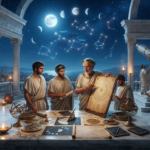
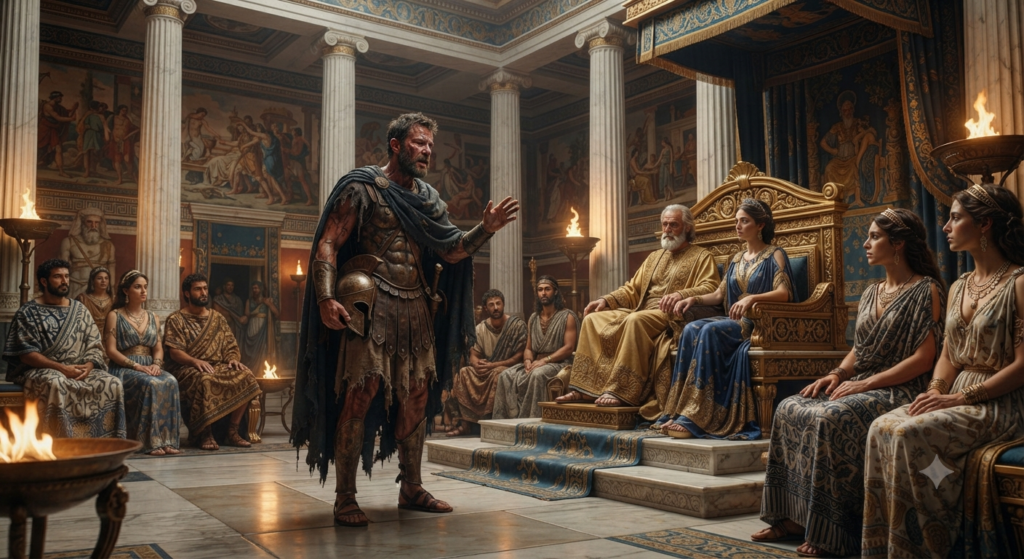
Odysseus arrives at the Phaeacian court as a stranger stripped of status, carried by shipwreck and divine mercy into a world of order and abundance. His first appearance before Alcinous is marked by vulnerability: he has washed ashore, exhausted and naked of all visible honor. Yet the court of the Phaeacians is carefully arranged, almost like a model of civilized life, with feasting, music, and hospitality functioning as signs of social harmony. Against that setting, Odysseus’s silence and distress make him seem like a man standing outside the human community, someone who has crossed through chaos and now waits to be recognized again.
That contrast matters because the Odyssey presents hospitality, or xenia, as a moral test. Alcinous receives the stranger before knowing his name, and this generosity opens the space for Odysseus’s narrative. The hero does not begin with triumph; he begins with need. In simple terms, the court is like a safe harbor after a storm, and Odysseus can only explain the storm once he has been allowed to land. His arrival therefore frames the entire story as a search for belonging, not merely a set of adventures.
The Hero’s Plea for Shelter and Safe Passage
Before he fully reveals himself, Odysseus makes a careful plea for shelter and safe passage, appealing to Alcinous’s sense of justice and honor. He speaks as a suppliant, which in Greek culture is a powerful and delicate role: one who asks for help while placing himself under sacred protection. This is not the language of a warrior boasting of victory. Instead, Odysseus adopts the voice of a man who knows that survival depends on the goodwill of others. The plea is practical, but it also carries emotional weight, because it asks the king to see him as a human being rather than a drifting body at the edge of the sea.
His request for passage home also reveals the central desire driving all his wanderings. Odysseus does not want reward, conquest, or political advantage; he wants nostos, the return that restores a broken life. A useful analogy is a damaged bridge: all effort points toward crossing back to the familiar side, not toward building a new empire on the far bank. By addressing Alcinous in this way, Odysseus turns the king into a partner in restoration. Safe passage becomes more than transportation; it is the means by which identity, household, and memory can be repaired.
Odysseus Reveals His True Name to the King
Only after gaining some trust does Odysseus reveal his true name to the king, and this moment changes the tone of the whole exchange. While anonymity protects a stranger, a name restores the continuity of a person’s life. Odysseus has been hidden by circumstance, even reduced to a body without history, but now he speaks as the king of Ithaca, husband of Penelope, father of Telemachus, and veteran of Troy. The disclosure is more than identification. It is a claim that the man before Alcinous is the same one whose reputation once spread through the Greek world.
At the same time, the revelation invites memory and accountability. To name oneself is also to take ownership of one’s story, including errors and losses. Odysseus does not merely announce heroic identity; he prepares to explain how that identity was tested and nearly undone. In the Odyssey, a name is like a seal on a document: it confirms authorship, but it also binds the speaker to the contents. By revealing himself, Odysseus gives Alcinous access to the full truth of his suffering, and the king becomes the first listener who can receive the story as a whole.
Tales of the Cyclops and the Escape from Polyphemus
Odysseus recounts his encounter with the Cyclops Polyphemus as one of the clearest examples of human intelligence confronting brute force. The cave episode begins with curiosity and expectation, but quickly becomes a trap. Polyphemus is huge, solitary, and lawless, lacking the social restraint that makes human life possible. He eats Odysseus’s men without pity, turning hospitality upside down. In that inverted world, the rules of civilization vanish, and only wit can create a path out. Odysseus’s plan—intoxicating the giant, naming himself “Nobody,” and blinding him with a sharpened stake—shows how language and patience can defeat overwhelming power.
Yet the victory is not simple, because Odysseus’s pride complicates the escape. After leaving the cave, he cannot resist revealing his real name, an act that invites Poseidon’s revenge. This detail matters in the larger Odyssey because it shows that intelligence and self-command must work together. Cleverness alone is not enough if it is joined to vanity. The Cyclops story therefore functions as a lesson in limits: the hero survives by mind as much as by force, but he suffers because he cannot always govern his own desire for recognition. That tension follows him through the rest of his voyage.
The Land of the Lotus-Eaters and Lost Companions
When Odysseus recalls the Lotus-Eaters, he describes a danger that is quieter than violence but just as serious: the loss of memory and purpose. The lotus plant does not wound the body; it softens the will. Those who eat it forget home and no longer care to return. In practical terms, the island presents a temptation to stop wanting. That is a subtle form of destruction, because a person who abandons the desire for home has already begun to disappear as a moral being. Odysseus must drag his men back to the ships, not because they are physically unable to move, but because their minds have been lulled into passivity.
This episode deepens the meaning of nostos by showing that homecoming is not guaranteed by distance alone. The hardest enemy can be comfort without direction. Think of a traveler who sits down for a brief rest and then forgets the road entirely; the danger is not pain, but numbness. Odysseus’s explanation to Alcinous suggests that leadership requires vigilance over the imagination as well as the body. He cannot allow his crew to drift into forgetfulness, because forgetting Ithaca would mean surrendering the very goal that gives their suffering shape.
Circe, Her Magic, and the Warning from Hermes
Odysseus also conveys to Alcinous the story of Circe, whose palace transforms men into animals and exposes how fragile human self-control can be. The enchantress uses potion and wand to strip Odysseus’s companions of their human form, turning them into creatures that reflect appetite without reason. This is a symbolic disaster: when reason fails, a man becomes like the beasts ruled only by impulse. Circe’s magic makes visible what is usually hidden, namely, that civilization depends on restraint. Odysseus’s resistance, aided by Hermes and the protective herb moly, depends not on greater strength but on divine warning and disciplined awareness.
The Hermes episode is especially important because it shows that survival in the Odyssey often requires knowledge from outside oneself. Odysseus is not self-sufficient; he needs signs, counsel, and timing. Hermes gives him the means to resist Circe, much like a physician offering an antidote before poison takes hold. Once Circe is overcome, she becomes a guide rather than an enemy, instructing Odysseus about the next stages of his journey. The story therefore joins threat and instruction. Danger is never only danger; it can also become the occasion for insight if the hero listens carefully and acts with restraint.
The Descent to Hades and the Prophet Tiresias
Odysseus then describes his descent to Hades, an episode that gives the entire narrative a grave and reflective tone. In the underworld, he confronts the reality that all human glory is temporary. Warriors who once fought at Troy now exist only as shades, pale figures deprived of the life they once commanded. This is not merely an adventure in a strange place. It is a confrontation with mortality itself. Odysseus seeks out Tiresias because only the prophet can tell him how to return home, but the journey to the dead also teaches him what homecoming means: it is a race against time, against loss, and against the final silence that waits for everyone.
Tiresias gives warning and direction, especially about Helios’s cattle and the dangers that await on the sea. The prophecy turns Odysseus’s future into a moral path rather than a random sequence of events. In a sense, the underworld episode is like reading the fine print before signing a dangerous contract. The hero cannot avoid hardship, but he can understand its terms. Alcinous hears from Odysseus that knowledge often comes at the edge of despair, and that the dead, by their stillness, make the living more aware of what they stand to lose if they fail to return.
Scylla, Charybdis, and the Perilous Return Voyage
As Odysseus explains the voyage home, he focuses on the narrow passage between Scylla and Charybdis, where sailors must pass between two forms of death. Scylla, with her many heads, represents sudden and unavoidable loss; Charybdis, the whirlpool, threatens complete destruction. Odysseus cannot eliminate danger here, only choose the lesser harm. That is one of the poem’s starkest lessons. Sometimes leadership means accepting that every option is damaged. He chooses to keep the ship moving, sacrificing a few men to preserve the rest, a decision that reveals the terrible arithmetic of survival at sea.
This passage matters because it strips away heroic fantasy and shows command under pressure. Odysseus does not glide through the strait like a triumphant conqueror. He endures it like a pilot steering through rocks in darkness, where hesitation would ruin everyone. The episode also shows how the sea itself functions as a moral landscape in the Odyssey. It tests whether a man can think clearly when no clean solution exists. To Alcinous, Odysseus’s account demonstrates that wisdom is often less about winning than about choosing damage carefully, with eyes open and heart steady.
The Loss of Helios’s Cattle and Zeus’s Wrath
Odysseus’s account of the cattle of Helios marks the point where human disobedience becomes cosmic punishment. Despite warnings, his starving men slaughter the sacred cattle on Thrinacia, believing immediate hunger more pressing than divine command. The decision is understandable on a human level, but the poem treats it as fatal misjudgment. The men confuse necessity with permission. That confusion is common in life: when people are under pressure, they may begin to think that urgency justifies everything. Odysseus explains to Alcinous that this was precisely the error, and that Zeus’s thunderbolt destroyed the ship as a result.
The punishment is severe because the offense is not only theft but a refusal to respect sacred limits. Helios’s cattle belong to the divine order, and crossing that boundary brings ruin. Odysseus alone survives, clinging to wreckage like a man holding the last fragment of a shattered world. This survival is bitter, not triumphant. The loss of his companions follows from a chain of choices, not blind fate alone. Through this episode, the Odyssey teaches that endurance requires obedience as well as courage. Strength without self-restraint can destroy the very crew a leader is sworn to protect.
Alcinous Hears the Full Story of Odysseus’s Wandering
By the time Odysseus finishes his long narrative, Alcinous has heard not merely a list of adventures but the full shape of a life in exile. The story joins cunning, suffering, pride, grief, and divine interference into one continuous account. What Odysseus reveals is that wandering is not accidental in the moral sense. Each episode exposes a different pressure on human beings: temptation, fear, vanity, hunger, and grief. The king hears how a heroic survivor must balance intelligence with humility and endurance with restraint. The Odyssey uses this frame to make the past intelligible, not as spectacle, but as hard-earned wisdom about what it costs to come home.
For Alcinous, the tale also confirms the dignity of hospitality, because the king has given Odysseus the space to speak truthfully. The recounting itself becomes part of the hero’s return. A man cannot fully go home until his experience has been named and witnessed. In that sense, Odysseus’s speech is as important as any voyage. He speaks to Alcinous, but he also restores himself through speech, turning broken memory into ordered narrative. What Odysseus tells King Alcinous in the Odyssey is a complete account of danger, loss, and survival, but it is also a meditation on identity and home. By narrating his journey from Troy through monsters, enchantment, prophecy, and divine punishment, he explains why return is never simple and why wisdom must be learned through suffering. The story he gives Alcinous is the story of a man trying to recover both his house and his name.

Orin Vale has spent the better part of two decades tracing the threads that connect the world’s oldest stories — from the halls of Asgard to the banks of the Nile, from Olympus to the jungles of the Maya. What began as a childhood fascination with flood myths and trickster gods grew into years of independent study across comparative mythology and ancient religion, always chasing the same question: what did these stories mean to the people who first told them? Orin writes for readers who want more than trivia — the ones looking for the beliefs, fears, and truths that myths were built to carry.