The sixth labor of Hercules was the cleansing of the marshes of Stymphalia in Arcadia, where a vast flock of man-eating Stymphalian birds had taken refuge. In the classical tradition, this was one of the more difficult tasks assigned to Heracles, not because of brute strength alone, but because the enemy was hidden, numerous, and dangerous at a distance. Ancient authors preserve slightly different details of the episode, yet they agree on the central fact: Hercules drove out and destroyed the birds that terrorized the region.
Hercules and the labor of the Stymphalian birds
The sixth labor is commonly known as the defeat of the Stymphalian birds, a mythic flock associated with the marshes near Lake Stymphalia in Arcadia. Unlike some of Hercules’ other labors, this task was not a straightforward contest with a single monster. The birds were numerous, elusive, and protected by difficult terrain, making the labor a test of strategy as much as strength. In the later Greek tradition, they are among the best-known of the hero’s opponents.
Apollodorus gives the clearest summary of the labor: Hercules could not enter the marsh easily, so he used the aid of Athena to force the birds into the open and then shot them with arrows. Other sources, including Pausanias and later Roman writers such as Ovid, preserve related versions with small variations. What remains constant is that the labor marked another stage in Hercules’ service to Eurystheus and his gradual conquest of the wild and dangerous edges of the Greek world.
Why Eurystheus imposed this dangerous task
Eurystheus, the king who assigned the Twelve Labors, repeatedly set Hercules tasks meant to be nearly impossible. In myth, these labors function as both punishment and trial: Hercules must not only atone for his past actions but also prove his exceptional status through deeds that ordinary men could never complete. The Stymphalian birds suited this purpose well, since they were dangerous enough to threaten a whole district and remote enough to make direct combat difficult.
The choice of task also reflects a recurring pattern in the labors. Eurystheus often seeks to defeat Hercules by forcing him into situations where strength alone will not suffice. A flock hidden in reeds and marshland could not be mastered like a lion or a boar. The labor therefore emphasizes cunning, divine assistance, and endurance, qualities that recur throughout the hero’s mythic career.
The marshes of Stymphalia in Arcadia
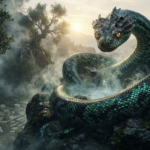
Stymphalia lay in Arcadia, a region often portrayed in Greek literature as mountainous, rural, and close to untamed nature. The marshes around the lake formed a difficult landscape of reeds, stagnant water, and hidden ground, a fitting setting for a creature associated with menace and concealment. In mythic geography, such places stand at the edge of civilization, where order is fragile and danger is never far away.
Ancient writers treat the site as real and localizable, even when the surrounding story is highly legendary. Pausanias, who often records local traditions and sacred landscapes, notes the region in connection with the birds and with later cultic memory. The marshes themselves matter to the story because they explain why the birds survived and why Hercules needed help; the terrain turned a hunt into a tactical operation.
Bronze beaks, feathers, and lethal attacks
The Stymphalian birds are usually described as having bronze beaks, metallic claws, and feathers that could be used as weapons. Some traditions even say their feathers could be launched like arrows, while others emphasize the force of their pecking and the damage they caused as a flock. The result is the same in every version: these were not ordinary birds, but monstrous creatures with a hybrid, almost armored nature.
Their danger lay in both their physical attack and their numbers. A single beast could be faced directly, but a mass of birds hidden in reeds and rising suddenly into flight would overwhelm local people and livestock alike. In later iconography, the birds became a dramatic symbol of lethal swarming force, and their metallic features made them visually distinct from the more familiar monsters of Greek myth.
Athena’s aid and the use of a rattle
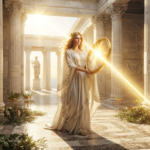
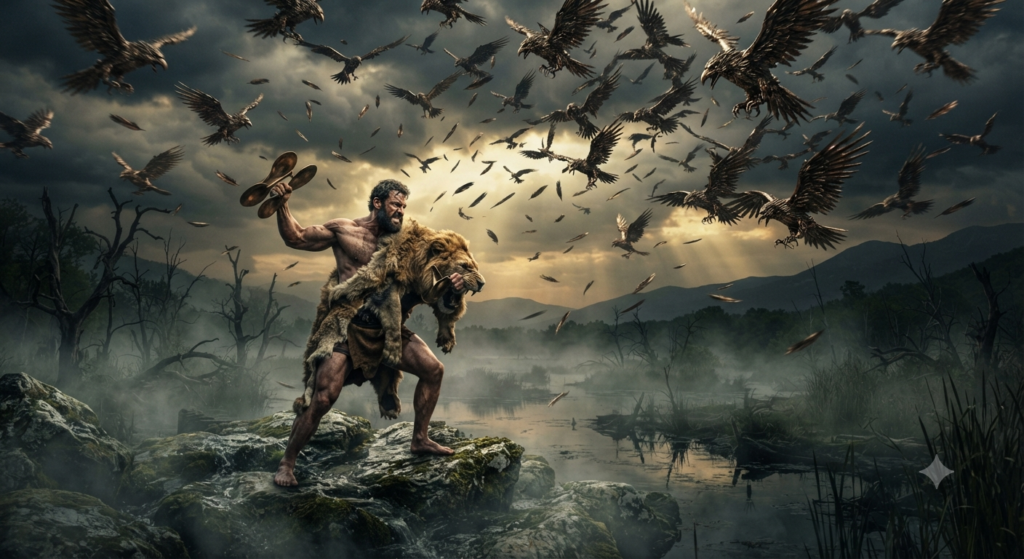
The most important turning point in the labor is Athena’s intervention. According to Apollodorus, Athena provided Hercules with a bronze rattle, or in some tellings a pair of cymbals, made by Hephaestus. The noise startled the birds and drove them from the marshy cover where they had been safe. This detail is central to the myth because it shows divine intelligence assisting heroic action.
Athena’s role also gives the labor a distinctly Greek character: victory comes not from force alone, but from the right application of technique. Hercules does not simply charge into the reeds and fight blindly. He uses sound to alter the birds’ behavior, revealing them to the open air where arrows can reach them. The rattle is one of the most memorable objects in the Twelve Labors, precisely because it makes strategy visible.
Apollo and the flight of the birds
Some later or parallel accounts connect the birds’ dispersal with Apollo, though Athena remains the standard helper in the main literary tradition. In mythic storytelling, divine associations often shift across regions and authors, and Apollo’s presence may reflect his broader role as a god of archery, order, and purification. Where he appears in relation to the labor, he does not replace Hercules’ achievement but reinforces the sense of divine favor surrounding it.
The birds’ flight from the marsh was only part of the solution. Once they rose into the open, they became vulnerable to Hercules’ arrows, and the labor moved from concealment to direct confrontation. That movement matters symbolically as well as narratively: what was hidden in the wilderness had to be exposed before it could be subdued. Apollo’s connection, where given, fits that shift from disorder to disciplined aim.
How Hercules drove the flock from cover
Hercules approached the marsh with caution, since the birds’ advantage was their hidden position. With Athena’s instrument making noise, he forced them to rise, and then he loosed arrows into the fleeing flock. Apollodorus states that he killed many of them, while the survivors departed the region; the exact number is not consistently given in surviving sources. What matters is that he cleared the area enough to end the immediate threat.
The labor is notable because it combines patience, intervention, and violence in a tightly organized sequence. Hercules does not win by endurance alone, nor by a single spectacular blow. He manipulates the environment, relies on divine help, and then finishes the task with his bow. In that sense, the sixth labor presents Hercules as a hero of both force and judgment.
Ancient sources on the sixth labor’s details
Apollodorus, in the Bibliotheca, offers the most concise and influential version of the sixth labor. He identifies the Stymphalian birds, the marshy setting, Athena’s assistance, and Hercules’ use of arrows after the birds were driven out. This account became foundational for later retellings and summaries of the Twelve Labors.
Other ancient authors preserve the episode in less direct ways. Pausanias refers to local traditions and the memory of Hercules in Arcadia, while Ovid alludes to the labor in his poetic treatment of Hercules’ exploits. The variations are useful because they show how a myth could be adapted for geography, cult, and literature without losing its core shape. Across these sources, the sixth labor remains a recognizable episode of divine aid and heroic clearing of the wild.
The birds as symbols of wilderness and peril
The Stymphalian birds are more than a single monster in a heroic tale. They represent the threat posed by untamed spaces, especially marshes and reed beds that resist human control. Their bronze armor, swarming behavior, and hidden nesting place make them a mythic version of the dangers that lie beyond settled land. In that sense, they fit a broader pattern in Greek myth, where the hero brings order to places marked by confusion or pollution.
Their symbolism also reflects a tension common in the Twelve Labors: nature is not simply beautiful or benign, but powerful, dangerous, and resistant. Hercules’ task is not to erase wilderness altogether, but to force it into a human and divine order. The birds embody a hostile aspect of the natural world, and their defeat becomes part of the mythic process by which civilization defines its boundaries.
The place of the sixth labor in the Twelve Labors
The sixth labor stands between more famous feats such as the Nemean Lion and the Ceryneian Hind, and it helps show the range of Hercules’ mythic identity. He is not only a slayer of beasts, but a figure who can adapt to different forms of danger. By the time he reaches the Stymphalian marshes, he has already faced monstrous strength and will go on to encounter tasks that involve geography, capture, and even descent into the underworld.
In the larger cycle, the labor demonstrates that Hercules’ greatness lies in versatility. The story of the Stymphalian birds is brief in the surviving sources, yet it captures a core principle of Greek heroic myth: chaos must be confronted in whatever form it appears, whether as beast, flood, or hidden flock. That is why the sixth labor remains memorable, even though its details are less expansive than some other episodes in the hero’s legend.
What was the sixth labor of Hercules? It was the clearing of the Stymphalian birds from the marshes of Arcadia, a feat accomplished through divine help, tactical ingenuity, and deadly archery. In the mythic imagination, the labor endures because it shows Hercules not only as a warrior of immense strength, but as a hero who could overcome danger hidden in the wild places of the world.

Orin Vale has spent the better part of two decades tracing the threads that connect the world’s oldest stories — from the halls of Asgard to the banks of the Nile, from Olympus to the jungles of the Maya. What began as a childhood fascination with flood myths and trickster gods grew into years of independent study across comparative mythology and ancient religion, always chasing the same question: what did these stories mean to the people who first told them? Orin writes for readers who want more than trivia — the ones looking for the beliefs, fears, and truths that myths were built to carry.