In ancient Greece, sacred trees were not treated as decorative symbols alone. They stood at the boundary between the human world and the divine, rooted in local landscape yet charged with memory, ritual, and myth. Some trees belonged to particular gods, some marked the presence of a nymph or a hero, and others were honored because they were old, rare, or attached to an oracle, sanctuary, or burial custom. The question of what trees were considered sacred in ancient Greece does not lead to a single list so much as a sacred ecology, in which oak, laurel, olive, cypress, poplar, willow, pine, and fruit trees each carried their own religious force.
Sacred trees in ancient Greek religion and myth
Greek religion rarely separated the divine from the natural world as sharply as later traditions often do. A tree could be simply a tree, yet it could also be the dwelling place of a god’s favor or a marker of divine presence. Homer, Hesiod, and later writers such as Pausanias and Ovid preserve a world in which groves, trees, and springs formed part of worship, not as abstractions but as places where prayer, sacrifice, and story met.
This sacred quality was not uniform across Greece. Different poleis and sanctuaries honored different trees, and local cult could preserve a single notable specimen for generations. A tree might be revered because it was linked to a divine epiphany, because its species had been associated with a god, or because it grew in a consecrated grove protected by custom and law. In practice, sacred trees in ancient Greece were as much about place and memory as about botany.
Why groves and trees were treated as holy
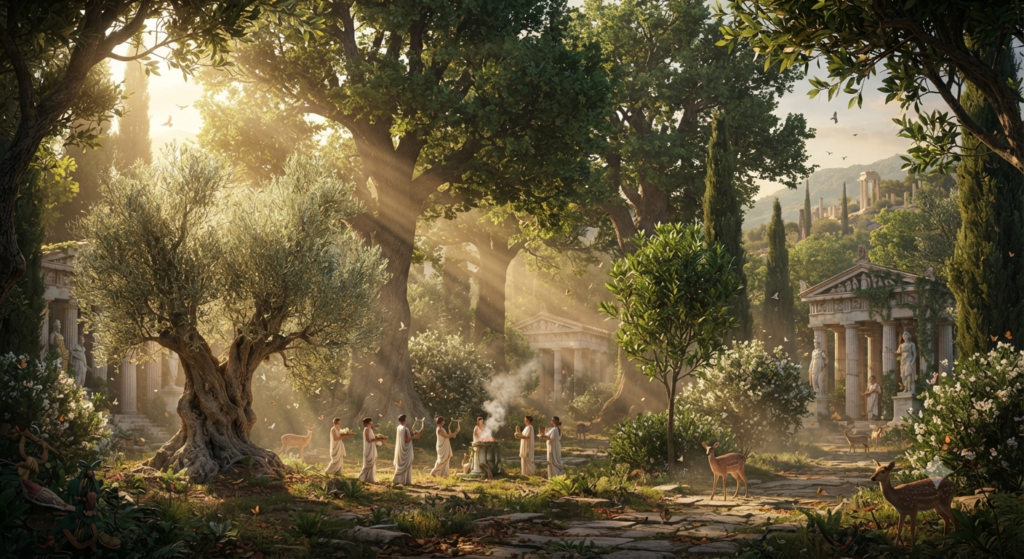
Groves were especially important because they offered enclosure without walls, a natural setting suited to silence, ritual purity, and divine nearness. In epic and hymn, the gods are repeatedly imagined as appearing in wooded places, and sanctuaries often incorporated groves or isolated trees as part of their sacred landscape. The Greek word alsos, meaning grove, could imply not just vegetation but a space set apart.
Their holiness also reflected older Mediterranean and Near Eastern patterns, but the Greeks made those patterns distinctly their own. A grove could be taboo to cut, hunt, or graze in, and violating it risked divine punishment. Such protections appear in various local traditions and in literary accounts of sacrilege, showing that the sacred tree was not only an object of admiration but also of boundary-making. To approach a holy tree was to enter a charged zone where mortal use was limited by divine claim.
The oak of Zeus and Dodona’s oracle
Among all sacred trees in Greek tradition, the oak is the most closely associated with Zeus. At Dodona in Epirus, one of the oldest Greek oracles, Zeus was consulted through the rustling of the sacred oak leaves and the interpretive practices of priests and priestesses. Homer refers to Dodona as the seat of Zeus’s oracle, and later authors preserve the image of the god speaking through the oak’s movement and sound.
The oak fit Zeus well: it was long-lived, strong, and majestic, qualities that matched the king of the gods. In some traditions, the sacred oak at Dodona was the very medium of prophecy, while in others the grove as a whole was holy to Zeus. Ancient visitors did not merely admire the tree; they listened to it. The oak thus became an instrument of divine communication, rooted in earth yet speaking for the sky god.
The laurel of Apollo at Delphi and Delphi
The laurel is the tree most firmly tied to Apollo, especially at Delphi. Greek myth connects Apollo and the laurel through the story of Daphne, who was transformed into a laurel tree to escape him in Ovid’s telling; although this is Roman literature, it reflects and reshapes a Greek association already well established. At Delphi, laurel branches were used in ritual purification, offerings, and prophetic practice, linking the god of the oracle with the tree of inspiration.
Apollo’s laurel was not only symbolic but practical. Priests and supplicants used laurel in ceremonies, and the Pythia’s prophetic world was surrounded by its presence. The tree suggested both divine restraint and victory, which is why laurel crowns later became emblems of honor. In the Delphic setting, the laurel marked Apollo as a god who reveals truth while remaining aloof, his sacred tree fitting a deity of light, measure, and inspired speech.
Olive trees, Athena, and Athens’ sacred gift
The olive tree was sacred above all to Athena and to Athens itself. According to well-known myth preserved by authors such as Apollodorus and Pausanias, Athena won patronage of the city by offering the olive tree, while Poseidon offered a saltwater spring or another maritime gift depending on the version. The Athenians judged Athena’s gift more useful, and the olive became a permanent sign of her favor.
On the Acropolis, the sacred olive was not just a symbol but part of civic religion. Pausanias describes the olive tree there as one of the city’s most revered objects, connected to Athena’s presence and to Athenian identity. Olive oil had enormous practical value in Greek life, used for food, light, sport, and ritual, which made the tree’s sacredness especially fitting. It represented peace, sustenance, and the intimate tie between a goddess and her city.
The cypress and funerary rites in Greek belief
The cypress was strongly associated with death, mourning, and the underworld in Greek and later Greco-Roman tradition. Although its symbolism becomes especially prominent in later literature, the tree’s dark evergreen character made it an apt sign of grief and memorial. In Greek funerary contexts, branches or imagery connected with cypress could signal the presence of death and the need for ritual care.
Its sacred status was therefore different from that of oak or laurel. The cypress was not chiefly a tree of oracle or triumph, but of threshold and remembrance. Because it remains green while other trees wither, it could suggest endurance beyond death, yet also the stillness of the grave. In Greek belief, that stillness was not empty; it belonged to the ordered handling of the dead and to the boundary between the living and the departed.
Poplar and willow in hymns, rivers, and cults
Poplar and willow appear less centrally than oak or olive, but they still belonged to sacred Greek landscapes. The poplar is associated with river gods, nymphs, and heroic memory in various traditions, while the willow often belongs to wetlands, lamentation, and liminal spaces near water. In Homer and later poetry, trees by streams or in sacred groves often carry an aura of divine inhabitation.
These trees mattered because rivers and springs were themselves sacred, and the vegetation around them inherited that character. A willow bending over water suggested transition, movement, and sorrow; a poplar rising near a riverbank evoked a place where nature and cult meet. In hymnic and local religious settings, such trees were not always universal symbols, but they were often sacred by proximity, belonging to the living landscape of a deity, a river, or a nymph.
Pine and the rituals of Dionysian worship
The pine is one of the trees most closely linked to Dionysian worship. Dionysian processions and ritual objects often included the thyrsus, a staff tipped with ivy or sometimes pine cone imagery, and pine appears in several traditions of festive, ecstatic cult. In the world of Dionysus, the pine suits a god of wildness, fertility, and altered boundaries.
Pine also connects to the forested, mountainous spaces where Dionysian rites were imagined to unfold. It is a tree of resin, scent, and endurance, but in ritual it could become part of the god’s untamed energy. Greek sources do not assign the pine the same single, central role that the laurel has for Apollo, yet it clearly belongs to Dionysian sacred imagery, especially where dance, processions, and the life of the thiasos entered wooded terrain.
Fruit trees in divine gardens and local sanctuaries
Fruit trees were sacred when they were tied to divine abundance, local custom, or a particular sanctuary. Figs, pomegranates, apples, and other orchard trees appear in myth as gifts, emblems, or elements of blessed landscapes. Some are linked to goddesses of fertility and the harvest, while others belong to heroic or semi-divine gardens where plenty signifies divine order.
Their sacredness was often practical as well as symbolic. A fruitful tree could represent prosperity blessed by the gods, and in some sanctuaries the care of orchards formed part of the cult’s material life. Greek myth frequently places divine power in cultivated rather than wild settings, showing that holiness could dwell not only in ancient forest groves but in ordered gardens, where human tending and divine favor worked together.
Nymphs, dryads, and the living soul of wood
The fullest spiritual meaning of sacred trees in ancient Greece appears in the figures of nymphs and dryads. Dryads were tree nymphs, often understood as bound to particular trees or woods, and their fate could rise and fall with the life of the tree itself. In mythic imagination, this made wood animate, vulnerable, and personally inhabited.
That belief explains why cutting a holy tree could be treated as a grave offense. If a tree housed a nymph or stood under divine protection, it was more than material; it was part of a living sacred order. Greek myth does not always describe every tree as conscious or divine, but it repeatedly imagines certain trees as ensouled, watched over, and remembered by powers older than human settlement. The sacred tree, then, was never just timber waiting to be shaped. It was a meeting point between earth, god, and story.
Ancient Greece did not honor one single tree as sacred above all others. Instead, it recognized a range of holy trees whose meaning depended on deity, place, and ritual use. The oak belonged to Zeus, the laurel to Apollo, the olive to Athena, and the cypress to death and remembrance, while pine, willow, poplar, and fruit trees occupied their own sacred roles in cult and myth. Together they reveal a religious world in which the natural landscape was never neutral.
To ask what trees were considered sacred in ancient Greece is to see how closely Greek worship was tied to the living environment. Groves could be sanctuaries, branches could carry prayer, and a single tree could embody the presence of a god or a nymph. In that world, holiness grew quietly from the ground up, through bark, leaf, root, and shade.

Orin Vale has spent the better part of two decades tracing the threads that connect the world’s oldest stories — from the halls of Asgard to the banks of the Nile, from Olympus to the jungles of the Maya. What began as a childhood fascination with flood myths and trickster gods grew into years of independent study across comparative mythology and ancient religion, always chasing the same question: what did these stories mean to the people who first told them? Orin writes for readers who want more than trivia — the ones looking for the beliefs, fears, and truths that myths were built to carry.