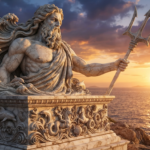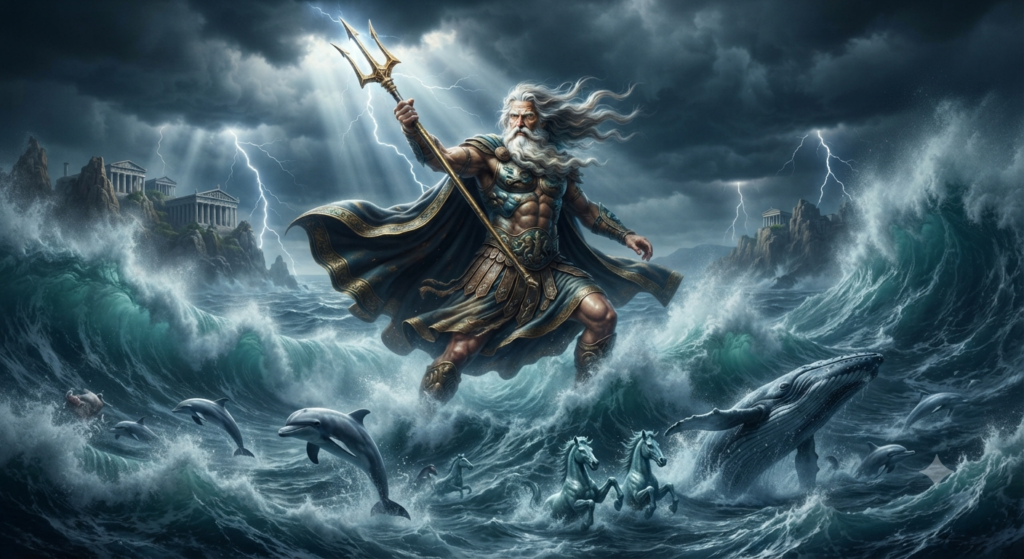
Poseidon’s trident, called Neptune’s trident in Roman tradition, is one of the most enduring symbols in classical mythology. It belongs to the sea god of the Greeks and Romans, a deity whose authority extended over the waters, storms, horses, and the hidden shocks of the earth. More than a simple weapon, the trident marks Poseidon as a ruler whose power is immediate and elemental, able to stir waves, split stone, and assert divine will in the mortal world. In Greek and Roman art, literature, and cult, the three-pronged spear became the visual shorthand for his sovereignty.
Poseidon and Neptune in Greek and Roman myth
In Greek myth, Poseidon is one of the great Olympian gods, the brother of Zeus and Hades and a son of Cronus and Rhea. After the overthrow of the Titans, the three brothers divided the cosmos by lot: Zeus received the sky, Hades the underworld, and Poseidon the sea. His Roman counterpart, Neptune, was originally an older Italic water deity who was later identified with Poseidon and absorbed many of his traits. Although Roman religion gave Neptune his own local character, classical literature and art largely merged the two figures into a single sea god.
The trident belongs to this shared divine identity. In both traditions, it signifies mastery over the marine realm and the dangers that come with it. The weapon is not just an accessory placed in the god’s hand by artists; it is a mark of office, a visible sign that this deity commands the deep. Because Poseidon could appear as both benefactor and destroyer, the trident captures the dual nature of his rule: it can guide, strike, and transform.
The trident as a sign of divine authority
In classical iconography, gods are often identified by their attributes, and Poseidon’s trident functions much like Zeus’s thunderbolt or Athena’s helmet and spear. It is a badge of authority before it is a weapon. Ancient viewers would have recognized the trident as a symbol of dominion over the sea, much as a king’s staff or scepter signifies rule among humans. The three-pronged design makes the implement distinctive and memorable, reinforcing Poseidon’s status as a god whose power is both ancient and unmistakable.
Literary sources also present the trident as an instrument of command. In myth, Poseidon does not merely wield it in combat; he uses it to assert his will upon the landscape and the waters. This association with authority extends beyond narrative into cult and civic imagination. Seafaring peoples, coastal cities, and island communities could see in the trident a symbol of the forces that governed their fortunes, whether through safe passage or ruinous storms.
Sea storms, earthquakes, and the god’s power
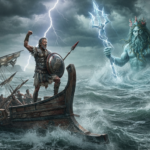
Poseidon was not only the lord of the sea but also a god associated with earthquakes, earning the epithet “Earth-Shaker” in Homer. The trident expresses this connection vividly. In myth, when Poseidon strikes the earth or sea with his weapon, the result can be waves, fissures, or violent upheaval. The instrument becomes a visible explanation for natural force, a divine cause for events that ancient people experienced as sudden and overwhelming.
This association helps explain why the trident was feared as much as it was honored. Sailors depended on Poseidon’s favor, but they also knew that the same power that calmed the waters could raise tempests. In epic and later mythography, the god’s trident stands for a universe in which the sea and the ground beneath it are not stable, passive elements, but realms responsive to divine action. The symbol therefore captures both movement and danger, the two qualities most closely tied to his cult.
How the trident shaped maritime symbolism
Because Poseidon governed the seas, his trident naturally became a maritime symbol across the ancient Mediterranean. It appears on coins, mosaics, pottery, and reliefs, especially in contexts connected to ports, naval power, or sea travel. For communities dependent on commerce and fishing, the image of the trident could stand for protection, abundance, and the unpredictable conditions of maritime life. It was a compact visual language for the entire relationship between humans and the sea.
The trident also influenced later seafaring symbolism well beyond antiquity. In modern heraldry and decorative art, it continues to evoke the ocean, maritime authority, and naval strength. Its persistence owes much to the clarity of the classical image: a single object that immediately calls to mind Poseidon’s realm. Even where the religious meaning has faded, the trident still carries the old associations of force, depth, and command over waters that cannot be fully controlled.
Poseidon’s weapon in Homeric and Hesiodic epics
Homer and Hesiod establish the core of Poseidon’s mythic identity, even when they do not dwell extensively on the trident as a physical object. In the Iliad and Odyssey, Poseidon repeatedly intervenes with dramatic force, shaking the earth, stirring the sea, and opposing human plans. The epic poems present him as a god whose power is active, immediate, and often terrifying, the kind of deity for whom a weapon of striking and splitting is entirely fitting.
Hesiod’s Theogony situates Poseidon within the cosmic order after the Titanomachy, giving him a formal place among the Olympians. Later ancient writers and visual traditions make explicit what epic often implies: the trident is the emblem through which his force is recognized. In Apollodorus and other mythographers, the weapon becomes more fully defined as the god’s characteristic tool, integrating literary tradition with the visual culture of the ancient world.
Roman Neptune and the spread of the trident
When Neptune was identified with Poseidon, the trident traveled into Roman religious and artistic life. Roman writers such as Ovid describe Neptune in ways that reflect the Greek model, emphasizing his rule over water and his capacity for sudden intervention. The trident thus moved across linguistic and cultural boundaries, becoming part of a shared classical vocabulary. In the Roman world, it appeared not only in mythic scenes but also in public art and imperial imagery.
The spread of Neptune’s trident was tied to the expansion of Roman power across the Mediterranean. As Rome became a maritime empire, the sea god’s symbolism acquired political resonance. The trident could suggest naval dominance, safe passage, and the reach of Roman authority over waters once controlled by other peoples. This adaptability helped the symbol endure: it could belong equally to myth, cult, and state imagery without losing its essential association with the sea god.
The trident in contests for cosmic rule
Several myths of divine conflict sharpen the meaning of Poseidon’s trident by placing it within struggles for power. Although Zeus usually holds the thunderbolt as his signature weapon, Poseidon’s trident appears as a parallel mark of sovereignty, one suited to a god whose domain is a major division of the cosmos. In the division of the world among the Olympians, the weapon reflects not just sea power but a legitimate share in universal order.
There are also myths in which Poseidon contests authority with other gods or heroes, and the trident helps frame these encounters as acts of divine claim. In the rivalry over Athens, for example, Poseidon’s blow with the trident creates a salt spring or sea-water source on the Acropolis in some versions, while Athena offers the olive tree. The story is not simply about a gift contest; it shows how Poseidon’s tool can mark territory, establish presence, and express a god’s right to a place.
Myths of creation, fountains, and sacred springs
The trident is sometimes linked to acts of creation or transformation, especially in stories involving water sources. Ancient authors preserve variants in which Poseidon strikes the ground and brings forth a spring, fountain, or saltwater pool. The best-known example is the Acropolis myth of Athens, though other local traditions also connect him with wells, coastal openings, and miraculous waters. These stories show the trident as more than a destructive implement; it can also open the earth and release hidden moisture.
Such myths reflect a broader ancient understanding of water as a sacred and liminal element. Springs and fountains were often associated with divine presence, and the trident’s ability to summon water from stone reinforces Poseidon’s role as a god who governs not only the open sea but also its sources and outlets. The image is potent because it merges geology, sacred geography, and divine agency into one act of striking power.
Worship, votive images, and temple iconography
Poseidon’s trident was widely represented in ancient worship. Votive offerings, reliefs, painted vessels, and temple decorations frequently depicted the god with his three-pronged spear, making the symbol part of religious devotion as well as storytelling. In sanctuaries near the sea, the image would have had particular force, reminding worshippers that the god’s favor mattered to navigation, fishing, and coastal life. Pausanias, among other ancient observers, records sacred sites where Poseidon’s presence was prominent in local ritual memory.
Temple iconography often emphasized the trident because it offered immediate recognition. The object could be shown alone, held upright, or placed in the god’s hand alongside horses, dolphins, or other marine symbols. Its repeated use across different media suggests that ancient people did not regard it as a mere artistic convention. It was a concentrated symbol of divine power, one that linked cult practice to mythic narrative and to the practical realities of life beside the sea.
Why the trident remains Poseidon’s emblem
The trident remains Poseidon’s defining emblem because it gathers many strands of his character into one image. It recalls his rule over the sea, his power over storms and earthquakes, his place among the Olympians, and his ability to strike the world into motion. Few mythological symbols are as concise or as enduring. The three-pronged weapon is visually distinctive, but its strength lies in the meanings it carries: authority, danger, sovereignty, and elemental force.
Even in modern culture, the trident still reads instantly as the sign of the sea god. That endurance comes from the clarity of the ancient sources and the consistency of classical art, which fixed Poseidon and Neptune together in the imagination of later ages. The symbol has survived because it is not merely decorative. It expresses a mythic truth at the heart of the old stories: the sea is ruled, but never tamed, and the god who governs it does so with a power as deep and unpredictable as the waters themselves.
Poseidon’s trident is significant because it is both a weapon and a symbol of rule. In myth, it marks the sea god as a sovereign force over waters, earthquakes, and sacred springs; in art and worship, it became the most recognizable sign of his identity. From Homer and Hesiod to Roman Neptune and later maritime imagery, the trident has endured as a compact expression of divine power, one that still carries the weight of the ancient Mediterranean imagination.

Orin Vale has spent the better part of two decades tracing the threads that connect the world’s oldest stories — from the halls of Asgard to the banks of the Nile, from Olympus to the jungles of the Maya. What began as a childhood fascination with flood myths and trickster gods grew into years of independent study across comparative mythology and ancient religion, always chasing the same question: what did these stories mean to the people who first told them? Orin writes for readers who want more than trivia — the ones looking for the beliefs, fears, and truths that myths were built to carry.