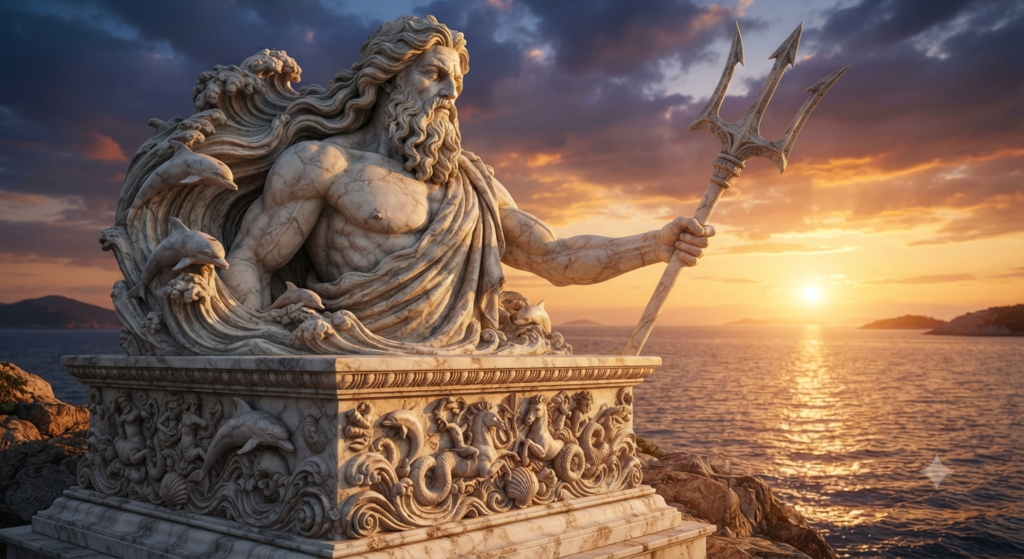
A Greek statue of Poseidon typically presents the sea god as a powerful, mature male figure, often standing in the same heroic visual language used for Zeus but marked by attributes of the ocean. In classical art, Poseidon is not usually shown as a monstrous force of nature; instead, he appears as a restrained, idealized deity whose authority is conveyed through his beard, muscular body, and the trident that identifies him at a glance. Because ancient artists worked across different periods and regions, no single image is universal, but certain features recur so often that they form the standard visual tradition of the god of the sea, earthquakes, and horses.
Poseidon in Greek Sculpture and Mythic Iconography
In Greek myth, Poseidon is one of the great Olympian gods, brother of Zeus and Hades, and ruler of the sea after the division of the cosmos. Sculptors represented him in ways that communicated that rank: not as a youthful sailor, but as an ancient, sovereign force. His image overlaps strongly with that of Zeus, since both gods may appear as bearded, commanding men of mature age, yet Poseidon is distinguished by maritime symbols, especially the trident.
Classical iconography usually presents Poseidon as calm, self-possessed, and physically commanding. He is rarely shown in the manner of a local river deity or a minor nymphal figure; instead, he carries the bearing of a god whose domain is vast and untamed. This visual tradition can be seen in temple sculpture, vase painting, reliefs, and later Roman copies of Greek originals, where his identity is established through both form and attribute.
The Sea God’s Beard, Hair, and Stern Expression
A typical statue of Poseidon shows a full, often wavy beard and long hair, both rendered to suggest age, strength, and divine authority. Ancient sculptors favored thick curls that could resemble the motion of waves, a subtle visual link between the god’s body and the sea itself. His hair and beard are usually more abundant than those of younger gods, reinforcing the sense of an ancient ruler rather than a youthful athlete.
His expression is generally solemn or stern. Poseidon is not commonly portrayed as smiling or softened by intimacy; even when calm, his face tends to carry a forceful gravity. That severity suits his mythic role, since he is a god associated not only with the sea’s bounty but also with storms, earthquakes, and sudden upheaval. In sculpture, this sternness becomes part of the god’s authority.
Trident, Fish, and Marine Symbols in Hand
The trident is the clearest and most essential marker of Poseidon in Greek sculpture. In myth, it is the emblem of his power over the sea, and in art it functions almost as a visual signature. When a statue preserves the original composition, the trident is often held upright in one hand or angled beside the body, instantly separating Poseidon from Zeus, Hades, or other bearded gods.
Other marine symbols may appear, though less consistently. Fish, dolphins, shells, or seaweed motifs sometimes accompany the god, especially in decorative reliefs or later works that expand the maritime theme. Yet the trident remains the central attribute in classical tradition. Without it, a statue may resemble a generic Olympian male; with it, the figure becomes unmistakably Poseidon.
Muscular Build and the Idealized Male Body
Poseidon is typically sculpted with the idealized physique of a Greek god: broad shoulders, a strong chest, defined abdomen, and powerful limbs. This body reflects the classical preference for divine masculinity as perfected human form, not exaggerated or grotesque anatomy. The god’s strength is expressed through proportion and balance rather than through extreme bulk.
Because Poseidon governs immense natural forces, his body often suggests latent energy rather than raw violence. He stands as an athlete, warrior, and cosmic sovereign at once. Greek sculptors used that idealized body to show that a god’s power is beautiful as well as dangerous, and Poseidon’s physique belongs fully to that artistic language.
Drapery, Nudity, and the Classic Marble Poseidon
Many statues of Poseidon are nude or nearly nude, following the classical convention for gods whose power is displayed through the male body itself. Nudity in Greek art does not imply vulnerability; rather, it conveys timeless excellence, heroic scale, and divine confidence. A nude Poseidon can appear especially severe and monumental, with the trident providing the only necessary clue to his identity.
Other images show him partially draped, often with a cloak gathered around the hips or thrown across one shoulder. Such drapery can create a sense of motion and dignity, especially in marble copies where folds help animate the figure. The balance between nudity and cloth varies by period and workshop, but in both cases the sculptor seeks to emphasize the god’s commanding presence.
Poseidon’s Pose: Stride, Stance, and Gesture
Poseidon is often shown in a stable, upright stance, though some statues give him a forward stride that suggests movement and mastery of the space around him. A common formula is the contrapposto pose, with the weight resting on one leg and the other relaxed, creating a quiet but forceful rhythm in the body. This stance suits a deity who controls motion without being disordered by it.
His gesture may be restrained, but it usually implies power. One arm can be raised to support the trident, while the other may hang at the side or extend outward in a gesture of command. Even in stillness, the pose often suggests imminent action, as if the sea god could summon waves or shake the earth with a single movement.
Bronze Originals and Marble Copies of the God
Many celebrated Greek statues of Poseidon were originally cast in bronze, a material prized for its strength, detail, and ability to capture extended limbs and dramatic balance. Bronze suited a god associated with open space, since it allowed sculptors to create more dynamic poses with less structural support than marble. Unfortunately, many bronze originals are lost, and what survives today is often known through later copies or literary references.
Marble copies, made in Greek and especially Roman times, preserve much of the iconography of these originals, though sometimes with adaptations required by the material. A marble Poseidon may have added supports, altered proportions, or slightly softened details, yet the essential identity remains the same. These copies are crucial for understanding how classical audiences may have seen the god in temples and public spaces.
Sea Horses, Dolphins, and Other Accompanying Motifs
Because Poseidon is also the god of horses, statues sometimes incorporate equine imagery alongside maritime symbols. In myth, he is deeply linked to horses, and ancient artists occasionally reflected that connection through paired motifs or by placing him near hippocamps, sea-horses, or related creatures. This dual identity, lord of sea and horse, is one of the most distinctive features of his cult and image.
Dolphins are another common companion symbol, especially in decorative contexts. They reinforce the aquatic aspect of the god without changing the basic sculptural formula. In some works, the surrounding relief or base may include waves, shells, or marine fauna, turning the statue into a broader statement about Poseidon’s dominion rather than a single isolated figure.
Regional Differences in Greek Statues of Poseidon
Poseidon’s image was not identical throughout the Greek world. In Athens, Corinth, the Peloponnese, and coastal sanctuaries, local traditions could influence whether he appeared more martial, more nautical, or more closely aligned with civic identity. In some places he was honored as an earthquake god or a patron of horses as much as a sea deity, and those emphases could affect artistic choices.
Regional variation also appears in style. Archaic representations can be more rigid and formal, while Classical works favor naturalism and controlled movement. Hellenistic and Roman adaptations may heighten drama, emotion, or decorative richness. Even so, the god remains recognizable across these differences because the essential visual markers endure: beard, trident, mature physique, and a presence that feels older than the coastline itself.
How Worship and Art Shaped Poseidon’s Image
Poseidon’s sculptural image grew out of worship as much as myth. In sanctuaries, his statues did not merely decorate space; they embodied divine presence, offering worshippers a visible form through which to approach the god. This sacred function encouraged artists to maintain a stable iconography, because a recognizable Poseidon served both ritual and civic needs.
At the same time, mythology gave artists a rich but focused repertoire. The sea god’s control over waters, earthquakes, and horses allowed sculptors to connect him with power, motion, and force without abandoning the classical ideal of proportion. That is why a Greek statue of Poseidon typically looks like a mature, muscular, bearded god holding a trident, poised between calm authority and the immense, unsettled energy of the sea.
The result is one of the most enduring images in Greek art: a divine ruler whose body is as disciplined as the world he commands is wild. Whether rendered in bronze, marble, or relief, Poseidon’s standard form joins beauty and power, making his statue instantly recognizable even when the surrounding details vary from one sanctuary or region to another.

Orin Vale has spent the better part of two decades tracing the threads that connect the world’s oldest stories — from the halls of Asgard to the banks of the Nile, from Olympus to the jungles of the Maya. What began as a childhood fascination with flood myths and trickster gods grew into years of independent study across comparative mythology and ancient religion, always chasing the same question: what did these stories mean to the people who first told them? Orin writes for readers who want more than trivia — the ones looking for the beliefs, fears, and truths that myths were built to carry.