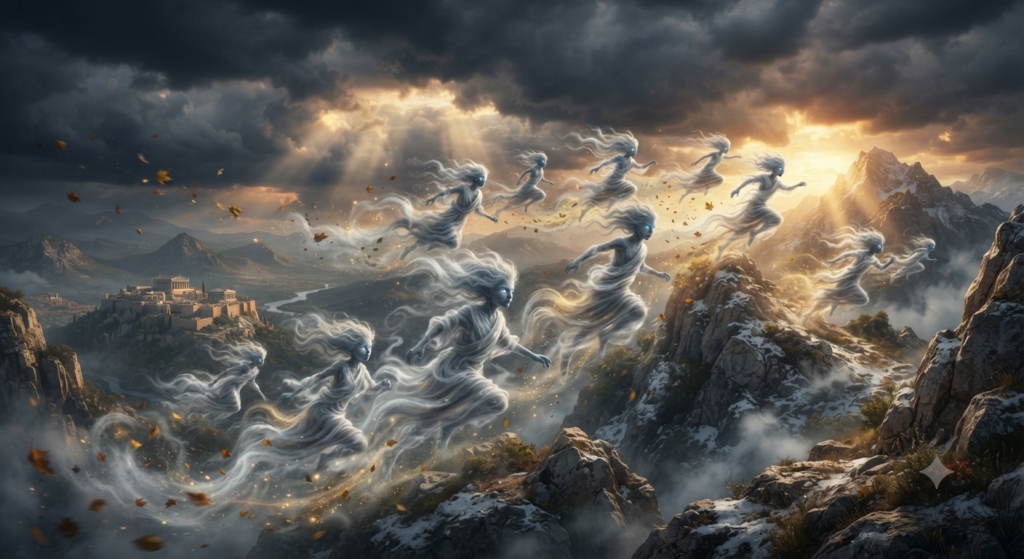
The Ekdromoi are a shadowy and little-attested name in Greek myth, usually discussed as minor wind spirits rather than as one of the great, personified winds of the Greek world. Unlike the well-known Anemoi—Boreas, Zephyrus, Notus, and Eurus—the Ekdromoi do not stand out in surviving literature as fully formed gods with clear myths, parentage, or cults. What remains is a faint but intriguing trace in the broader Greek habit of imagining winds, gusts, and local atmospheric powers as living daimones that moved through mountains, coasts, and open places.
Ekdromoi and the minor wind spirits of Greece
The Ekdromoi belong to the large, flexible world of Greek wind daimones, beings that were not always treated as major deities but were still understood as forces with agency. In Greek religion, the boundary between “god,” “spirit,” and “personified natural power” was often fluid. A wind could be the work of a named Olympian or the action of a lesser, local power. The Ekdromoi fit best into that second category: less a single grand mythic personality than a class of atmospheric spirits remembered in fragments and later discussion.
Because the evidence is so sparse, the Ekdromoi are better approached as part of a mythic pattern than as a character with a fixed biography. Greek tradition repeatedly populated the landscape with divine presences tied to movement in nature: breezes, storm fronts, sudden gusts, and the strange voices of places where air rushes through rock and forest. The Ekdromoi likely belonged to that imaginative field, where winds were not merely weather but signs of living forces moving across the world.
Meaning of the name Ekdromoi in ancient Greek
The name Ekdromoi is usually connected with Greek language forms suggesting something that “runs out,” “rushes forth,” or “comes streaming out.” That etymological sense suits wind spirits well, since gusts appear suddenly, almost as if they have burst from a hidden place. In ancient Greek, names often carried descriptive force, and a term like this would have sounded vivid and physically immediate to ancient listeners.
Even so, the name itself does not give us a complete mythology. It tells us how the spirits were imagined to behave more than who they were. Greek naming conventions for lesser divine beings often emphasized function, movement, or locality rather than elaborate genealogy. In that respect, the Ekdromoi resemble many other minor powers in Greek religion: their identity lies in what they do, not in an extended story preserved by epic poets.
Wind daimones and their place in myth
Greek mythology is full of daimones—spirits or powers that are not quite mortal and not always the same as the great gods. These beings could be protective, dangerous, or simply part of the unseen texture of the world. Wind daimones belonged to this category of half-visible power. They were felt in weather, heard in trees and ravines, and invoked in practical life by sailors, farmers, and travelers who depended on the sky’s moods.
The Ekdromoi, as minor wind spirits, belong to this diffuse spiritual landscape. They are part of a world where nature is animated at many levels at once. A violent gale might be understood through the action of the Anemoi, while a local draft funneling through a pass or cliff could be attributed to lesser spirits. This layering of divine explanation is typical of Greek thought and helps explain why so many small atmospheric beings could coexist beside the major wind gods.
Ekdromoi in relation to the Anemoi
The Anemoi are the famous wind gods of Greek myth, each associated with a cardinal direction and a recognizable seasonal character. Boreas, Zephyrus, Notus, and Eurus appear in art and literature with far greater clarity than the Ekdromoi ever do. If the Anemoi are the grand, named rulers of wind, the Ekdromoi are best understood as lesser attendants or local manifestations of the same elemental force.
Ancient Greek religion did not always insist on a single, exclusive explanation for natural phenomena. A storm could be attributed to a major god, a local daimon, or a cluster of forces working together. In that framework, the Ekdromoi may represent a more intimate and regional level of wind belief, while the Anemoi embody the larger, pan-Hellenic system of personified winds. The distinction is important: the Anemoi are mythic figures with strong literary identities, whereas the Ekdromoi remain obscure and secondary.
Ancient sources and the silence around them
One of the most striking things about the Ekdromoi is how little the major ancient sources say about them. Homer, Hesiod, Apollodorus, and Ovid do not give them the kind of prominent role that later readers might expect from a named mythic group. That silence does not prove they were unimportant in all contexts, but it does show that they never entered the mainstream literary canon in the way the principal winds did.
This kind of silence is common with minor spirits in Greek tradition. Many local or functional beings were part of religious life without becoming major poetic subjects. What survives may come from later lexicographical references, scholarly glosses, or modern reconstruction based on Greek naming patterns and related beliefs. For the Ekdromoi, the surviving record is thin enough that caution is essential: they should be described as obscure wind spirits rather than as a well-documented divine family.
Regional cults, weather lore, and local belief
Greek religion was deeply local, and weather lore often reflected the experience of a specific valley, harbor, or mountain road. A community living with sudden coastal winds or dangerous upland gusts would naturally imagine such forces as alive. The Ekdromoi make sense within that environment, even if the surviving texts do not preserve a full cultic picture. They fit the Greek tendency to name and respect the particular character of a place’s weather.
In practical terms, such spirits would have belonged more to custom and local understanding than to formal temple cult. Sailors, shepherds, and travelers were all dependent on the wind’s behavior, and local belief often translated that dependence into divine language. Whether the Ekdromoi had sacrifices, prayers, or dedications of their own is not securely attested, but their imagined domain would have overlapped with the everyday experience of communities living close to harsh and changeable landscapes.
Nature spirits on ridges, coasts, and passes
Greek imagination often placed spirits in threshold spaces: mountain ridges, narrow passes, sea cliffs, and exposed promontories. These are places where air moves visibly and powerfully, where the world seems open to the force of the sky. Minor wind spirits like the Ekdromoi belong naturally to such settings. They are less at home in stable interior spaces than in the edges and openings of the terrain.
This geographic logic matters. Ancient myth often explained a place by giving it an inhabiting presence. A pass that whistled in winter, a coast that caught sudden squalls, or a ridge that seemed to release gusts from hidden chambers could all be interpreted as the dwelling or pathway of a spirit. The Ekdromoi, if understood in this light, become part of a broader Greek sensibility that treated landscape and divinity as inseparable.
Greek wind nymphs, daemons, and hybrids
Greek tradition does not always keep wind beings in neat categories. Some are male, some female, some more like nymphs, and some exist as vague daemonic powers. The line between a wind spirit and a nymph can blur, especially when local cult and poetic imagination overlap. While the Ekdromoi are usually treated as spirits rather than nymphs, they belong to the same wide family of hybridized natural beings that fill Greek myth.
This flexibility is one reason Greek weather deities remain so varied. A breeze might be personified as a beautiful attendant, a dangerous force, or an unnamed spirit moving through the air. In later literature and regional belief, these categories could mingle freely. The Ekdromoi stand at that borderland, not fully grand enough to be Olympian, yet more than a mere metaphor for wind.
Distinguishing Ekdromoi from named wind gods
It is important not to confuse the Ekdromoi with the better-attested wind gods of Greece. The named Anemoi have myths, iconography, and wider recognition in ancient art and literature. The Ekdromoi do not occupy that same space. They are not simply another set of directional winds, nor are they interchangeable with Boreas or Zephyrus. Their obscurity is part of their identity.
This distinction matters for accuracy. Many modern retellings flatten Greek divine beings into a few famous names, but ancient belief was far richer and more layered. The Ekdromoi, if discussed at all, should be placed among the lesser atmospheric powers that surrounded the famous gods. They are a reminder that Greek myth was not only a gallery of major figures, but also a living ecology of secondary spirits, regional powers, and half-named presences.
Legacy of the Ekdromoi in later scholarship
The Ekdromoi have had a modest afterlife in modern scholarship, where they are sometimes mentioned in discussions of Greek wind lore, local daimones, or the broader problem of fragmentary divinity in ancient religion. Because the sources are limited, scholars tend to treat them cautiously, noting that their exact status cannot be reconstructed with confidence. That caution is appropriate, since overconfident claims quickly outrun the evidence.
Still, their obscurity itself has value. The Ekdromoi show how much of Greek religion lived outside the great literary texts. They invite readers to think beyond famous gods and toward the smaller presences that shaped ancient experience of weather and place. In that sense, the Ekdromoi remain compelling not because they are richly narrated, but because they stand at the edge of what can still be glimpsed from the ancient record.
The Ekdromoi are one of those elusive names that reveal the depth of Greek myth by their very scarcity. They remind us that ancient religion was not limited to the famous Olympians or the winds named in epic, but included local, functional, and often unnamed powers that gave shape to the natural world. As minor wind spirits, the Ekdromoi belong to that quieter layer of belief, where landscape, weather, and divine presence continually overlap.

Orin Vale has spent the better part of two decades tracing the threads that connect the world’s oldest stories — from the halls of Asgard to the banks of the Nile, from Olympus to the jungles of the Maya. What began as a childhood fascination with flood myths and trickster gods grew into years of independent study across comparative mythology and ancient religion, always chasing the same question: what did these stories mean to the people who first told them? Orin writes for readers who want more than trivia — the ones looking for the beliefs, fears, and truths that myths were built to carry.