Perseus is one of the great heroes of Greek myth, remembered as the son of Zeus and Danaë, the slayer of Medusa, and the rescuer of Andromeda. He belongs to the heroic age that links divine intervention, perilous quests, and the founding of noble lineages. In the surviving myths, Perseus is both a wonder-working survivor and a royal figure whose deeds shaped later Greek stories.
Perseus in Greek Myth: hero, prince, slayer
Perseus stands among the most famous heroes of Greek tradition because his story combines birth from divine power, exile, monster-slaying, and kingship. In the oldest surviving accounts, he is not merely a warrior but a prince of Argos, or in some versions of Seriphos, whose life is shaped by prophecy and the unpredictable will of the gods. His most celebrated deed is the killing of Medusa, the only mortal Gorgon, an act that marks him as one of the great monster-slayers of myth.
He is also remembered as a founder figure in Greek legend. Later traditions connect him to cities, dynasties, and heroic descendants, including the lineage that culminates in Heracles. Ancient writers present him as a model of a hero favored by divine aid, though not without suffering and danger. The myth of Perseus survives because it is both a personal adventure and part of a wider web of Greek memory.
Danaë, Zeus, and the prophecied golden child
Perseus was the son of Danaë, daughter of Acrisius, king of Argos. According to the tradition preserved by Apollodorus and others, Acrisius had been warned by an oracle that he would die at the hands of his daughter’s son. In response, he shut Danaë away, sometimes described as being sealed in a bronze chamber, hoping to prevent any child from being born. The myth places human fear directly against divine determination.
Zeus nevertheless came to Danaë in the form of golden rain, and from that union Perseus was conceived. The image of the golden child became one of the most enduring scenes in Greek art and literature, though the exact manner of Zeus’s approach varies in later retellings. Danaë and her infant son were eventually cast into the sea in a chest, a grim act meant to remove the threat while preserving the appearance of piety. The gods, however, had already set the story in motion.
Acrisius and the attempt to avert fate
Acrisius’s actions belong to a familiar pattern in Greek myth: the attempt to escape fate only helps bring it about. Rather than killing Danaë outright, he chose confinement and then exile by sea, as if distance could defeat prophecy. Classical myth often treats this kind of resistance as futile, not because the characters lack intelligence, but because destiny in Greek thought is not easily evaded by force or caution.
Danaë and Perseus survived when the chest washed up on the island of Seriphos, where they were rescued by Dictys, a fisherman in the standard version of the tale. Dictys protected them and raised Perseus at his household. His brother, Polydectes, ruled the island and later became the force that set Perseus on his famous quest. The shift from royal paranoia to island refuge is one of the myth’s great transitions, moving Perseus from endangered child to future hero.
The quest for Medusa and the Gorgon’s head
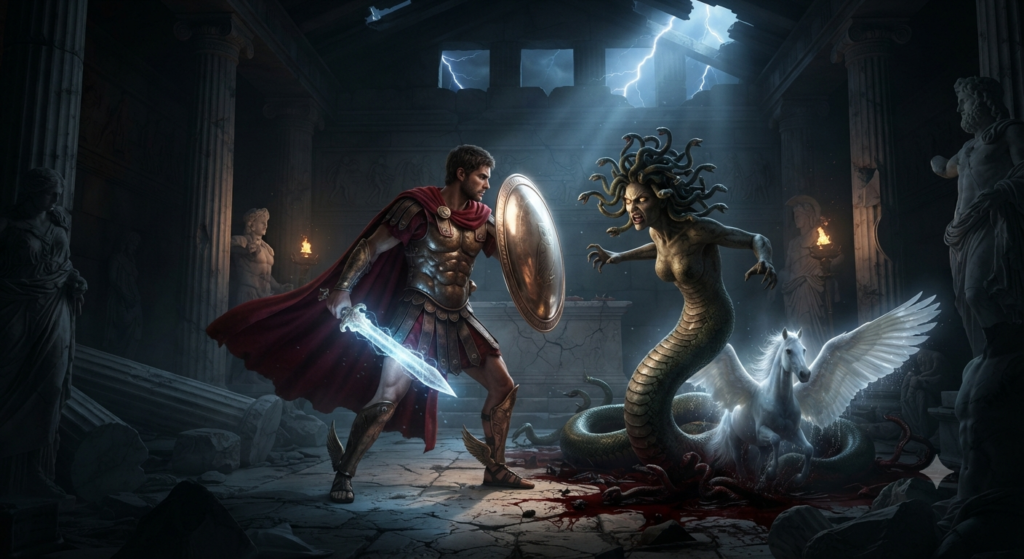
Perseus was eventually sent on the impossible task of bringing back the head of Medusa, one of the three Gorgons. In mythic terms, this is the central ordeal of his life. Medusa alone was mortal, while her sisters Stheno and Euryale were immortal; this detail appears in sources such as Hesiod and later mythographers. The Gorgon’s gaze turned living beings to stone, making direct combat impossible.
The mission was often presented as a cunning test designed by Polydectes, who wanted Perseus removed from Seriphos. Yet the task became real heroism through the intervention of divine helpers and Perseus’s own resolve. Ancient sources differ somewhat in how the journey unfolds, but they agree that the slaying of Medusa required supernatural guidance and exceptional caution. The act produced not only victory, but also lasting symbols: the head, the winged sandals, and the mirrored shield all became part of Perseus’s identity.
Athena, Hermes, and the gifts of the gods
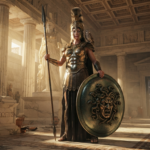
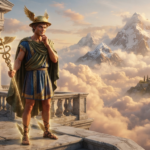
Athena and Hermes are the main divine allies in the most familiar versions of Perseus’s quest. Athena provides guidance and, in some accounts, the polished shield that allows Perseus to see Medusa’s reflection rather than her direct gaze. Hermes gives him the sickle or sword needed for the killing, along with directions that lead him toward the Graeae and the Gorgons. These gifts make clear that Perseus’s success is inseparable from divine favor.
Before reaching Medusa, Perseus also encounters other magical figures and receives further tools in some versions of the myth. The nymphs provide the kibisis, the magical bag for carrying the severed head, and sometimes the cap of invisibility and winged sandals are included among the divine gifts. The story exists in several ancient tellings, especially in Apollodorus and Ovid, and the precise sequence can vary. What remains constant is the blend of strategy and divine assistance, which distinguishes Perseus from a purely martial hero.
Andromeda, the sea monster, and rescue
On his return journey, Perseus encountered Andromeda, who was chained to a rock as a sacrifice to a sea monster. The story is most fully known from later literary retellings, including Ovid, though it rests on older mythic material. Andromeda had been offered to appease a divine punishment sent against her family or land, depending on the version. Perseus fell in love with her and offered to rescue her if he could marry her afterward.
Perseus defeated the monster in different ways across the tradition, sometimes by sword, sometimes by showing Medusa’s head and turning it to stone. After the rescue, he claimed Andromeda as his bride, though her betrothal had often been arranged to another man, leading to further conflict. The scene became one of the most beloved in Greek art because it unites danger, love, and miraculous power. It also shows how Perseus’s victory over Medusa continued to shape events long after the Gorgon had died.
Perseus returns with Medusa’s deadly power
The head of Medusa remained deadly after death, and this power defines the second half of Perseus’s myth. On the way back, he used it to punish enemies, including those who had threatened him or opposed his marriage. The Gorgon’s head functioned as both weapon and sacred object, a source of terror even in defeat. In mythic logic, Perseus does not merely carry a trophy; he carries a force that still belongs to the world of monsters and gods.
When he returned to Seriphos, Perseus discovered that Polydectes had continued to trouble Danaë. In the familiar account, he revealed Medusa’s head and turned Polydectes to stone, ending the king’s abuse of power. The fate of Dictys is more peaceful: in some traditions, Perseus rewards him by making him king of the island. This contrast between the tyrant and the benefactor is central to the moral shape of the myth, even though Greek myth usually presents it through action rather than explicit lesson.
The fate of Polydectes and Dictys in myth
Polydectes is remembered as the figure whose cruelty made Perseus’s return necessary. Ancient sources do not always agree on his exact character, but he is typically portrayed as a ruler who desired Danaë and used Perseus’s absence to advance his own ends. His transformation into stone by Medusa’s head is one of the most fitting punishments in myth, since the weapon he helped set in motion returns to judge him. In this way the monster’s power survives as an instrument of justice.
Dictys, by contrast, appears as a hospitable and protective man. He shelters Danaë and Perseus, and in some versions of the story Perseus later honors him with the kingship of Seriphos. This pairing of figures reflects a recurring Greek pattern: the righteous helper is rewarded, while the greedy ruler is destroyed. The myth’s island setting also gives it a distinctive texture, placing royal drama in a small maritime world where hospitality, kinship, and power are closely bound together.
Perseus in ancient sources and later retellings
The myth of Perseus appears in several important ancient sources, each preserving different emphases. Hesiod refers to Perseus in genealogical and heroic contexts, while Apollodorus offers one of the clearest prose summaries of the full story. Ovid’s Metamorphoses gives the tale a more literary and dramatic form, especially in the scenes involving Medusa and Andromeda. Pausanias also preserves local traditions and regional associations that show how widely the hero was remembered.
Later retellings expanded the myth into new artistic and literary forms. Hellenistic poets, Roman authors, vase painters, sculptors, and later European artists all adapted Perseus to their own needs. Some versions stress his nobility, others his cleverness, and others the wonder of divine assistance. While details shift from source to source, the core remains stable: a threatened child becomes a heroic prince, destroys Medusa, saves Andromeda, and returns bearing a power that can alter fate.
Perseus’ legacy in Greek legend and art
Perseus left a deep mark on Greek legend as a heroic ancestor and a symbol of divinely aided courage. He was linked to the founding of Mycenae in later tradition and became an important figure in royal genealogies, especially those that connected the old heroic world to later dynasties. His descendants included figures who mattered greatly in Greek mythic history, which helped keep his name alive beyond the adventure itself.
In art, Perseus is instantly recognizable through the severed head of Medusa, the winged sandals, and his encounter with Andromeda. These images gave artists a way to represent motion, danger, and triumph within a single scene. The myth survives because it joins several lasting themes: the pressure of prophecy, the aid of the gods, the defeat of terror, and the fragility of human power before destiny. Perseus remains one of Greek mythology’s clearest examples of a hero shaped by fate but never reduced by it.
The myth of Perseus is a story of prophecy fulfilled, monsters overcome, and divine gifts turned into human victory. It moves from the locked chamber of Danaë to the sea-washed island of Seriphos, from Medusa’s fatal gaze to Andromeda’s rescue, and finally to the fall of a king who thought he could control events. Through every stage, the hero’s life reflects a classic Greek idea: fate may be resisted, but it cannot be escaped.

Orin Vale has spent the better part of two decades tracing the threads that connect the world’s oldest stories — from the halls of Asgard to the banks of the Nile, from Olympus to the jungles of the Maya. What began as a childhood fascination with flood myths and trickster gods grew into years of independent study across comparative mythology and ancient religion, always chasing the same question: what did these stories mean to the people who first told them? Orin writes for readers who want more than trivia — the ones looking for the beliefs, fears, and truths that myths were built to carry.