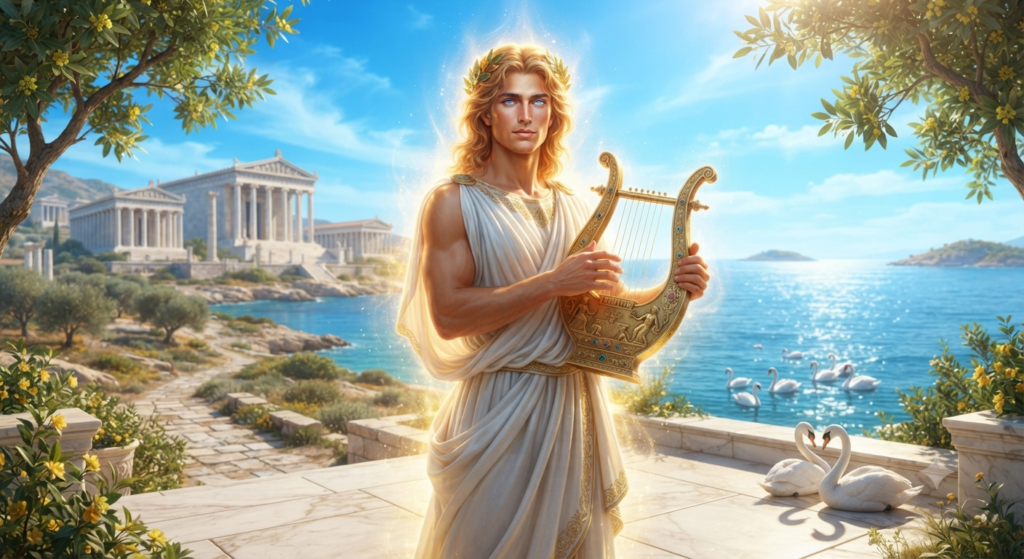
The island of Delos is most closely associated with Apollo, the Greek god of light, prophecy, music, and healing. In the classical tradition, Delos was not merely a place touched by the god’s presence; it was his sacred island, the setting of one of Greek myth’s most important births and the heart of a major cult center in the Aegean. Artemis, his twin sister, is bound to the island as well, but Apollo remains the deity whose name echoes most strongly through Delos’ religious history.
Delos in Greek myth and sacred geography
Delos occupied a special place in the Greek imagination because it was seen as both geographically real and mythically distinct. Unlike many sacred sites that were associated with local heroes or city cults, Delos was regarded across the Greek world as an island set apart by divine purpose. Ancient writers treated it as a place of arrival, refuge, and revelation, where the gods had shaped the landscape itself through birth and oath.
Its importance was not limited to myth. Delos became one of the most respected panhellenic sanctuaries in the Aegean, a shrine recognized by many Greek communities beyond the island itself. This status grew directly from its association with Apollo, whose presence gave Delos a kind of sacred legitimacy that later generations continued to honor in ritual, poetry, and political life.
Apollo and Artemis on the island of Delos
Apollo is the god most firmly linked to Delos, but Artemis belongs there too through the twin birth story. In the standard mythic version, Leto gave birth to Artemis and then Apollo on Delos after wandering in search of a place that would receive her. The island therefore became the setting of divine arrival, and both twins were remembered as having first entered the world there.
Even so, the two deities do not share Delos in quite the same way. Artemis is present in the birth narrative and later cult, yet Apollo becomes the island’s dominant divine figure. Delos was celebrated as his birthplace, his sanctuary, and the center of his worship, while Artemis’ role remains closely tied to the drama of the twins’ birth rather than to the island’s long-term religious identity.
Why Apollo is tied to Delos most closely
Apollo’s bond with Delos is stronger than that of any other god because the island was identified as the place where he first appeared among mortals and immortals alike. In Greek myth, birthplace often carried lasting power, and for Apollo that power was immense. As a god of order, clarity, and sacred music, he fit naturally with an island that was imagined as clean, protected, and set apart from ordinary life.
The association was reinforced by cult practice. Delos was not just remembered as Apollo’s birthplace; it became one of the principal centers of his worship. Offerings, hymns, and festivals all treated the island as his own domain, and this long ritual history made Apollo the definitive divine presence of Delos in both local and wider Greek tradition.
Leto’s refuge and the birth at Delos
The myth of Leto’s refuge explains why Delos became so sacred. According to the tradition preserved in sources such as the Homeric Hymn to Apollo, Leto wandered in labor while Hera barred her from giving birth on firm land. At last, Delos received her, and in return the island gained everlasting honor as the birthplace of her children.
Different authors preserve variations in the story, but the core idea remains stable: Delos offered sanctuary where others would not. That act of refuge transformed the island into a place marked by divine favor. Leto’s suffering, Apollo’s birth, and the island’s acceptance of the goddess became inseparable in Greek memory, binding Delos to Apollo in a way no later cult could fully undo.
The Delian sanctuary in classical worship
By the classical period, Delos had become a major religious center dedicated above all to Apollo. Sanctuaries, altars, processional spaces, and treasuries shaped the island into a sacred landscape. Pilgrims and delegations from different Greek communities came there to honor the god, making Delos an important point of contact between religion, politics, and interstate identity.
The sanctuary also reflected Delos’ broader prestige in the Greek world. In the Archaic and Classical eras, especially under Athenian influence, the island hosted public ceremonies and offerings that confirmed its status as a panhellenic holy place. Apollo’s Delian sanctuary therefore stood not only as a local cult site but as a center where Greek communities could acknowledge a shared sacred past.
Homeric hymns and Apollo’s Delian cult
The Homeric Hymn to Apollo is one of the most important texts for understanding Apollo’s connection to Delos. In the hymn, the island is praised for receiving Leto and for rejoicing at Apollo’s birth, and the god himself is celebrated in a distinctly Delian context. The poem also presents a vision of worship, song, and remembrance that helps explain why the island became so closely associated with his cult.
Other ancient references continue this image of Apollo as Delos’ divine master. The Delian festivals, hymns sung in his honor, and traditions about his epiphany all extend the hymn’s sacred atmosphere into later practice. Together, they show that Apollo’s Delian cult was not a minor local devotion but a major expression of Greek religious life.
Artemis, Delos, and the twin birth legend
Artemis cannot be separated from Delos, since many versions of the myth place her birth before Apollo’s and make her the first child of Leto on the island. In some accounts she is even associated with assisting in the birth of her brother, a detail that reflects her later role as a goddess connected with childbirth and transitions. The island thus remembers both twins, even if Apollo dominates its cult.
Still, the myth’s emphasis falls more heavily on Apollo. Artemis’ presence gives the story completeness and symmetry, but it is Apollo who emerges as the island’s lasting divine identity. Delos is remembered as the place where the twins arrived, yet in religious practice and later tradition it is Apollo whose name becomes almost synonymous with the island itself.
Oracles, festivals, and Delian religious power
Apollo’s connection with prophecy made Delos especially significant, since his worship there linked the island to divine speech and revelation. While Delphi became the most famous oracle of Apollo, Delos still carried the aura of sacred knowledge and divine communication. The god’s presence on the island suggested order and legitimacy, qualities that helped elevate its religious standing.
Festivals on Delos also strengthened this power. Processions, musical contests, and communal rites honored Apollo and drew participants from beyond the island, reinforcing his status as a panhellenic god. In this setting, Delos became more than a birthplace myth; it became a living religious stage where Apollo’s authority could be publicly affirmed.
Delos in Pausanias and later Greek tradition
Later Greek authors, including Pausanias, continued to recognize Delos as a place defined by Apollo’s birth and worship. Pausanias often preserves the remembered sacred geography of Greece, and Delos appears within that broader network of holy sites. His testimony reflects how deeply the island’s identity remained tied to Apollo even after its political importance shifted over time.
In later tradition, the island’s sacred character endured through memory rather than through uninterrupted power. Political fortunes changed, and the practical role of Delos evolved, but the mythic association did not fade. Apollo remained the god who defined the island’s meaning, while Delos remained the landscape where his presence was first made manifest.
How Delos became Apollo’s enduring island shrine
Delos became Apollo’s enduring island shrine because myth, cult, and collective memory all pointed in the same direction. The island was the place where Leto found refuge, where Apollo was born, and where later generations gathered to honor the god through ritual and song. Few sacred places in Greek religion are so completely shaped by a single divine figure.
That is why the answer to the question is so clear in the classical tradition: Apollo is the Greek god most associated with the island of Delos. Artemis shares the mythic scene, and Leto makes the sanctuary possible, but Apollo is the deity who gives Delos its lasting identity in Greek myth and worship.

Orin Vale has spent the better part of two decades tracing the threads that connect the world’s oldest stories — from the halls of Asgard to the banks of the Nile, from Olympus to the jungles of the Maya. What began as a childhood fascination with flood myths and trickster gods grew into years of independent study across comparative mythology and ancient religion, always chasing the same question: what did these stories mean to the people who first told them? Orin writes for readers who want more than trivia — the ones looking for the beliefs, fears, and truths that myths were built to carry.