In Greek myth, the sea is not ruled by a single goddess in the way a kingdom has one sovereign. The waters belong above all to Poseidon, yet women and feminine powers gather around the shore, the surf, and the hidden life of the deep. When people ask which Greek goddess is associated with the sea and beaches, the answer depends on whether they mean the open sea, the coast, or the divine presence felt along the water’s edge. For the shoreline, Aphrodite, born from the sea foam, is often the most familiar answer; for the sea itself, Amphitrite stands nearest to queenly rank among the goddesses of the salt water.
Which Greek goddess rules the sea and shore?
Greek myth does not present one universally accepted “sea goddess” in the modern sense. Poseidon is the god who rules the sea, earthquakes, and horses in Homer and later tradition, while female figures are linked to the marine world in more specialized ways. Amphitrite is the consort of Poseidon and a queenly figure of the sea; Thalassa personifies the sea itself in later poetic and mythic traditions; and Aphrodite, though primarily a goddess of love and beauty, is strongly connected with sea-born imagery and coastal cult.
The beaches and coastlines of the Greek world were also sacred spaces where divine presence was experienced through ritual, offerings, and local cults. Sailors, fishers, and island communities did not always distinguish sharply between sea goddess, shore goddess, and protective divinity of harbors. In that sense, the question has several historically valid answers, but Aphrodite and Amphitrite are the two names most often associated with the sea and beaches.
Poseidon, Amphitrite, and the maritime realm
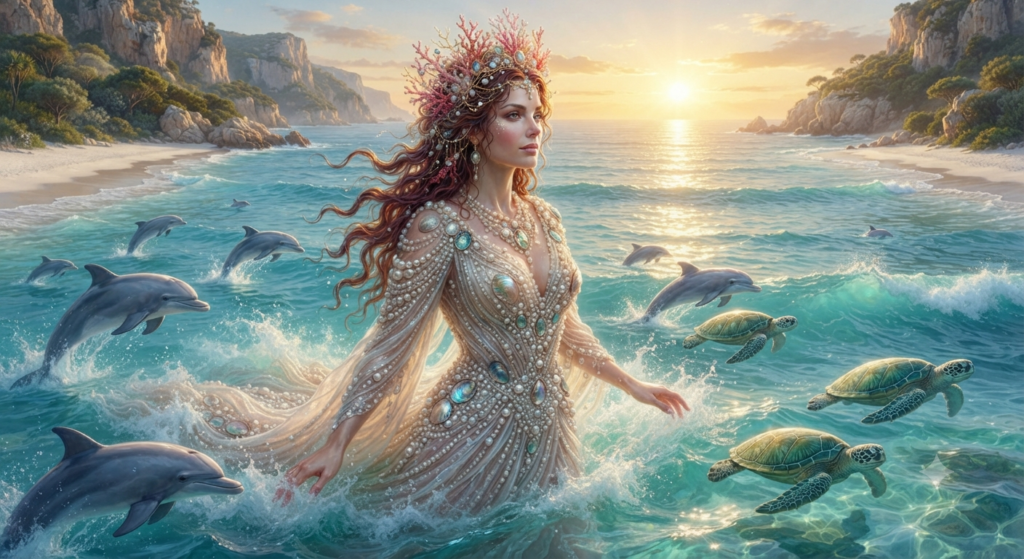
Amphitrite appears in Homer as the wife of Poseidon, and in later tradition she becomes the most prominent female ruler associated directly with the sea. She is not the sovereign of the waters in the way Poseidon is, but she occupies a royal position within the maritime divine household. Pindar, Apollodorus, and later mythographers preserve her as a sea goddess with dignity and authority, often imagined among dolphins, marine creatures, and the broad salt waters.
Her mythology is comparatively sparse, which is itself significant. Unlike Aphrodite or Athena, Amphitrite was not defined by many elaborate narrative cycles; rather, her power was expressed through title, association, and cultic presence. In art and literature she often appears as the stately feminine counterpart to Poseidon, making her one of the clearest candidates when speaking of a Greek goddess associated with the sea.
Aphrodite and the beaches of Cyprus
Aphrodite is not the goddess of the sea in a strict functional sense, yet she is perhaps the most famous divine figure connected with beaches, surf, and sea foam. Hesiod’s Theogony gives the classic account of her emergence from the sea near Cyprus after the violent severing of Uranus, and this origin tied her forever to the coastline. Her epithets, especially Aphrodite Ourania and Aphrodite Kypris, preserve that union of marine birth and island worship.
Cyprus became one of the most important centers of her cult, and coastal imagery remained central to her identity. In poetry and art, she is carried by the sea, washed ashore, or honored near harbors and shore sanctuaries. While she governs love rather than tides, her origin story makes her the goddess most closely associated with beaches in the popular imagination, especially where the sea meets sand and stone.
Nereids, sea nymphs, and coastal lore
The Nereids, daughters of Nereus and Doris, are sea nymphs who embody the gentler and more life-filled aspects of the Mediterranean waters. In Homer and Hesiod, they appear as a graceful chorus of marine divinities, often aiding sailors, grieving with mortals, or accompanying divine processions. Among them is Thetis, mother of Achilles, whose myths connect the sea with both tenderness and sorrow.
These nymphs are important because they show how Greek religion distributed marine power among many figures rather than one goddess alone. Their presence explains why local coastal lore often imagined the shore as inhabited by divine women who guarded coves, reefs, and inlets. While not usually “rulers” of the sea, the Nereids gave a feminine face to the coastline and its changing moods.
Oceanus, Tethys, and the deep waters
Oceanus and Tethys belong to the older cosmological generation in Hesiod’s tradition. Oceanus is a Titan, not a goddess, and he represents the great world-encircling river or the deep boundary waters of the earth. Tethys, his consort, is a Titaness connected with the sources of rivers and the nourishing, generative aspect of water. They are not beach deities, but they belong to the architecture of the sea in mythic cosmology.
Tethys, in particular, illustrates how Greek myth located female power in the watery origins of life. Her role is less visible in cult than in genealogy, where many river gods and nymphs are traced through her line. She is part of the broader mythic background against which later sea goddesses, including Amphitrite and the Nereids, can be understood.
The goddess Thalassa in Greek myth
Thalassa is the personification of the sea itself, and her name is the ordinary Greek word for “sea.” In later mythic and literary traditions she appears as a female embodiment of the waters, sometimes merged with older local conceptions of the marine element. She is less prominent in cult and narrative than Amphitrite or Aphrodite, but she remains one of the clearest names for a sea goddess in Greek imagination.
Because Thalassa is a personification rather than a richly developed Olympian figure, she often functions symbolically. Writers could invoke her when they wanted the sea to feel alive, ancient, and female. She reminds us that Greek myth did not only tell stories of gods with personalities; it also gave form to natural powers themselves.
Sea winds, harbors, and island worship
Greek seafaring depended on winds, harbors, and island chains, so divine protection at sea was often local and practical. Many coastal communities honored deities through small shrines, offerings before voyages, and rites carried out near safe anchorages. The wind gods, sea nymphs, and harbor divinities formed a living religious landscape around the Mediterranean.
Island worship was especially important in places such as Cyprus, Cythera, and parts of the Aegean, where the border between land and water felt sacred. Aphrodite’s cult on islands and near shorelines reflects this geography, as does the broader tendency to imagine the coast as a threshold between human settlement and divine power. Beaches were not only scenic spaces; they were places of crossing, prayer, and return.
Classical sources on divine powers at sea
Hesiod is essential for Aphrodite’s sea-born origin, while Homer gives Amphitrite her place in Poseidon’s household and treats the marine gods as part of a larger divine order. Apollodorus later preserves mythic genealogies that clarify the relationships among sea deities, and Pindar helps sustain their noble, ceremonial tone. These sources do not always agree in emphasis, but together they show a layered tradition.
Pausanias is especially useful for local cult and the material traces of worship, since he records sanctuaries, images, and regional practices that connect divinity to specific places. Through these classical sources, the sea appears not as a single domain with one goddess, but as a network of powers: queenly, maternal, beautiful, and elemental.
Beach sanctuaries in the Greek world
Sanctuaries near the sea often honored gods and goddesses who could protect travelers, traders, and fishermen. Aphrodite’s shrines on islands and coastal promontories are among the best known, but marine cults were diverse and deeply regional. At many sites, offerings were made at the shoreline before a voyage or after a safe return, turning the beach into a sacred boundary.
Archaeology and literary testimony together suggest that such places were not marginal. On the contrary, they were vital nodes in Greek religious life because the sea linked communities rather than separating them. A beach sanctuary could belong to Aphrodite, to a local nymph, to Poseidon, or to a composite set of divine powers invoked for safety and passage.
How Greek myth linked goddesses to coasts
Greek myth linked goddesses to coasts by weaving together origin stories, cult practice, and poetic imagery. Aphrodite’s birth from the sea foam made her inseparable from beaches and islands; Amphitrite gave the sea a queenly feminine presence; the Nereids populated the waters with grace; and Thalassa embodied the sea as such. Each figure reflects a different way of imagining the boundary between land and water.
So the simplest answer to the question is that Aphrodite is the Greek goddess most often associated with beaches, while Amphitrite is the goddess most closely tied to the sea itself. The mythic world is richer than any single title, however, and the Greeks understood the coast as a shared realm of divine forces rather than the domain of one goddess alone.

Orin Vale has spent the better part of two decades tracing the threads that connect the world’s oldest stories — from the halls of Asgard to the banks of the Nile, from Olympus to the jungles of the Maya. What began as a childhood fascination with flood myths and trickster gods grew into years of independent study across comparative mythology and ancient religion, always chasing the same question: what did these stories mean to the people who first told them? Orin writes for readers who want more than trivia — the ones looking for the beliefs, fears, and truths that myths were built to carry.