The question of how the planets are connected to Greek mythology leads directly into the naming habits of the ancient Mediterranean world. The familiar planets were not originally understood as distant worlds in the modern sense, but as wandering lights in the sky, each associated by Greek and later Roman observers with a divine figure whose character seemed to match its appearance and movement. That connection survived for centuries, shaping astronomy, literature, and the cultural memory of the gods.
The Roman names of Greek planetary gods
The planet names used in English today are mostly Roman, yet many of the gods behind them are the same deities the Greeks knew under different names. When Greek learning was absorbed into Roman culture, the planets were linked to the Roman pantheon, and those Roman names became standard in later European languages. Because Roman religion often identified its gods with Greek counterparts, the planetary system carries both traditions at once.
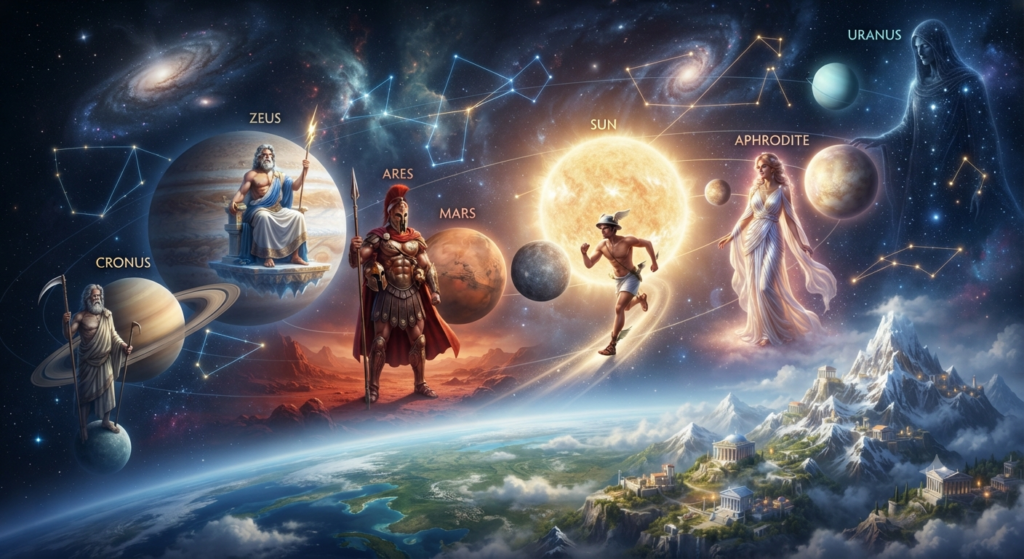
This is why the modern sky preserves a mixed inheritance. Mercury, Venus, Mars, Jupiter, Saturn, Uranus, Neptune, and Pluto are Roman names, but the mythic identities behind them frequently overlap with Greek figures such as Hermes, Aphrodite, Ares, Zeus, Cronus, Ouranos, Poseidon, and Hades. The planets are therefore one of the clearest places where classical mythology remains visible in everyday language.
Why Mercury echoes Hermes in the sky
Mercury is the planet closest to the Sun and one of the fastest-moving objects visible to the naked eye, which made it an apt celestial emblem for a messenger god. In Greek mythology, that role belongs to Hermes, who serves as herald, guide, and swift intermediary between divine and human worlds. The Roman Mercury inherited many of those same functions, so the planet’s name reflects a very old association between speed, travel, and communication.
The link is not accidental poetry but part of a broader ancient pattern. Planetary motion mattered to Greek and Babylonian observers, who noticed that Mercury slipped quickly through the sky and appeared near the Sun. Such movement suited Hermes, whose mythic identity includes agility, cunning, and boundary-crossing. The sky itself seemed to enact the god’s nature.
Venus and Aphrodite in planetary lore
Venus is the brightest planet in the night sky and often appears as the evening star or morning star, a brilliance that naturally invited association with beauty and desire. In Greek mythology, that sphere belongs to Aphrodite, the goddess of love, attraction, and powerful fertility. The Roman Venus took over much of Aphrodite’s cultural profile, and the planet’s name reflects that convergence.
Ancient writers did not treat this link as a mere decorative metaphor. The planet’s radiance and prominence made it a fitting celestial body for a goddess whose influence could be overwhelming and irresistible. In poetic tradition, Aphrodite is deeply tied to the force of longing, and Venus in the heavens became a luminous sign of that same power. The planet and the goddess together embody visibility, allure, and a kind of sovereign beauty.
Mars and Ares as war gods in orbit
Mars is the red planet, and its color helped make it a natural symbol of bloodshed, conflict, and martial force. In Greek mythology, the corresponding figure is Ares, the god of battle, whose presence in epic poetry often signals the chaos and violence of war. The Roman Mars was more dignified and foundational than Ares in Roman religion, yet the planetary name still carries the association with combat.
The redness of Mars was especially important to ancient imagination. Color was not a trivial detail in classical thought; it could reveal a thing’s essence. Since Ares is repeatedly linked with destruction, rage, and the noise of the battlefield in Homer and later sources, the planet Mars seemed to mirror that god’s character from afar. The result is a celestial body permanently marked by the language of war.
Jupiter, Zeus, and the ruler of Olympus
Jupiter is the largest planet in the solar system, and in Roman and Greek myth alike the king of the gods stands at the center of divine authority. The Roman Jupiter corresponds to Greek Zeus, ruler of Olympus, wielder of thunder, and guarantor of oaths and cosmic order. The planet’s size and prominence made it an obvious emblem for supreme power.
In myth, Zeus is the figure who secures dominion after the overthrow of the Titans, as told by Hesiod and later traditions. Jupiter’s planetary status therefore fits a god associated with rule, stability, and sovereign visibility. Ancient astronomers and poets alike could see in Jupiter’s bright, steady presence a fitting image of kingship in the heavens.
Saturn, Cronus, and the older divine age
Saturn was identified by the Romans with the Greek Titan Cronus, father of Zeus in the standard mythic genealogy. This association places the planet in relation to an older divine order, one that precedes Olympian rule and belongs to an earlier age of the cosmos. In Greek mythology, Cronus is a complex figure tied to succession, time, and the violent transition between generations.
The planet Saturn’s slow motion may have encouraged associations with age, endurance, and deep time. Although the Roman Saturn had important agricultural and festival associations of his own, the Greek connection with Cronus became especially influential in later cultural memory. The planet thus came to suggest antiquity itself, a far older cosmic regime than the bright kingship of Jupiter.
Uranus and the Greek god of the heavens
Uranus is one of the few planets whose name comes more directly from Greek than Roman tradition, preserving the primordial god Ouranos, the personification of the sky. In Hesiod’s Theogony, Ouranos is not a classical Olympian but an ancient cosmic being who belongs to the earliest generation of divine history. The planet Uranus therefore points to the sky not as a mere physical space, but as a mythic ancestor of the heavens.
It is worth noting that Uranus was named much later than the visible planets known to antiquity, after its discovery in the modern era. Yet the choice of name was deliberate, keeping the classical pattern alive. By using the Greek god of the heavens, astronomers extended the old mythic logic into the expanded solar system, showing how deeply classical naming customs continued to shape scientific language.
Neptune, Poseidon, and the sea beyond earth
Neptune is linked with Poseidon, the Greek god of the sea, earthquakes, and horses. In Roman and Greek mythology, this deity governs waters and the restless power beneath the earth’s surface. When the planet Neptune was discovered, its deep blue color and remote position suggested a fitting connection to oceanic depth, even though the association was made through modern astronomical naming rather than ancient observation.
The mythic resonance is especially strong because Poseidon represents forces that are immense, unstable, and difficult to contain. The sea in Greek thought is both sustaining and dangerous, a realm of passage and peril. Neptune’s distant, cold blue image in the modern imagination naturally evokes that same sense of depth beyond ordinary human reach.
Pluto and Hades in the outer darkness
Pluto corresponds to Hades, the Greek god of the underworld, though the Roman name Pluto comes from a related idea of wealth and the hidden riches of the earth. In Greek mythology, Hades rules the realm of the dead, but he is not simply a figure of annihilation; he is also a necessary sovereign of the invisible order beneath life. The planetary name therefore carries both darkness and hidden abundance.
Pluto was discovered long after the classical period, yet its name powerfully extended the ancient pattern of mythic astronomy. Its remoteness and faintness made it seem suitable for a god associated with the farthest boundaries of existence. Even though modern classification has changed Pluto’s status, the name remains one of the strongest examples of Greek mythology surviving in celestial language.
Ancient astronomy and mythic naming customs
For the ancient Greeks and Romans, planets were not merely objects of calculation. They were wandering gods or god-linked lights whose movements invited interpretation through myth, omen, and philosophical speculation. Greek astronomy developed alongside mythology rather than in isolation from it, and the naming of celestial bodies reflected a world where story and observation were closely intertwined.
Later astronomy replaced much of this symbolic framework, yet the old names endured because they were culturally powerful and intellectually memorable. They link the modern sky to Hesiod’s genealogies, Homeric divine conflict, and the broader classical imagination. The planets remain a living archive of Greek mythology, carrying the memory of gods across the darkness of space.
The planets are connected to Greek mythology through a long chain of naming, interpretation, and cultural inheritance. What began as ancient attention to wandering lights became a durable system in which each major planet recalled a divine figure whose nature seemed to match its appearance or motion. Even today, looking at the solar system means moving through a sky still marked by Hermes, Aphrodite, Ares, Zeus, Cronus, Ouranos, Poseidon, and Hades.

Orin Vale has spent the better part of two decades tracing the threads that connect the world’s oldest stories — from the halls of Asgard to the banks of the Nile, from Olympus to the jungles of the Maya. What began as a childhood fascination with flood myths and trickster gods grew into years of independent study across comparative mythology and ancient religion, always chasing the same question: what did these stories mean to the people who first told them? Orin writes for readers who want more than trivia — the ones looking for the beliefs, fears, and truths that myths were built to carry.