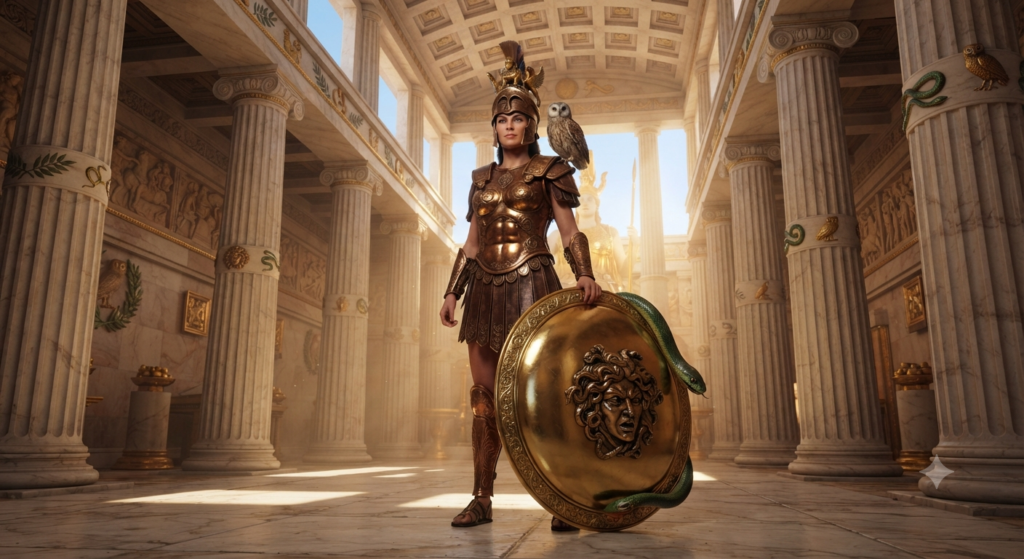
Athena, the Greek goddess of wisdom, warcraft, craft, and civic order, is often shown with serpents or linked to snake imagery in myth and cult. This association does not come from a single story alone, but from several layers of Greek religion: the old earth powers beneath Athens, the protective force of the goddess, the terrifying edge of her aegis, and the sacred creatures kept at her shrines. In Greek thought, the snake could signify danger, renewal, guardianship, and the hidden life of the earth, all of which suit Athena in different ways.
Athena and the Serpent in Greek Myth
Athena is not a snake goddess in the simple sense, nor is the serpent her exclusive emblem. Yet Greek myth repeatedly brings her into contact with snakes because she stands at the boundary between ordered civilization and older, more primal powers. She is the virgin daughter of Zeus in the Olympian family, but she is also deeply tied to Athens, whose sacred landscape preserved older chthonic memories. In that setting, the serpent becomes one of the goddess’s most enduring companions and symbols.
The association also reflects the flexibility of Greek myth itself. Different regions and authors emphasized different aspects of Athena’s identity. In Homer, she is a radiant strategist and protector; in later cult and local legend, she becomes the guardian of a city whose ancient relics and sacred animals include serpents. The result is a goddess whose wisdom is not abstract alone, but grounded in the older language of sacred creatures and inherited ritual.
Snakes in Athena’s Ancient Iconography
Greek art often depicts Athena wearing a helmet, carrying spear and shield, and sometimes accompanied by snakes. These serpents appear on vases, reliefs, and statues as decorative and symbolic features, especially in the classical and Hellenistic periods. They can coil around her aegis, rise from the edges of her garments, or appear beside her in scenes that stress divine protection and martial readiness.
This iconography is not random ornament. In Greek visual culture, snakes often marked sacred potency, household protection, and the presence of powers connected to the earth and the dead. When placed with Athena, they reinforce her as a goddess who defends boundaries. She is not a wild force herself, but she commands forces that remain dangerous if not properly ordered. The serpent helps express that controlled, unsettling power.
The Aegis, Gorgons, and Chthonic Power
One of the clearest reasons Athena is associated with snakes is the aegis, her terrible protective goatskin or shield-covering, which in many artistic versions bears the Gorgoneion, the severed head of Medusa. Medusa’s hair becomes a mass of snakes after her transformation, and that serpentine terror passes into Athena’s iconography through the aegis. In Homer and later tradition, the aegis is a fearsome divine object that inspires panic and drives enemies away.
The connection reaches beyond Medusa herself. The Gorgons belong to a world older and darker than Olympus, and snakes in Greek thought often signal chthonic force, the power of the earth below. Athena does not belong to the underworld, but she can wield symbols drawn from its edge. That is part of her uniqueness: she absorbs the frightening energy of older powers and turns it into disciplined divine protection.
Erichthonius and the Sacred Snake Child
A major myth linking Athena to snakes concerns Erichthonius, the autochthonous, or earth-born, king associated with early Athens. In one widely known version, Hephaestus attempts to violate Athena, and from the episode springs the child Erichthonius, whom Athena takes into her care. The infant is often described with serpent features or as being hidden in a chest with serpents. Later authors, including Apollodorus, preserve versions in which Athena entrusts the child to the daughters of Cecrops and forbids them to open the container.
This story binds Athena to the snake through themes of secrecy, guardianship, and autochthony. Erichthonius represents the deep native identity of Athens, born from the soil itself, and the serpent is a natural emblem for that earth-born status. Athena does not mother the child in a human sense, but she protects him as a sacred charge, which makes the snake less a sign of horror than of legitimate Athenian identity.
Why the Snake Marked Athena’s Protection
Snakes are often associated with Athena because they are effective symbols of vigilant guardianship. A snake is alert, watchful, and capable of striking suddenly. It can dwell near homes, temples, and storerooms, making it a natural emblem for a goddess who safeguards civic life, domestic order, and sacred space. In this way, the serpent complements Athena’s protective role rather than contradicting it.
The same animal also carries the idea of renewal, since snakes shed their skin. Greek religion did not systematize symbolism in the modern way, but ancient worshippers readily understood such natural signs. Athena’s protection is therefore not soft or sentimental. It is stern, intelligent, and enduring, like the serpent that waits in silence until needed. That quality suits a goddess who defends cities, crafts, and lawful power.
Athena Polias and the Serpent of Athens
Athena Polias, “Athena of the city,” was especially important in Athens, where her cult was bound to the identity of the polis itself. In this civic setting, the serpent became one of the goddess’s most famous sacred companions. Pausanias describes the Erechtheion on the Acropolis and mentions the sacred snake maintained there, connected with Athena’s worship and Athenian ritual life. The snake was treated with reverence, and its wellbeing was taken as a sign of divine favor.
This local serpent was not merely a curiosity. It stood for the enduring presence of Athena’s protection over the city, especially in a shrine linked to ancient kings and the sacred past of Athens. The pairing of Athena and the serpent here reflects continuity: goddess, city, and soil belong together. The reptile’s presence in the shrine made visible what Athens believed about itself, namely that its order rested on ancient and sacred foundations.
Temple Rites, Offerings, and Sacred Reptiles
Greek sanctuaries often included animals whose presence carried ritual significance, and snake veneration appears in several cult contexts. At Athena’s shrines, offerings may have been made to maintain sacred order and to honor the divine guardian of the place. While practices varied by locality, the ancient sources show that the serpent of Athena was cared for as a living sacred sign rather than as a mere temple resident. The animal’s appetite, behavior, and survival could all be interpreted ritually.
Such rites fit the broader Greek habit of linking divine favor with the visible health of sacred creatures. At Athena’s sanctuary, the serpent could function as a barometer of the goddess’s presence. If the creature was well, the city could feel reassured; if neglected or absent, anxiety followed. This is one more reason Athena’s snake imagery endured, because it connected mythic symbolism with practical cult life.
Snakes as Symbols of Wisdom and Vigilance
Athena is the goddess of mêtis, a kind of practical intelligence, resourcefulness, and strategic wisdom. Snakes fit this profile well. They are quiet, observant, and difficult to surprise. Their movements suggest patience rather than brute force, and their sudden speed mirrors the intelligent strike of a calculated plan. Greek viewers could recognize in the serpent a living image of the goddess’s mental discipline.
At the same time, snakes in ancient cultures often carried ambivalent meaning. They could heal or harm, guard or threaten. That ambiguity is apt for Athena, whose protection is fierce and whose wisdom is often severe. She is not a gentle pastoral deity; she is a guardian of cities, a patron of skilled labor, and a strategist in war. The serpent belongs to that world of controlled danger, where intelligence masters violence without erasing it.
Classical Sources on Athena’s Snake Imagery
The literary evidence for Athena and snakes comes from several classical authors, each emphasizing different elements. Homer presents Athena as armed and majestic, especially in the Iliad and Odyssey, where her protective and martial qualities dominate. Later mythographers such as Apollodorus preserve the story of Erichthonius, which strongly links the goddess to serpent imagery and Athenian identity. These texts do not always explain the symbolism directly, but they establish the mythic framework.
Pausanias is especially valuable for cult detail, since he describes sacred places, objects, and local traditions in Greece. His account of Athens helps explain how the serpent functioned in actual worship, not just story. Meanwhile, visual evidence from vase painting and sculpture shows that snake imagery around Athena was widespread enough to become familiar to Greek audiences. The sources together make one thing clear: the association is ancient, layered, and rooted in both myth and ritual.
Athena’s Serpents in Art, Cult, and Legend
In Greek art, the serpent beside Athena could signify a range of ideas at once: civic protection, sacred power, earth-born legitimacy, and the goddess’s command over dangerous forces. In cult, the serpent at her sanctuary helped embody the living presence of the goddess in Athens. In legend, figures like Erichthonius and Medusa tied her more deeply to snake imagery, though in different ways and with different meanings. No single explanation exhausts the symbol.
Athena is associated with snakes because Greek religion saw in the serpent a perfect emblem for her paradoxical nature. She is civilized but severe, rational yet close to ancient powers, protective but fearsome. The snake, likewise, is both creature of the earth and figure of hidden intelligence. In Athena’s case, the symbol endures because it captures something essential about her: wisdom that watches, defends, and never sleeps.

Orin Vale has spent the better part of two decades tracing the threads that connect the world’s oldest stories — from the halls of Asgard to the banks of the Nile, from Olympus to the jungles of the Maya. What began as a childhood fascination with flood myths and trickster gods grew into years of independent study across comparative mythology and ancient religion, always chasing the same question: what did these stories mean to the people who first told them? Orin writes for readers who want more than trivia — the ones looking for the beliefs, fears, and truths that myths were built to carry.