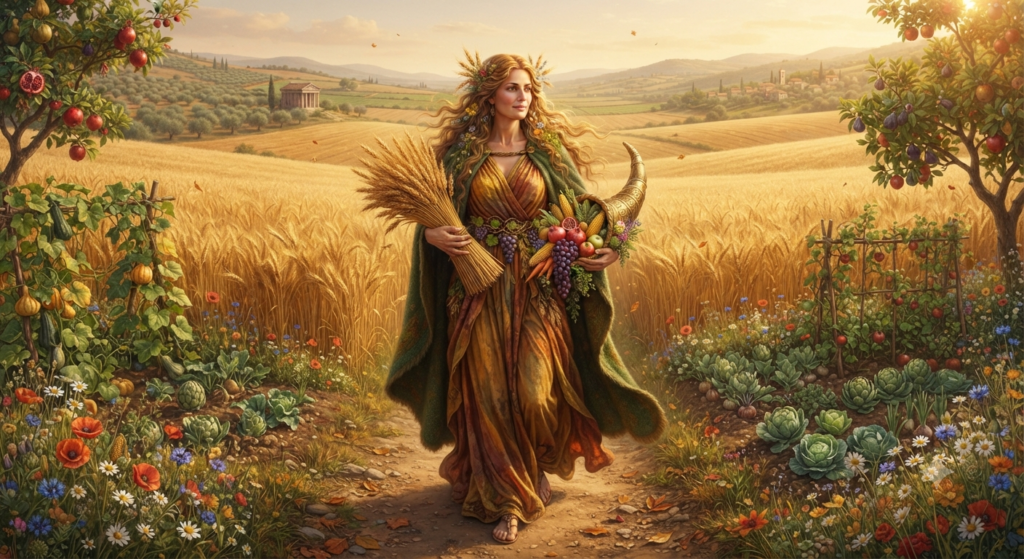
In Greek mythology, the goddess most closely associated with agriculture and gardening is Demeter, the ancient power of grain, fertile soil, and the annual rhythm of sowing and harvest. Her domain extends beyond the field into the ordered life of the garden, where cultivated growth depends on care, season, and restraint. Ancient sources present her not as an abstract symbol, but as a divine force whose favor meant bread, plenty, and the flourishing of human settlement itself.
Demeter, Greek Goddess of Grain and Harvest
Demeter is the clearest answer to the question of which Greek goddess is associated with agriculture and gardening. She presides over grain, cultivated land, and the gifts that come from the earth when it is tended by human hands. In Hesiod’s Theogony and Works and Days, the world of farming is central to divine order, and Demeter stands among the major powers who make life possible through harvest.
Her name is often linked by ancient and modern interpreters to the earth as “mother,” though the etymology is debated. What is not debated is her role in Greek religion: she was invoked for crops, fertility, and rural prosperity. While the Greeks did not separate agriculture and gardening in the modern sense as sharply as we do, Demeter governed the cultivated landscape as a whole, especially the plants that sustained households and cities.
Why Demeter Governs Agriculture and Crops
Demeter’s authority over agriculture comes from her intimate connection to cereals, especially wheat and barley, which were the staples of the Greek diet. Farming in the ancient Mediterranean depended on seasonal rains, careful timing, and the annual return of fertility to the earth. Demeter personified that return. The field was not merely productive ground; under her care, it was a sacred space where human labor met divine blessing.
Her dominion also reflects the ancient Greek understanding that civilization itself rested on agriculture. The move from wild gathering to cultivated land marked the boundary between the untamed and the ordered. Demeter occupies that threshold. She does not govern wilderness growth in the way Artemis might be associated with untrodden nature, but rather the disciplined abundance of fields, orchards, and gardens shaped by human cultivation.
Demeter in Homeric Hymns and Early Worship
The Homeric Hymn to Demeter is the most important early literary source for her cult and character. It tells of Demeter’s grief after Persephone’s removal to the underworld and shows the goddess withdrawing her gifts from the earth. In that narrative, crops fail, the ground becomes barren, and humanity faces famine until compromise is reached. The hymn makes unmistakable that Demeter’s powers are agricultural in the deepest sense: when she withholds favor, life at once becomes fragile.
Early worship of Demeter appears widely across Greek regions, especially in farming communities. Sanctuaries were often placed near fields or at the edges of inhabited land, where people could ask for the success of crops and the stability of the seasons. In these settings, Demeter was not remote or purely mythic. She was the divine presence behind plowing, harvesting, and the sustenance of the household.
Persephone, Seasons, and the Cycle of Fields
Persephone’s myth is inseparable from Demeter’s agricultural identity. In the best-known version, preserved in the Homeric Hymn to Demeter, Persephone is taken to the underworld and later returns for part of the year, while remaining below for the rest. The seasonal absence and return of the daughter becomes a cosmic explanation for the cycle of fertility and barrenness that shapes the fields.
Different ancient sources preserve different emphases in this story, but the agricultural meaning remains consistent. When Persephone is away, the world falls into dormancy; when she returns, growth resumes. This does not map neatly onto every local Greek climate, and scholars have long noted that the myth is broader than a simple seasonal allegory. Even so, the connection between Persephone’s movement and the life of the land became one of the most enduring images in Greek religion.
Sacred Groves, Gardens, and Rural Rites
Although Demeter is primarily a goddess of grain, she also belongs to the wider sacred landscape of groves, garden plots, and productive rural spaces. Greeks often honored deities at places where cultivated land met natural growth: olive groves, boundary sanctuaries, and rural shrines near fields. Such sites reflected a worldview in which gardening was not separate from agriculture, but part of the same ordered relationship between people and earth.
Rural rites for Demeter varied by region, yet many shared a concern with fertility, seed, and the health of the land. Women in particular played an important role in some festivals and local observances, reflecting Demeter’s strong association with household nourishment and the generative powers of the earth. The goddess of grain was therefore also a guardian of carefully tended growth, whether in a field of barley or a small enclosed garden.
Eleusinian Mysteries and Fertility of the Land
The Eleusinian Mysteries, centered at Eleusis near Athens, are among the most famous Greek rituals linked to Demeter. Their exact rites were secret, but ancient testimony and scholarly reconstruction show that they involved Demeter, Persephone, and themes of fertility, renewal, and the hope of a better fate after death. The connection to agriculture was fundamental: the Mysteries dramatized the relationship between seed, burial, and new life.
The city of Eleusis itself was deeply tied to grain cultivation, and the ritual language of the Mysteries drew on agricultural realities familiar to participants. The sacred drama was not a distant abstraction. It spoke to the fact that seeds are hidden in the earth before rising again, just as Persephone descends and returns. In that sense, the fertility of the land and the mystery of human life were bound together in Demeter’s cult.
Offerings to Demeter for Sowing and Reaping
Ancient Greeks offered Demeter the first fruits of the harvest, cakes made from grain, and gifts tied to the cycle of sowing and reaping. Such offerings acknowledged that the harvest did not belong to human labor alone. Before households consumed bread, the goddess of agriculture received honor for making it possible. Ritual meals and sacrifices could mark key moments in the agricultural year, especially at planting and harvest time.
The timing of these offerings mattered. Sowing was a moment of trust, since seed had to be placed in the earth long before any return could be seen. Reaping, by contrast, was a moment of gratitude and measured restraint. Demeter’s cult gave both stages religious meaning. Through offering, the farmer recognized dependence on forces beyond skill, weather, or tools.
Symbols of Wheat, Poppy, and the Sheaf
Demeter’s symbols are among the most recognizable in Greek mythology. Wheat and barley identify her immediately as the giver of grain, and the sheaf or bundle of harvested stalks signals completion, abundance, and the gathering in of life-sustaining crops. These images appear in art, cult objects, and literary references, reinforcing her role as the divine source of cultivated plenty.
The poppy is another important symbol, though its meaning is layered. In Greek tradition, it is associated with Demeter through fertility, sleep, and the abundance of the earth. Some depictions show her holding poppies alongside grain, suggesting both the richness of the field and the quiet rest that follows labor. Together, these symbols make clear that Demeter is not merely a harvest figure, but the goddess of the agricultural cycle in its fullness.
Demeter’s Cult Across Greek City-States
Demeter was honored throughout the Greek world, though local practices differed from city to city. At Athens, Eleusis gave her cult extraordinary prestige. In Sparta, Sicily, Thessaly, and many rural communities, she remained closely linked to the land and to practical rites of fertility. Her worship shows how deeply agriculture shaped Greek religion across regional boundaries.
Scholars generally agree that her cult was especially important in communities dependent on cereal farming. Yet her reach was broader than farming alone, because grain was the foundation of civic life. A city-state depended on harvest surpluses, grain storage, and the stable reproduction of food. Demeter’s cult therefore belonged not only to the countryside but to political order itself, since without crops there could be no secure polis.
Legacy of the Harvest Goddess in Mythology
Demeter’s legacy endures because she embodies one of humanity’s oldest relationships: the bond between people and cultivated land. In mythology, she is the force that makes fields fruitful and the goddess whose sorrow can withhold abundance. For this reason, she remains the definitive Greek goddess of agriculture and gardening, especially in the sense of tended, fruitful, life-giving growth.
Her story continues to resonate because it speaks to cycles that are both practical and symbolic. Seedtime and harvest, loss and return, labor and blessing all converge in her figure. In Greek myth, Demeter is the ancient face of the growing earth, the keeper of grain, and the divine presence behind the garden’s quiet promise of renewal.
To ask which Greek goddess is associated with agriculture and gardening is to arrive at Demeter, whose authority over grain, fertile soil, and cultivated growth was central to Greek religion. Through her myths, rites, and symbols, the Greeks expressed the truth that human life depends on the earth’s seasonal generosity. Demeter remains one of mythology’s most enduring images of harvest, cultivation, and the sacred patience of the land.

Orin Vale has spent the better part of two decades tracing the threads that connect the world’s oldest stories — from the halls of Asgard to the banks of the Nile, from Olympus to the jungles of the Maya. What began as a childhood fascination with flood myths and trickster gods grew into years of independent study across comparative mythology and ancient religion, always chasing the same question: what did these stories mean to the people who first told them? Orin writes for readers who want more than trivia — the ones looking for the beliefs, fears, and truths that myths were built to carry.