The nymph associated with turtles in Greek mythology is Chelone. Her name itself is closely tied to the Greek word chelōnē, meaning “tortoise” or “turtle,” and her story explains why she is remembered not as a radiant woodland maiden, but as the origin of the tortoise in one of Greek myth’s classic metamorphosis tales. In the surviving literary tradition, Chelone belongs to the world of divine punishment, where a single act of defiance draws the attention of the gods and reshapes a mortal or semi-divine figure into an animal form that carries the memory of the offense.
Greek myth preserves Chelone mainly through later literary sources, especially mythographers and poets who like to explain the natural world through story. Her tale is not among the best-known myths of Olympus, but it is firmly rooted in the ancient pattern of aetiology: a narrative that accounts for why a creature, object, or custom exists as it does. In Chelone’s case, the slow, armored tortoise becomes inseparable from a nymph who refused a divine summons and was transformed as a result.
The turtle nymph in Greek myth: Chelone
Chelone is the name attached to the nymph who became a tortoise in Greek myth, and she is the figure most directly associated with turtles in the ancient tradition. The name is meaningful in itself, since chelōnē is the Greek term for a tortoise or turtle, making the myth an especially clear example of a name and story reinforcing one another. She is not one of the major nymphs of Homeric or Hesiodic fame, but a more localized, explanatory figure preserved in later mythic retellings.
Her importance lies less in a long narrative cycle than in the power of her transformation. Greek mythology often used nymphs as liminal beings: part human, part natural, and vulnerable to divine intervention. Chelone fits that pattern exactly. She stands as the nymph whose identity is folded into the animal she becomes, giving the tortoise a mythic ancestry and a moral dimension shaped by the gods.
Hermes, the feast, and the broken tortoise shell
The best-known version of Chelone’s story centers on Hermes and a divine feast. In the myth, Hermes was preparing for the wedding of Zeus and Hera, or a comparable assembly of the gods in some tellings, and invited many beings to attend. Chelone alone refused the summons. According to the account preserved in later sources, she remained at home, dismissive of the invitation and unconcerned with divine authority.
Hermes punished her by overturning her house or striking her dwelling, after which Chelone was transformed into the tortoise. In some retellings the house itself becomes symbolic of the shell she now carries, so that her new body is linked with the burdens of her former refusal. The story is brief, but its image is durable: the tortoise as a creature withdrawn into its shell, like Chelone shut in her own resistance to the gods.
How Chelone defied Zeus at the wedding
Chelone’s defiance is central to the myth, because Greek narratives of metamorphosis rarely punish mere presence; they punish contempt, insolence, or refusal of order. In the version associated with her, she declines to attend the wedding feast of Zeus and Hera, an event that represents not only a divine marriage but also the proper alignment of Olympus itself. To ignore such a summons was to place personal stubbornness above cosmic hierarchy.
That act of refusal gives the story its meaning. Chelone does not simply miss a celebration; she rejects participation in a sacred moment. Greek mythology often frames such acts as hybris, a dangerous self-assertion against divine will. Her punishment is therefore not arbitrary. It reflects a recurring mythic logic in which the gods enforce rank and ritual through transformation, turning defiance into permanent physical memory.
The transformation of Chelone into a tortoise
Chelone’s metamorphosis is the point at which her story becomes a natural explanation for the tortoise itself. After her refusal, Hermes transforms her so that she bears a shell and moves slowly, carrying the image of her own house on her back in some versions of the tale. This is an elegant mythic punishment: the home she failed to leave for the divine wedding becomes inseparable from her body.
The transformation also changes the tone of the myth. Chelone is no longer simply a nymph who erred; she becomes the very figure through whom the tortoise enters Greek imagination. Metamorphosis myths often preserve a trace of the original being inside the new form, and Chelone’s stubbornness survives in the animal’s withdrawn, self-contained nature. The tortoise becomes a living emblem of refusal, enclosure, and endurance.
Sources on Chelone in Greek literary tradition
Chelone is not heavily attested in the earliest Greek epics, and that matters for understanding her place in the tradition. Her story survives mainly in later mythographic and poetic sources, where writers compiled older material and shaped it into concise explanatory tales. Among the most often cited are Aesopic and post-classical traditions, as well as references in mythographers such as Apollodorus and later commentaries, though details vary by source.
Because the evidence is scattered, scholars generally treat Chelone as a well-established mythic figure within the broader tradition of Greek animal aetiologies rather than as a character from a single canonical text. Her story was remembered because it answered a question: why does the tortoise carry its shell and move so slowly? That explanatory function gave the myth enduring value even when the nymph herself remained obscure.
Turtle symbolism in ancient Greek storytelling
In ancient Greek storytelling, turtles and tortoises often suggested slowness, self-protection, and withdrawal from the open world. They could also be associated with endurance, since the creature survives through patience rather than speed. Chelone’s myth makes use of these qualities by turning them into narrative consequence: her inwardness and refusal become the defining features of her animal form.
Greek authors also connected turtles with domestic space and shelter. A shell is a natural house, and that image made the tortoise especially suitable for a story about a nymph who would not leave her home for a divine occasion. The symbol is simple but effective. By becoming a tortoise, Chelone is fixed forever in a condition that mirrors her choice, and the animal itself carries the moral and poetic weight of the myth.
Why Chelone is linked with the slow turtle
Chelone is linked with the slow turtle because her myth explains slowness as a consequence of divine punishment. The animal’s measured movement is not treated as a random natural fact; it becomes the visible mark of a story about reluctance and resistance. In mythic thinking, physical traits often preserve the memory of character, and Chelone’s pace is one of the most striking examples.
This linkage also makes the myth memorable across languages and cultures. Even readers unfamiliar with Greek sources can understand the logic immediately: a nymph who would not attend the gods is made to carry her home with her, unable to move quickly or freely again. The tortoise’s slow, deliberate motion thus gains a mythological explanation that is both vivid and morally charged.
Hermes’ caduceus and the tortoise connection
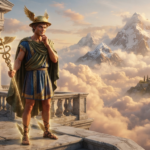
Hermes is the divine agent of Chelone’s transformation, and his role connects the myth to his wider identity as messenger, guide, and enforcer of divine order. The caduceus, his staff, is not directly central to Chelone’s story in the surviving sources, but Hermes’ association with exchange, movement, and transformation frames the myth well. He is the god who arrives, confronts refusal, and turns a defiant figure into a creature of permanence and enclosure.
The tortoise connection is also interesting because Hermes later becomes associated with invention and cleverness in other myths, most famously in traditions about the lyre. In that broader mythic atmosphere, the tortoise can appear as a creature of symbolic importance rather than merely zoological interest. Chelone’s transformation belongs to this world of divine ingenuity, where Hermes reshapes the meaning of an animal through action and punishment.
Nymphs, metamorphosis, and divine punishment
Chelone’s story belongs to a larger Greek pattern in which nymphs are transformed after offending a god or crossing a sacred boundary. Metamorphosis myths often preserve a tension between beauty and punishment, freedom and fixity. The nymph, a figure of nature and movement, becomes trapped in the form of the natural thing she is meant to explain.
Divine punishment in these stories is rarely random. It reflects the ancient belief that the gods uphold order through visible change. Chelone’s fate is especially clear because the punishment itself becomes the explanation for a creature’s defining feature. Her myth is therefore both narrative and theology of a sort: a brief account of how the divine will can enter the texture of the natural world.
Chelone’s place among Greek animal aetiologies
Chelone occupies an important place among Greek animal aetiologies, even if she is not as famous as myths about spiders, nightingales, or laurel trees. Her story explains an animal through a named personage whose behavior matches the creature’s qualities. That alignment is characteristic of Greek myth-making, where a story and a natural feature are made to illuminate one another.
Her place in the tradition is also significant because it shows how Greek mythology could preserve small, elegant tales alongside the grand epics of gods and heroes. Chelone’s narrative does not need a long genealogy or a battlefield to endure. It survives because it gives the tortoise a mythic memory, and because the image of a nymph turned into her own shell is one of those ancient stories that remains immediately intelligible across centuries.
Chelone is the nymph associated with turtles in Greek mythology, remembered through a myth of refusal, punishment, and transformation. Her story links the tortoise to the divine world through Hermes and the wedding feast of the gods, turning an animal trait into a lasting mythic symbol.
In the broader Greek tradition, Chelone stands as a small but vivid example of how mythology explains nature. The slow turtle, with its shell and retreat, becomes more than a creature of the earth: it becomes the shaped memory of a nymph who would not answer the gods.

Orin Vale has spent the better part of two decades tracing the threads that connect the world’s oldest stories — from the halls of Asgard to the banks of the Nile, from Olympus to the jungles of the Maya. What began as a childhood fascination with flood myths and trickster gods grew into years of independent study across comparative mythology and ancient religion, always chasing the same question: what did these stories mean to the people who first told them? Orin writes for readers who want more than trivia — the ones looking for the beliefs, fears, and truths that myths were built to carry.