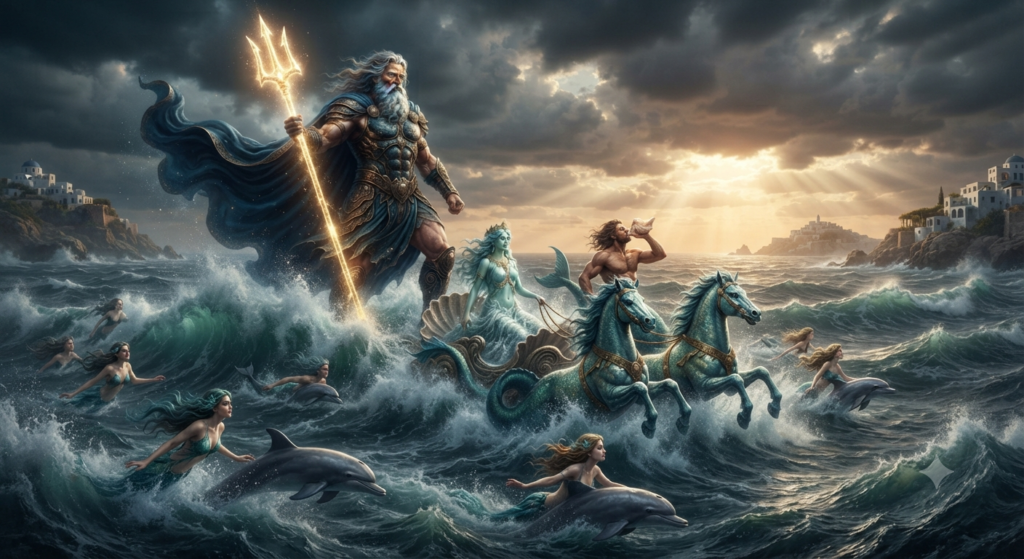
The Aegean Sea was never just a stretch of water between Greece and Asia Minor; in Greek imagination, it was a living realm governed by divine powers, watched by sea spirits, winds, island deities, and gods whose cults flourished along its coasts. Some were rulers of the deep, others protected sailors, and others shaped the seas through islands, harbors, and breezes. In myth and worship alike, the Aegean belonged to a whole divine landscape rather than to a single god alone. ## Poseidon and the rule of the sea
Poseidon and the rule of the sea
Poseidon was the foremost god associated with the Aegean Sea. In Homer and later tradition, he is the great shaker of the earth and master of the sea, invoked by sailors across the Greek world. His authority over waters is not limited to the Aegean, but that sea lies at the heart of many myths in which his power is felt through storms, earthquakes, and the perilous crossing between islands and mainland. The Greeks built temples to him on promontories and coastal sites, reflecting his presence wherever the sea was dangerous and necessary.
His connection to the Aegean is both mythic and practical. The name of the sea itself was linked in ancient tradition to King Aegeus, father of Theseus, who was said to have leapt into those waters in grief. Yet Poseidon remains the divine figure most closely tied to the sea’s rule in religious thought. In cult, he was honored not only as a maritime god but also as a force governing horses, land tremors, and the unstable boundary between earth and water, which made him especially relevant in a region of islands, straits, and uncertain passage.
Nereus, the Old Man of the Sea
Nereus is one of the older sea divinities associated with the Aegean, though his role differs from Poseidon’s sovereignty. In Hesiod, he is a primordial marine god, called the “Old Man of the Sea,” known for wisdom, gentleness, and the gift of truthful prophecy. He is not the lord of waves and storms, but a figure of deep marine antiquity, representing the sea as enduring, ancient, and full of hidden knowledge. For Greek myth, that made him an apt presence in the Aegean’s older imaginative geography.
Nereus appears in several myths as a helper to heroes who need guidance through the sea’s dangers. Heracles wrestles him for information, and later traditions preserve his association with the shifting, elusive nature of maritime knowledge. In the Aegean world, where travel depended on reading winds, currents, and island routes, such a figure made symbolic sense. He embodies a sea older than human navigation, a sea that must be understood, not conquered.
The Nereids and coastal Greek worship
The Nereids, the daughters of Nereus and Doris, were among the most widely revered sea spirits connected to the Aegean. Hesiod names many of them, and Greek poets often portray them as beautiful attendant deities who move with grace through the waters. They appear in the company of Poseidon, Achilles’ divine mother Thetis being the most famous among them, and they often serve as protective presences for sailors, fishermen, and coastal communities. Their mythic identity is inseparable from the sea’s margins.
Their importance was not only literary. Across the Greek world, especially in island and shoreline settings, sea nymphs received worship in local forms that blurred the line between myth and cult. The Nereids could be honored in caves, springs near the coast, and sanctuaries facing the water. In the Aegean, where towns depended on maritime trade and fishing, such local reverence reflected a practical and devotional need: the sea was both sustenance and threat, and the Nereids represented its more benevolent face.
Amphitrite in Aegean maritime myth
Amphitrite, wife of Poseidon, belongs firmly among the deities associated with the Aegean Sea. Her name appears in Homeric and later sources as the queenly consort of the sea god, often standing for the sea itself in poetic language. In some traditions she is a Nereid, while in others she is simply a divine sea figure whose marriage to Poseidon expresses his dominion. Her role is less active than his, but no less significant in the mythic order of the waters.
In maritime imagination, Amphitrite gives the sea a royal and ordered aspect. She is not usually depicted as a storm-bringer, but as a divine presence who complements Poseidon’s rule. Because the Aegean was so deeply woven into Greek travel, fishing, and island life, a goddess associated with the sea’s majesty would naturally belong to its symbolic world. Her name survives in many poetic references, reminding us that the sea in Greek thought was not only violent but also dignified, vast, and sovereign.
Triton as herald of the sea gods
Triton is one of the best-known figures tied to sea divinity in the Aegean mythic sphere. In early tradition, he is the son of Poseidon and Amphitrite, and in later art and literature he becomes the horn-bearing herald of the sea gods. He is often imagined with the upper body of a man and the tail of a fish, a form that belongs to later iconography but reflects his hybrid marine nature. His trumpet can calm or stir the waters, marking him as a mediator of divine sea power.
Triton’s association with the Aegean comes through this role as messenger and agent of maritime transformation. He appears in the wider Greek mythic world, but the sea lanes of the Aegean, crowded with islands and peninsulas, are the kind of setting in which a herald of the deep would feel especially present. As with many marine spirits, he bridges the human and divine realms, announcing that the sea is not empty space but inhabited and responsive.
Aeolus and the winds over the Aegean
Aeolus, lord of the winds, is not a sea god in the narrow sense, yet he is deeply associated with the Aegean because wind determined travel across it. In Homer’s Odyssey, Aeolus grants Odysseus the winds in a leather bag, a story that highlights how Greek sailors imagined the sea as governed by divine weather as much as by divine waters. The Aegean, with its seasonal winds, depended on forces that could make sailing swift, delayed, or impossible.
Later tradition presents Aeolus in different ways: sometimes as a mortal king entrusted with the winds, sometimes as a divine or semi-divine keeper of them. Whatever the version, his relevance to the Aegean is clear. Sailors moving among the islands had to respect the etesians, local gusts, and sudden changes in weather. Aeolus personified that necessity, standing as the divine counterpart to every careful navigator watching the horizon.
Apollo and Delphi’s island seascapes
Apollo is not a sea deity, yet he is associated with the Aegean through islands, coastal sanctuaries, and the routes that linked sacred places across the sea. His island cults, especially at Delos, connect him strongly to the Aegean religious landscape. Delos, one of the most important sacred islands in Greek tradition, was the reputed birthplace of Apollo and Artemis in the Homeric Hymn to Apollo. That makes Apollo a major divine presence in the Aegean, even if his realm is prophecy, music, purification, and order rather than the sea itself.
The maritime dimension of Apollo’s cult is often overlooked, but it is essential to his place in Aegean mythology. Islanders and seafarers approached his sanctuaries through the sea, and his festivals drew pilgrims by ship from many regions. Delphi itself is inland, yet its oracle influenced voyages and colonial ventures throughout the Aegean world. Apollo thus belongs to the sea’s religious network: not as its ruler, but as a god whose sacred authority traveled across it.
Artemis, islands, and shoreline sanctuaries
Artemis is closely linked to the Aegean through her birth on Delos and through her many sanctuaries on islands and coasts. Like Apollo, she is one of the children of Leto whose arrival on Delos gave the island central importance in Greek myth. Her cult often flourished in liminal places: near harbors, on headlands, in wetlands, and at the edges of settled land. These are the same kinds of environments that define the Aegean’s shoreline world.
Her association with the sea is indirect but powerful. Artemis is a goddess of wild nature, young life, and the boundary zones between civilization and wilderness. On islands, those boundary zones are especially visible, since the sea defines the edge of habitation itself. In some local traditions, she is a protectress of voyagers and a deity to whom women and communities turned for safety. Her presence in the Aegean reflects the geography of Greek religion, where divinity often followed the contours of land and water.
Dionysus, islands, and Aegean voyages
Dionysus also belongs to the Aegean divine world, especially through island myths and maritime epiphanies. One of the most famous tales is his encounter with sailors who attempt to abduct him, only to be transformed when he reveals his power in the sea. In the Homeric Hymns and later versions, Dionysus shows that he is not merely a god of wine and ecstasy but also a deity who can command the maritime realm. The story places him firmly within Aegean storytelling, where ships and islands serve as stages for divine revelation.
Island cults further strengthen this association. Dionysus was worshiped in many Aegean locales, where viticulture, seasonal fertility, and ritual ecstasy all fit the rhythms of island life. His processions, songs, and mysteries were not confined to the mainland. As a god who arrives, transforms, and unsettles ordinary boundaries, he suits a sea of crossings. In Aegean myth, Dionysus is often encountered not in the safety of harbor towns alone, but on the moving threshold between land and water.
Heroic sailors and divine protection at sea
The Aegean Sea in Greek myth is also shaped by heroes whose voyages depended on divine favor. Odysseus, Jason, Theseus, and other maritime travelers each move through a divine seascape in which gods, winds, and sea spirits intervene constantly. Their stories reveal that the Aegean was understood as a place of both adventure and danger, where survival depended on honoring the right powers and avoiding offense. Sailors prayed to Poseidon, the Dioscuri, and local protective deities before setting out.
This protective dimension is crucial to understanding which gods were associated with the Aegean Sea. The sea was not imagined through one hierarchy alone, but through a layered network of divine figures: rulers like Poseidon, ancient sea beings like Nereus, maritime attendants like the Nereids and Triton, wind powers like Aeolus, and island-linked gods such as Apollo, Artemis, and Dionysus. Together they formed the sacred map of the Aegean, a sea that was at once route, frontier, and inhabited divine space.
The gods associated with the Aegean Sea were not limited to one Olympian sovereign. Greek mythology presents the Aegean as a crowded sacred world, shaped by sea kings, nymphs, winds, island-born divinities, and protective powers invoked by those who traveled its waters. To ask which gods belonged to the Aegean is to see how deeply the Greeks linked geography and divinity, turning sea lanes and islands into a living mythic landscape.

Orin Vale has spent the better part of two decades tracing the threads that connect the world’s oldest stories — from the halls of Asgard to the banks of the Nile, from Olympus to the jungles of the Maya. What began as a childhood fascination with flood myths and trickster gods grew into years of independent study across comparative mythology and ancient religion, always chasing the same question: what did these stories mean to the people who first told them? Orin writes for readers who want more than trivia — the ones looking for the beliefs, fears, and truths that myths were built to carry.