Athens in Greek mythology is more than a city named for a goddess. It appears as a sacred landscape, a political center, and a remembered stage on which gods, heroes, and citizens all left their mark. In myth and cult alike, Athens is tied above all to Athena, whose favor explains the city’s identity in classical tradition, while other figures such as Poseidon, Theseus, and the old kings of Attica helped shape its legendary past.
Athens as Athena’s sacred city-state
Athens is most closely identified with Athena, the goddess of wisdom, strategy, crafts, and civic order. Classical sources consistently present the city as her special domain, and its very name was understood by the Greeks to record her victory over rival claims to the land. In Athenian tradition, the city was not merely protected by Athena; it was chosen by her and dedicated to her worship.
That relationship gave Athens a distinctive place in Greek mythology. Other cities might honor a patron deity, but Athens built its entire self-image around divine affiliation. The goddess was addressed as Polias, the protectress of the city, and as Ergane, guardian of craft and productive skill. This made Athens a mythic model of ordered civic life, where the divine and the political were imagined as closely linked.
The olive tree and the city’s founding
The olive tree belongs to the founding myth of Athens as one of its most enduring symbols. In the famous contest between Athena and Poseidon for the land, Athena offered an olive tree, while Poseidon produced a salt spring or a salt-water blow from the earth, depending on the version. The olive came to represent fertility, peace, and prosperity, and it was remembered as the gift that secured the city’s allegiance to Athena.
Ancient authors do not preserve a single uniform version of how the tree appeared, but they agree on its central meaning. The sacred olive on the Acropolis was treated as a living sign of Athena’s presence. It was said to be protected even in times of disaster, and its mythic origin connected the landscape itself with divine choice, making Athens a city whose identity grew directly from the earth as well as from cult.
Poseidon, Athena, and the contest myth
The contest between Poseidon and Athena is the foundational myth most strongly associated with Athens. Apollodorus and later writers preserve versions in which the gods competed for patronage of the land by giving gifts to the people or to the first kings, notably Cecrops. Poseidon’s gift signified sea power and force, while Athena’s embodied wisdom, stability, and useful abundance.
The myth also reflects a broader tension in Greek thought between competing forms of power. Poseidon represents the sea, earthquakes, and raw force; Athena represents intelligence, disciplined skill, and civic order. Athens chose Athena in myth because her gifts were judged more beneficial, and that choice allowed the city to imagine itself as guided by prudence rather than violence, even while it remained deeply connected to war and empire in historical time.
Athens in the Panathenaic festival tradition
The Panathenaia was the great festival of Athens, celebrated in honor of Athena Polias. It was not just a religious event but one of the central expressions of Athenian identity. The procession, sacrifices, athletic contests, and presentation of the woven peplos to the goddess all reaffirmed the bond between the city and its divine patron.
Myth and festival reinforced one another here. The woven robe carried for Athena was said to embody the work of the city’s women and the continuity of communal memory. In the broader Greek world, the Panathenaia became one of the best-known signs that Athens was not simply a polis among others, but a city whose civic life was ritually dramatized under Athena’s gaze. The festival also gave Athens a public myth of itself: unified, ancient, and favored by the goddess.
Theseus and Athens in heroic legend
Theseus is the great heroic figure most closely associated with Athens. Later Athenian tradition made him the unifier of Attica, the king who gathered scattered communities into one city-centered state. His stories range from the slaying of the Minotaur to struggles with bandits and foreign foes, and they place Athens within the larger heroic world of Greek myth.
The Theseus cycle also served an important civic purpose. By claiming Theseus as its own, Athens gave itself a heroic ancestry that matched its political ambitions. Pausanias and other sources preserve local traditions that linked him with monuments, shrines, and burials in and around the city. In this way, Athens became not only Athena’s city but also the city of a national hero whose myth helped define Athenian identity in the classical age.
The Acropolis as a mythic and cultic center
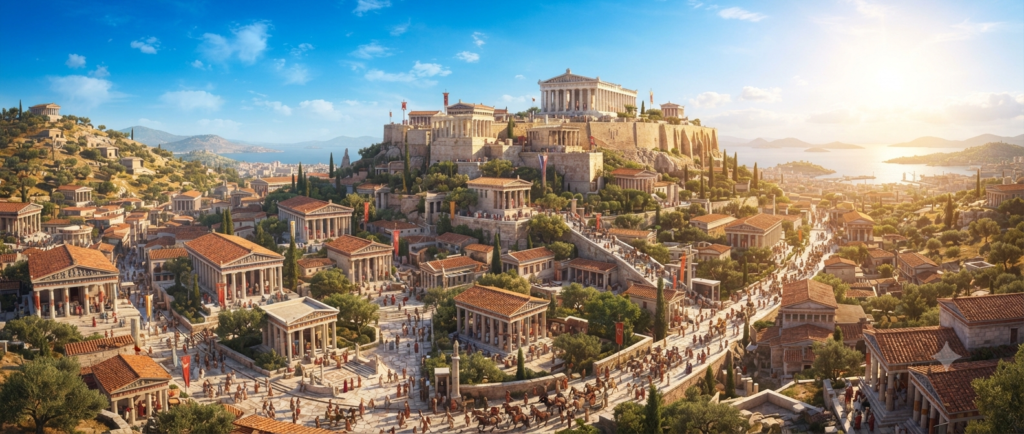
The Acropolis stands at the heart of Athens’ mythic landscape. In antiquity it was not just a fortification or elevated district, but a sacred summit crowded with temples, altars, and memory. Many of the city’s oldest legends were placed there, including the contest of the gods, the cult of Athena Polias, and traditions connected with early kings like Cecrops and Erechtheus.
The Acropolis also fused myth with visible ritual. Its shrines and sanctuaries embodied the city’s sacred history in stone and sacred practice. The Erechtheion in particular preserved complex cult associations, including very ancient local cults that later tradition linked with the earliest days of the city. As a result, the Acropolis functioned as a mythic archive, where Athenian stories were not simply told but inhabited.
Athenian temples, shrines, and divine worship
Athens contained a dense network of temples and shrines honoring Athena and many other gods. The Parthenon became the most famous, but it was only one part of a larger sacred city. Temples to Hephaestus, Ares, Zeus, Demeter, and Dionysus, along with numerous smaller altars and sanctuaries, made Athens a major religious center in the Greek world.
These spaces mattered mythologically because they connected the city with a wide range of divine narratives. Hephaestus was linked to the birth of Erichthonius in local legend, while Dionysus and Demeter anchored important civic cults and seasonal rites. Athens therefore appears in mythology not as a single shrine to Athena alone, but as a layered sacred environment where several gods were integrated into the city’s identity.
Oracles, omens, and Athens in sacred history
Athens also appears in mythic history through divine signs, oracular responses, and interpretations of fate. The city’s legendary past often unfolds under the pressure of prophecy, whether in stories of kings, cult foundations, or wartime decisions. Like many Greek communities, Athens understood its history as shaped by communication from the gods, especially through Apollo’s oracle at Delphi.
Such traditions helped Athens present itself as a city whose political and sacred life were sanctioned by divine order. Oracular guidance could confirm a ruler, warn against impiety, or justify ritual innovation. In the myths surrounding Athens, these signs often appear as turning points that bind human action to cosmic authority, giving the city a place in sacred history rather than ordinary chronology.
Athens in the tragedies of the classical age
Athenian tragedy transformed the city into a dramatic setting for some of the deepest themes in Greek myth. Playwrights such as Aeschylus, Sophocles, and Euripides often placed Athenian figures, institutions, or values at the center of inherited stories. The city became a moral and political horizon in which questions of justice, kinship, exile, and divine law could be tested.
Tragedy also reflected Athens back to itself. In works such as Euripides’ Heracleidae and Sophocles’ Oedipus at Colonus, Athens appears as a city of refuge, sanctity, or civic restraint. This is not pure praise, since tragedy is too nuanced for simple propaganda, but it does show how Athenian audiences saw their own city through mythic drama: powerful, pious, and vulnerable at once.
How Athens shaped Greek mythic memory
Athens played a special role in Greek mythology because it became one of the chief places where myth was organized into civic memory. Its festivals, monuments, and literary traditions preserved stories in forms that were repeated, displayed, and ritualized across generations. In that sense, Athens did not merely receive myths; it helped define how myths were remembered.
The city’s image as Athena’s chosen home, Theseus’ kingdom, and a center of sacred ritual gave it extraordinary weight in the Greek imagination. Even where myths were shared across the Greek world, Athens often offered one of their most influential versions. Its importance lies not only in the stories told about it, but in the way it turned myth into public identity, making the city itself part of Greece’s enduring legendary landscape.
Athens in Greek mythology is both a place and an idea. It is the city where Athena’s wisdom takes visible form, where heroic memory is tied to civic life, and where ancient ritual preserves the bond between gods and mortals. Through its myths, Athens became a symbol of sacred patronage, cultural authority, and the power of collective remembrance.

Orin Vale has spent the better part of two decades tracing the threads that connect the world’s oldest stories — from the halls of Asgard to the banks of the Nile, from Olympus to the jungles of the Maya. What began as a childhood fascination with flood myths and trickster gods grew into years of independent study across comparative mythology and ancient religion, always chasing the same question: what did these stories mean to the people who first told them? Orin writes for readers who want more than trivia — the ones looking for the beliefs, fears, and truths that myths were built to carry.