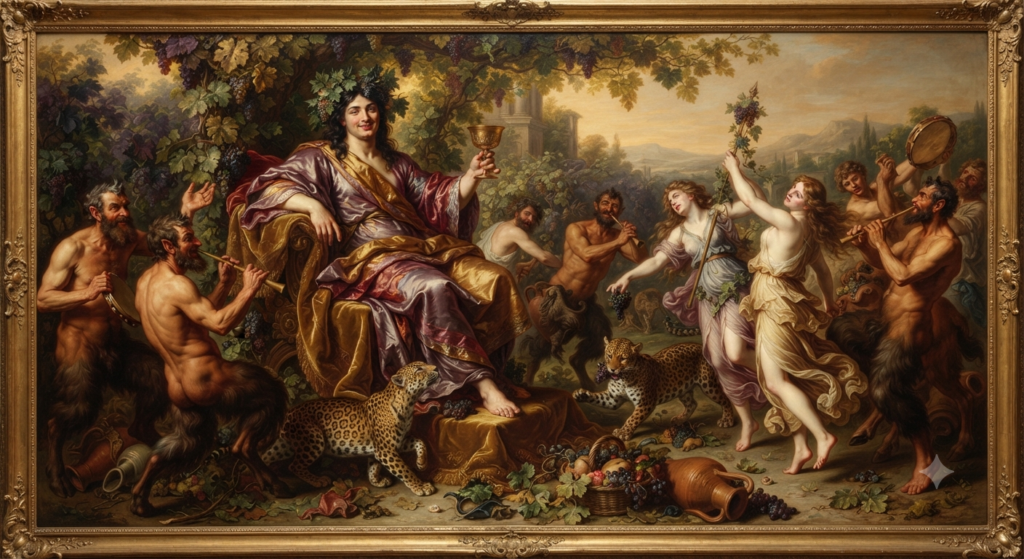
Dionysus, the Greek god of wine, ecstasy, fertility, theater, and ritual transformation, appears in some of the most vivid works of ancient and later art. In Greek and Roman tradition he is also known by the Roman name Bacchus, and paintings that depict him often show a world of vine leaves, leaping satyrs, ecstatic maenads, and the charged moment between civilization and release. The question of what are famous paintings depicting Dionysus is really a question about how artists across centuries have imagined divine pleasure, mythic excess, and sacred drama.
Dionysus in Greek art and sacred imagery
In the earliest visual traditions, Dionysus is usually not a solitary portrait figure but part of a larger sacred setting. Vase painting, wall painting, and sculptural reliefs often show him in procession, crowned with ivy or vine leaves, holding the thyrsus, or accompanied by animals and ecstatic followers. In archaic and classical Greece, these images belonged to a religious world in which the god’s power was tied to festivals, theater, and the boundary between order and release.
Because surviving panel paintings from ancient Greece are extremely rare, much of what is known comes from pottery and Roman copies of Greek compositions. Even so, the iconography is consistent: Dionysus appears youthful, bearded, or androgynous depending on period and locale, sometimes seated with Ariadne, sometimes riding a leopard, sometimes arriving in triumph. These recurring motifs formed the visual language later artists inherited when they turned to the god in easel painting.
Famous paintings of Dionysus through the ages
Among the most famous paintings depicting Dionysus are later works that reinterpret older mythic themes through Renaissance, Baroque, and Neoclassical eyes. Titian’s Bacchus and Ariadne is one of the best-known examples, showing the god leaping from his chariot toward Ariadne on Naxos, a scene drawn from ancient myth and Roman poetic tradition. His work helped define the image of Dionysus as youthful, kinetic, and irresistibly alive.
Other major painters returned to Bacchic subjects in different keys. Poussin painted mythological scenes of revelry with classical restraint, while Rubens filled Bacchic processions with flesh, motion, and abundance. In later centuries, artists such as Velázquez and Bouguereau used Bacchic imagery to explore beauty, intoxication, and the sensuous body. The god’s appeal endured because he could stand for both sacred mystery and artistic freedom.
Bacchus and Dionysus in classical iconography
In classical iconography, the names Bacchus and Dionysus often refer to the same deity, though the Roman Bacchus can carry a slightly different artistic emphasis. Greek imagery tends to preserve the god’s ritual and mythic roots, while Roman art and later European painting often stress festivity, wine, and sensual abundance. This distinction is not absolute, but it matters when identifying paintings that depict the figure under one name or the other.
Artists repeatedly used a small set of attributes to identify him: the ivy wreath, the thyrsus topped with a pinecone, the kantharos or drinking cup, and the leopard or panther. These signs appear in mosaics, frescoes, and easel paintings alike, making Dionysus instantly recognizable even when the scene is crowded with attendants. The iconography became so stable that later painters could invoke his presence through symbols alone.
The triumph of Dionysus in ancient frescoes
Ancient frescoes often present Dionysus in triumphant or processional form, especially in Roman domestic decoration. The wall paintings from Pompeii and Herculaneum preserve a rich visual record of Bacchic imagery: the god traveling in a chariot, attended by satyrs and maenads, or appearing in scenes that celebrate wine, fertility, and festive release. These frescoes do not merely illustrate myth; they transform the household into a space touched by divine vitality.
The House of the Vettii at Pompeii is especially important for understanding this tradition, with its Dionysiac themes and elegant painted panels. Such works show how popular and prestigious the god remained in Roman visual culture. The “triumph” of Dionysus in fresco was less about military conquest than about the ceremonial arrival of abundance, music, and altered consciousness into ordinary life.
Wine, ivy, and the god of theater
Dionysus is inseparable from wine, but ancient art also links him to theater and performance. In Greek religion, dramatic festivals were held in his honor, and painted scenes often reflect that relationship by showing masks, dancers, and performers around his figure. The god is not just the patron of intoxication; he is also the patron of metamorphosis, the power that allows a person to become another self for a moment.
Ivy and theatrical imagery reinforce this connection. The vine and its leaves mark the god as master of growth and seasonal change, while masks recall the shifting identities of tragedy and comedy. Painters who depicted Dionysus beside actors or in theatrical processions were capturing a Greek understanding of art itself as a Dionysiac act: disciplined, public, and yet rooted in emotional release.
Ariadne and Dionysus in Renaissance painting
One of the most enduring mythic pairings in Western painting is Ariadne and Dionysus. According to ancient sources, especially Roman retellings, Ariadne was left on Naxos after Theseus abandoned her, and Dionysus later claimed her as his bride. Renaissance painters seized on this moment because it offered both narrative drama and a powerful contrast between human abandonment and divine arrival.
Titian’s Bacchus and Ariadne remains the landmark version, with the god leaping across the sky in a burst of motion while Ariadne turns toward him in surprise and alarm. The painting draws on literary sources but transforms them into a radiant visual myth of fate and transformation. Later artists revisited the subject in calmer or more allegorical forms, but Titian’s image fixed Dionysus as a god of sudden encounter and irrevocable change.
Baroque visions of Bacchic processions
Baroque painters often favored movement, abundance, and theatrical intensity, all of which suited Dionysian subjects. Bacchic processions allowed artists to fill a canvas with bodies in motion: satyrs stumbling, maenads dancing, children carrying grapes, and the god himself crowned and attended. In such works, the myth becomes a scene of visual excess, balanced by the Baroque love of composition and light.
Rubens was especially influential in this register, giving Bacchic themes a muscular energy that made the ancient god feel physically present. The Baroque Dionysus is less distant deity than force of nature, an embodiment of vitality pressing against restraint. Even when the subject is playful, the imagery often carries a deeper sense of release, desire, and the fragility of control.
Mythic revelry in Neoclassical canvases
Neoclassical painters approached Dionysus with more restraint, but they did not abandon him. Instead, they reframed Bacchic revelry within ordered composition, clear contour, and idealized anatomy. The result was often a tension between the god’s unruly nature and the painter’s commitment to balance, creating works that feel both festive and controlled.
This style is visible in mythological scenes where Dionysian subjects become part of a broader classical past. The revelry is still there, but it is filtered through antique dignity and archaeological taste. Neoclassical painters treated Dionysus not simply as a symbol of intoxication but as part of the wider Greek imagination of ritual, beauty, and divine presence.
Symbolism of satyrs, maenads, and thyrsi
No image of Dionysus is complete without the figures that surround him. Satyrs and maenads appear repeatedly in painting because they embody the god’s sphere of influence: wildness, dance, music, and ecstatic surrender. Their presence signals that the scene is not merely decorative but mythologically charged, belonging to the dangerous and liberating world of Bacchic worship.
The thyrsus, a staff wrapped with ivy or vine leaves and tipped with a pinecone, is one of the clearest symbols of the god. In paintings it functions as both emblem and instrument, a sign of ritual power and a visual marker of divine authority. Together with satyrs, maenads, and animal companions, it tells viewers that Dionysus is a god whose domain includes both pleasure and peril, celebration and upheaval.
How artists portrayed the Olympian god
Across the centuries, artists have portrayed Dionysus in several recurring forms: youthful and graceful, mature and bearded, relaxed in repose, or animated in triumphant motion. Some works emphasize his beauty and sensuality, while others underline his authority over revelry and transformation. The differences often reflect not contradictions in the myth but the shifting artistic language of each age.
What remains constant is the sense that Dionysus stands at the edge of ordered life and calls attention to what lies beyond it. Famous paintings depicting him do not merely illustrate a deity of wine; they visualize a force that unsettles boundaries, summons performance, and renews the world through ecstatic encounter. That is why the god continues to fascinate painters and viewers alike.
Famous paintings depicting Dionysus endure because the god himself is a figure of transition. He belongs to fertility and festivity, but also to theater, metamorphosis, and the fragile moment when restraint gives way to release. From ancient frescoes to Renaissance masterpieces, artists have returned to him whenever they wanted to show motion, sensuality, and divine arrival. His image remains one of the most adaptable in Greek art, and one of the most vivid in the history of painting.

Orin Vale has spent the better part of two decades tracing the threads that connect the world’s oldest stories — from the halls of Asgard to the banks of the Nile, from Olympus to the jungles of the Maya. What began as a childhood fascination with flood myths and trickster gods grew into years of independent study across comparative mythology and ancient religion, always chasing the same question: what did these stories mean to the people who first told them? Orin writes for readers who want more than trivia — the ones looking for the beliefs, fears, and truths that myths were built to carry.