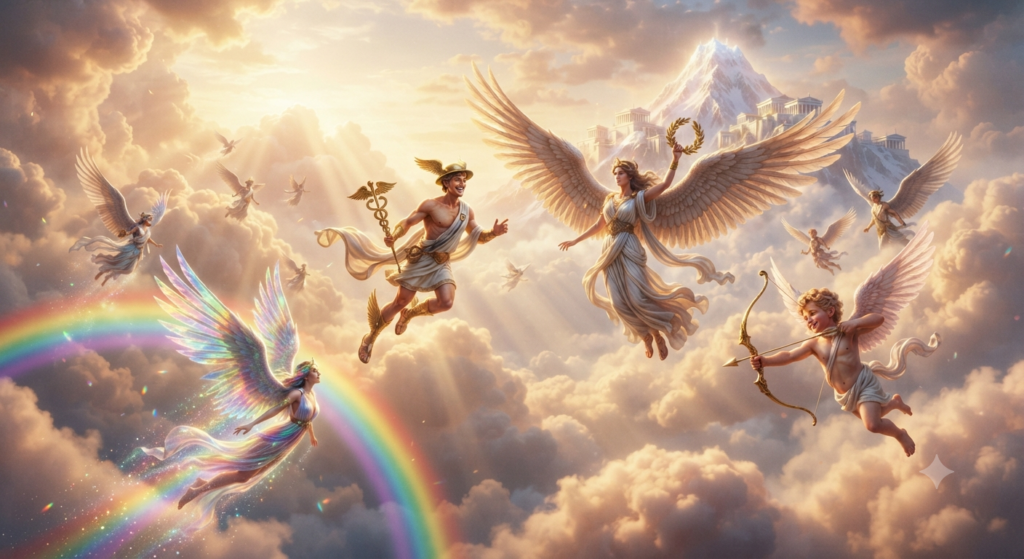
In Greek mythology, wings are less a single symbol than a whole vocabulary of divine power. They mark speed, message-bearing, sudden death, victory, desire, and the frail boundary between gods and mortals. Some figures are fully winged, some borrow wings through attributes such as sandals or shoes, and others appear in art with feathers, birds, or wind-like motion that suggest the same impulse toward motion beyond human limits.
Winged Gods in Greek Myth and Symbolism
Wings in Greek myth usually signal movement that ordinary bodies cannot achieve. They belong above all to beings who cross distances too quickly for human travel: messengers, personifications, and powers that arrive without warning. In Homer, Hesiod, Apollodorus, and later writers, wings often serve less as decoration than as shorthand for divine function, a visual cue that a figure belongs to the swift realm of the gods.
Not every winged figure is a major Olympian, and not every god is born with wings in the sources. Sometimes wings are literal, as with Nike or Eros; sometimes they are attached objects, as with Hermes’ sandals; sometimes they are poetic or artistic motifs rather than fixed mythic anatomy. Greek iconography made generous use of these signs, and later Roman art and literature reinforced them, so the tradition is broad but not always uniform.
Hermes and His Winged Sandals
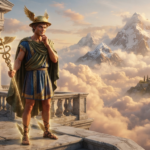
Hermes is the clearest answer to the question of which Greek gods are symbolized by wings, even though the wings are usually not on his body but on his sandals and sometimes his hat. In Homer’s Iliad and Odyssey, he is the god of speed, passage, and messages, able to move between Olympus, the mortal world, and the underworld with extraordinary ease. The winged footwear in later art captures that role better than any single image could.
The sandals, called talaria in later tradition, became one of Hermes’ defining attributes. They reflect his domains as divine herald, guide of travelers, protector of thresholds, and escort of souls. In the Homeric Hymn to Hermes, his quickness is central to his character from the moment of birth, and the winged emblem turns that narrative quality into a permanent visual symbol. When Greek and Roman audiences saw Hermes with wings, they saw movement itself given a divine face.
Nike, Goddess of Victory and Flight
Nike is the winged goddess most explicitly defined by her feathers. In archaic and classical art she appears as a swift female figure descending through the air, landing upon a battlefield, or crowning a victor with a wreath. Her name means victory, and her wings make that victory feel immediate, almost airborne, as though success has arrived from outside the human struggle and briefly touched it.
Unlike some gods who have wings only in selected images, Nike’s winged form is central to her identity. She is commonly associated with Zeus and Athena, especially in later Greek art, where she represents triumph in war, athletics, and civic contests. The famous cult image of Athena Nike at Athens shows how closely victory and divine presence were linked. Wings here do not imply distance from the world so much as the sudden descent of success into it.
Eros, the Winged God of Desire
Eros is one of the most enduring winged figures in Greek mythology, though his nature varies across sources. In Hesiod’s Theogony, Eros is an ancient cosmic force, one of the earliest powers to emerge after Chaos, far older than the playful boy of later art. By the classical and Hellenistic periods, however, he often appears as a winged youth or child whose arrows bring desire with unsettling speed.
The wings suit Eros because desire itself acts like flight: sudden, restless, and difficult to control. He is not merely decorative in vase painting and sculpture; his wings express the unpredictability of love and longing. In later myth, especially in accounts surrounding Psyche, Eros becomes a central figure of passion and testing. The wings mark him as a force that cannot be contained by ordinary human boundaries.
Iris and the Rainbow Messenger Wings
Iris, like Hermes, is a messenger, but her symbolism is gentler and more atmospheric. In Homer and Hesiod she serves as a divine envoy, often linked to the rainbow and to the swift transmission of divine commands. Her wings are not always emphasized in the earliest texts, but in later art she is commonly shown with wings that reflect her speed and her passage through sky and storm.
The rainbow association gives Iris a unique place among winged figures. She is not merely fast; she bridges heaven and earth by visible light, a natural phenomenon turned into divine imagery. In tragedy and later mythological tradition, she appears as a messenger of the gods, especially of Hera, and her wings reinforce her role as a brief, luminous arrival. Among Greek deities, she is one of the most elegant examples of winged symbolism joined to color, weather, and communication.
Thanatos and the Silent Wings of Death
Thanatos, the personification of death, is often imagined with wings in Greek art, though the literary tradition is more restrained. In Homer’s Iliad, Death and Sleep carry the body of Sarpedon, and later visual traditions sometimes give Thanatos dark wings to mark his silent descent. The image is powerful because it makes death not violent but inevitable, a presence that comes without sound.
His wings differ from those of Hermes or Nike. They are not celebratory, and they do not promise return. In vase painting and funerary art, Thanatos often appears alongside Hypnos, suggesting that sleep and death are neighboring states, both carried by invisible forces. The winged figure becomes a reminder that in Greek thought, death could be represented not only as a grim figure but as a calm, irreversible passage.
Hypnos, Sleep, and Feathered Imagery
Hypnos, the personification of sleep, is commonly associated with wings in later artistic tradition, especially in relation to feathers, drifting, and the soft descent into unconsciousness. In Homer and later poets, sleep can be imagined as a divine force that comes upon gods and mortals alike. The winged image is fitting because sleep does not strike like a weapon; it settles, floats, and carries the body away from waking awareness.
In mythology, Hypnos is also closely linked to dreams and to his brother Thanatos, with whom he shares a realm of quiet departure. The pair often appears together in art, one associated with rest and the other with death. When wings are attached to Hypnos, they suggest not speed in the heroic sense but a softer, enveloping motion, as though sleep descends like a curtain of feathers.
Daedalus, Icarus, and Mortal Wings
Daedalus and Icarus are not gods, but their story is essential to understanding why wings matter in Greek mythology. In Ovid’s Metamorphoses and related traditions, Daedalus fashions wings from feathers and wax so that he and his son can escape Crete. The myth is mortal, not divine, yet it reveals the same symbolic language: wings mean liberation, ingenuity, and the dangerous wish to rise beyond human limits.
Icarus’ fall gives the tale its lasting power. The wings that allowed ascent become the means of ruin when he flies too close to the sun. Greek myth often treats this tension seriously: flight is wondrous, but it is also perilous when mortals confuse borrowed power with divine nature. Daedalus succeeds through craft; Icarus fails through excess. Their wings are therefore a human counterpart to the gods’ winged emblems.
Apollo, Birds, and Divine Flight Motifs
Apollo is not usually counted among the winged gods in the same direct way as Hermes, Nike, or Eros, yet winged and avian motifs surround him in Greek tradition. Birds are sacred to him in various contexts, especially the swan and the raven, and his links to prophecy, distance, and sudden divine arrival often place him within the broader symbolism of flight. In some artistic traditions, especially later ones, his radiant motion is rendered in ways that echo winged divinity.
The connection is thematic rather than anatomical. Apollo’s powers move across spaces no mortal controls: he sends plague, grants healing, speaks through oracles, and governs light and harmony. Birds and airborne imagery suit these functions because they suggest elevated vision and far-reaching presence. While Apollo is not generally depicted as winged himself, his divine sphere belongs to the same symbolic world as the winged gods, where motion in the sky reflects authority on earth.
Winged Attributes in Greek Iconography
Greek iconography used wings as a visual language more than a strict biological feature. A winged staff, winged sandals, feathered shoulders, or a figure in rapid flight could all signal divine status, message-bearing, victory, or the passage between life and death. The gods most commonly symbolized by wings are Hermes, Nike, Eros, Iris, Thanatos, and, in some artistic traditions, Hypnos and related personifications.
That visual tradition shaped later Western art so thoroughly that winged figures became almost synonymous with Greek mythology itself. Yet the sources show a more nuanced picture: some deities are intrinsically winged, others acquire wings through attribute, and others are associated with flight through birds, motion, or poetic imagery. Read carefully, the wings of Greek myth do not merely decorate the gods. They tell us what each figure can do, how quickly power acts, and how closely the divine can approach the mortal world.
Wings in Greek mythology symbolize more than speed. They identify messengers, embody victory, express desire, and mark the fragile crossing between sleep, death, and awakening. Hermes, Nike, Eros, Iris, Thanatos, and Hypnos stand at the center of this imagery, while figures such as Daedalus and Apollo show how deeply the idea of flight shaped Greek thinking even beyond the fully winged gods.

Orin Vale has spent the better part of two decades tracing the threads that connect the world’s oldest stories — from the halls of Asgard to the banks of the Nile, from Olympus to the jungles of the Maya. What began as a childhood fascination with flood myths and trickster gods grew into years of independent study across comparative mythology and ancient religion, always chasing the same question: what did these stories mean to the people who first told them? Orin writes for readers who want more than trivia — the ones looking for the beliefs, fears, and truths that myths were built to carry.