Sword of Nuada (Sword of Light)
Introduction
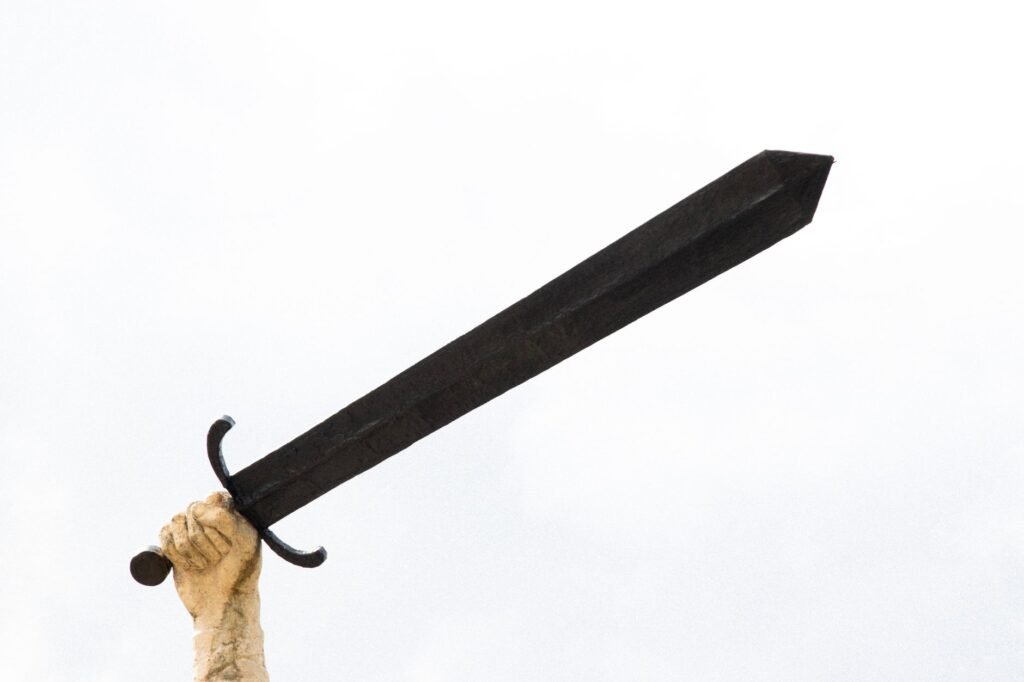
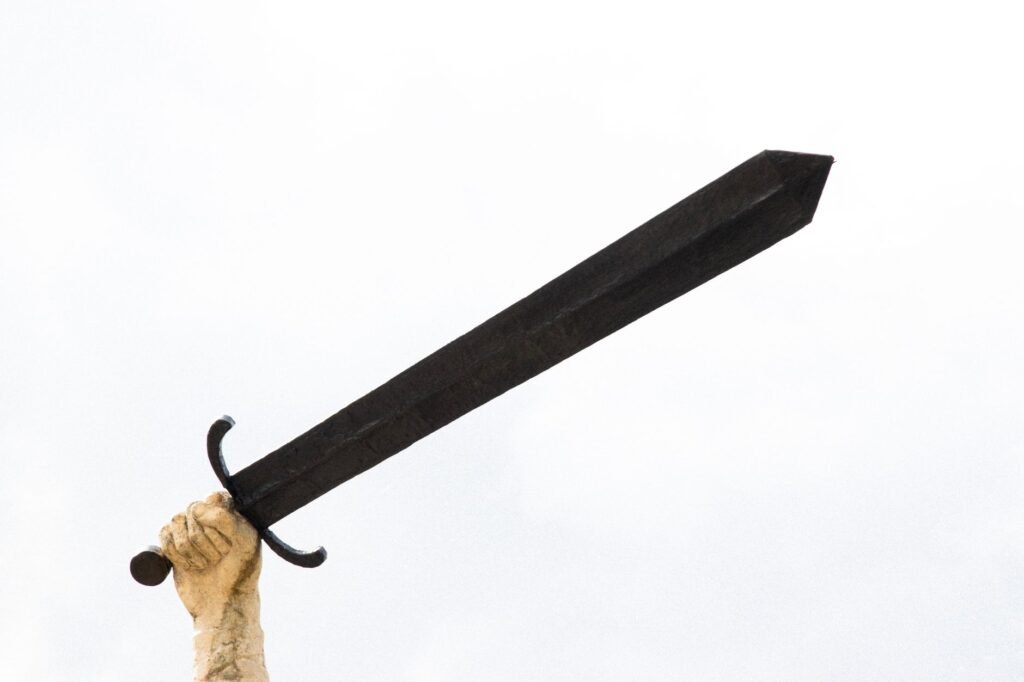
The Sword of Nuada, often called the Sword of Light, is one of the best-known magical weapons in Irish mythology. It belongs to Nuada Airgetlám—Nuada of the Silver Hand—who is a major king and warrior of the Tuatha Dé Danann, the divine or semi-divine people of early Irish myth. In later tradition, the sword became one of the Four Treasures of the Tuatha Dé Danann, together with the Lia Fáil (Stone of Destiny), the Spear of Lugh, and the Cauldron of the Dagda.
As a mythic object, the Sword of Nuada represents more than military power. It symbolizes rightful sovereignty, invincibility in battle, and the idea that legitimate kingship is inseparable from sacred authority. Like many legendary weapons in Celtic tradition, it is both an instrument of war and a sign of status, identity, and cosmic order.
Origin and Meaning
The name Nuada appears in Old Irish tradition as Nuada Airgetlám, usually translated as Nuada of the Silver Hand. The meaning of Airgetlám is straightforward: airgead or airget relates to silver, and lám means hand. The sword itself is not named in all early sources in exactly the same way, and the modern phrase “Sword of Light” is a descriptive label used in later retellings and translations.
In Irish mythological literature, the sword is sometimes associated with the broader category of ceithri saetha na Tuatha Dé Danann—the four treasures of the Tuatha Dé Danann. In that context, the weapon is not merely a personal sword but part of a mythic set of royal objects that help define the legitimacy and power of the Tuatha Dé Danann.
The title Sword of Light reflects a common motif in Celtic and broader Indo-European traditions: a weapon that shines, reveals truth, or cannot be resisted. However, it is important to distinguish later literary naming from the older medieval Irish texts, which do not always present the object with the same level of fixed nomenclature found in modern summaries.
Historical Context
The Sword of Nuada belongs to the world of medieval Irish mythography, not to recoverable historical Ireland. Our knowledge of it comes primarily from texts written down by Christian scribes who preserved much older oral traditions. These manuscripts combine mythology, pseudo-history, genealogy, and literary invention.
The relevant cultural background includes:
- Pre-Christian Irish traditions, in which gods and supernatural figures were remembered as heroic ancestors or legendary kings.
- Medieval Irish learned culture, where poets and historians attempted to organize local myths into coherent origin stories.
- Sovereignty mythology, a recurring theme in which kingship is validated by sacred objects and ritual legitimacy.
In many Irish myths, the Tuatha Dé Danann are portrayed as a highly skilled supernatural people associated with wisdom, magic, craftsmanship, and royal authority. Their treasures, including Nuada’s sword, mark them as possessors of a superior and sacred civilization. These objects function less like ordinary weapons and more like emblems of an idealized sacred age.
Main Characteristics
The Sword of Nuada is identified by several mythic characteristics, though details vary by source and retelling.
Core attributes
- Magical potency: It is a supernatural weapon, not a mundane blade.
- Association with kingship: It belongs to Nuada, a rightful king of the Tuatha Dé Danann.
- Battle effectiveness: It is linked with victory and irresistible force.
- Symbolic luminosity: The “Sword of Light” idea suggests brilliance, clarity, and divine power.
- Mythic status: It is one of the Four Treasures, placing it among the most important objects in Irish myth.
Identifying features
The sources are not unanimous in giving a detailed physical description. Unlike some famous swords in later literature, the Sword of Nuada is not consistently described with ornament, size, or manufacture in the surviving texts. Its significance lies more in its function and symbolic role than in its appearance.
| Feature | Description |
|---|---|
| Owner | Nuada Airgetlám |
| Tradition | Irish mythology |
| Type | Magical sword / royal treasure |
| Main symbolism | Sovereignty, victory, divine authority |
| Literary status | One of the Four Treasures of the Tuatha Dé Danann |
Family and Genealogy
Because the Sword of Nuada is an object rather than a person, it does not have family, spouses, or descendants in the usual sense. Its “genealogy” is mythic and cultural rather than biological.
Nuada’s mythic identity
Nuada is traditionally a king of the Tuatha Dé Danann and a central figure in the mythic cycle surrounding their arrival in Ireland. He is remembered for:
- His kingship among the Tuatha Dé Danann
- Losing his hand in battle
- Receiving a silver replacement hand, hence the epithet Airgetlám
- Continuing to play a major role in the divine history of Ireland
Mythic relationships
The sword belongs to Nuada, but its significance extends to the broader Tuatha Dé Danann, especially their kingship and collective identity. It is conceptually related to the other treasures of the same people and may be understood as a dynastic or civilizational emblem rather than a private possession.
Symbols
The Sword of Nuada is associated with several important symbolic themes.
Common symbolic meanings
- Light: Implies purity, truth, divine revelation, and victory.
- Sword: Represents war, justice, authority, and the power to cut through falsehood.
- Silver: Linked with brilliance, preciousness, and otherworldly craftsmanship in Irish tradition.
- Royal treasure: Suggests sacred legitimacy and inherited authority.
Symbolic interpretation
In mythological terms, swords often stand for more than violence. They can embody lawful rule, discernment, and the capacity to defend the cosmic or social order. The Sword of Nuada fits this pattern well: it is not only a weapon used in battle, but a sign that the Tuatha Dé Danann possess rightful and sacred power.
Sacred Animals
No specific sacred animal is universally and directly associated with the Sword of Nuada in the surviving primary sources. However, in the larger world of Irish mythology, certain animals often accompany or symbolize royal and heroic figures.
Broader symbolic associations in Irish tradition
- Boars: Often linked with warrior prestige and hunt imagery.
- Horses: Associated with sovereignty, nobility, and movement between worlds.
- Cattle: Central to wealth, power, and kingship in early Irish society.
- Ravens and crows: Frequently connected to war and fate in Celtic lore.
These associations are contextual rather than direct. They reflect the cultural environment of the myth rather than a documented cult of the sword itself.
Sacred Plants
No canonical sacred plant is specifically attached to the Sword of Nuada in the standard medieval sources. Still, plants important in Celtic myth may appear in the wider symbolic landscape of Irish legendary objects.
Commonly relevant plants in Celtic symbolism
- Oak: Strength, endurance, and sacred authority.
- Ash: Wisdom and protection in later Celtic traditions.
- Hazel: Knowledge and inspiration, especially in Irish lore.
- Yew: Longevity, death, and otherworldly association.
These are not official plant symbols of the sword, but they help situate it within a broader mythic world where natural objects and sacred power are closely connected.
Sacred Places
The Sword of Nuada is not tied to a single universally recognized shrine or temple in the way some deities or relics are. However, its mythic setting is strongly connected to several important places in Irish tradition.
Key locations in the mythic landscape
- Ireland: The principal stage for the myths of the Tuatha Dé Danann.
- Tara: In later tradition, the center of kingship and sovereignty in Ireland.
- The Otherworld: The supernatural realm from which the Tuatha Dé Danann are sometimes said to have arrived.
- Battlefields of myth: Places where the Tuatha Dé Danann fought the Fomorians and other adversaries.
Place and meaning
The idea of a royal treasure carried by a rightful king naturally aligns the sword with centers of authority, especially Tara. Even when the texts do not explicitly name a cult site, the sword belongs to a mythological geography of kingship and sacred power.
Powers and Attributes
The Sword of Nuada is best understood through its mythic functions.
Main powers
- Invincibility or exceptional battle power
- Association with legitimate sovereignty
- Connection to divine craftsmanship
- Symbolic illumination and truth
- Status as a treasure of an ancient people
Domain and responsibilities
The sword does not “rule” in the way a deity does, but it participates in the larger royal order of the Tuatha Dé Danann. Its role is closely linked to:
- Defense of the community
- Victory in battle
- Validation of kingship
- Preservation of mythic authority
In that sense, the sword is an emblem of the sacred duty to protect and govern.
Main Myths
The Sword of Nuada appears within the broader mythological cycle of the Tuatha Dé Danann. While the exact prominence of the sword varies, several related narratives help define its significance.
Arrival and treasures of the Tuatha Dé Danann
The Tuatha Dé Danann are said to have brought four major treasures from supernatural regions or learned lineages. These treasures demonstrate unmatched skill and magical power. The Sword of Nuada is one of these prized objects, emphasizing the group’s superiority in warfare and rulership.
Nuada’s kingship
Nuada is remembered as a king who lost his hand in battle. In many traditions, physical wholeness is linked to the fitness to rule. Nuada’s silver hand restored him in a symbolic sense, allowing him to remain associated with sovereignty. His sword belongs to this same narrative of restored authority.
Conflict with the Fomorians
The Tuatha Dé Danann are often opposed by the Fomorians, who in later myth are portrayed as chaotic or antagonistic beings. In this conflict, the sword would naturally belong to the side of order, culture, and rightful rule. The sword’s power helps embody the struggle between civilized sovereignty and destructive opposition.
The Four Treasures motif
In later medieval retellings, the treasures became a structured set:
| Treasure | Associated figure | Function |
|---|---|---|
| Lia Fáil | Often linked to kingship | Cries out under the rightful king |
| Sword of Nuada / Sword of Light | Nuada | Ensures victory and protection |
| Spear of Lugh | Lugh | Unbeatable in battle |
| Cauldron of the Dagda | Dagda | Provides abundance and sustenance |
This systematization may reflect scholarly organization in medieval Ireland rather than a single ancient fixed list in oral tradition.
Relationship with Other Mythological Figures
The Sword of Nuada is inseparable from the figures around it.
Nuada Airgetlám
Nuada is the primary owner and the figure most closely tied to the sword. As king, he embodies the sword’s functions of authority, warfare, and legitimacy.
Lugh
Lugh is another major hero of the Tuatha Dé Danann and later becomes a central royal and martial figure. In the framework of the Four Treasures, Lugh’s spear often receives greater emphasis in battle narratives, while Nuada’s sword remains a symbol of ancient kingship and martial excellence.
The Dagda
The Dagda, father-like figure and lord of abundance, is not directly connected to the sword, but his cauldron complements the sword in the Four Treasures system. Together they represent military strength and prosperity.
The Fomorians
As mythic adversaries, the Fomorians form the background against which the sword’s protective and warlike qualities make sense. The sword signifies the defense of order against hostile forces.
Worship and Cult
There is no clear evidence of a historical cult of the Sword of Nuada in the way one might speak of formal worship for a deity or shrine. It is a mythic object preserved in literature, not a surviving ritual artifact with a documented devotional practice.
Possible cultural functions
- Symbolic legitimacy in kingship traditions
- Literary reinforcement of sacred rulership
- Mythic memory of a prestigious heroic past
In medieval Irish society, sacred objects and stories could contribute to political ideology, even without direct ritual worship. The sword likely functioned as a literary and symbolic expression of royal authority rather than an object of independent worship.
Ancient Sources
The Sword of Nuada is known from medieval Irish literature rather than from the classical Greco-Roman canon. As a result, sources such as Homer, Hesiod, or Ovid do not treat it directly.
Important Irish sources and traditions
The following bodies of literature are relevant:
Lebor Gabála Érenn (The Book of Invasions)
A major medieval compilation that includes the Tuatha Dé Danann and their treasures.Cath Maige Tuired (The Second Battle of Mag Tuired)
One of the most important mythological battle narratives involving the Tuatha Dé Danann.Dindshenchas traditions
Place-lore texts that preserve mythic and legendary associations.Later medieval and early modern retellings
These often clarify or expand the treasure cycle.
On source variation
Different manuscripts and retellings may vary in detail, emphasis, and terminology. Some are more explicit about the sword as one of the Four Treasures, while others foreground Nuada’s kingship and silver hand more than the weapon itself.
Roman Equivalent
There is no exact Roman equivalent of the Sword of Nuada. Roman religion and myth did not preserve this object as part of their own tradition.
However, in a broad comparative sense, it can be loosely compared with other sacred or royal weapons in ancient Indo-European and classical traditions, such as:
- The divine weapons of Jupiter or Mars in Roman imagination
- The sword symbols of royal legitimacy in heroic epic
- Legendary weapons that confer authority or victory
These are only functional comparisons, not historical equivalences. The Sword of Nuada remains distinctively Irish and Celtic in meaning.
Influence on Modern Culture
The Sword of Nuada has become part of modern retellings of Celtic mythology and Irish legend. Its influence is seen especially in literature, fantasy, and popular media that draw on mythic treasure motifs.
Modern cultural presence
- Fantasy literature: Often used as inspiration for enchanted swords and royal relics.
- Role-playing games: Celtic myth frequently informs weapon naming and artifact design.
- Comics and film-adjacent adaptations: The broader myth of Nuada has been adapted and reimagined in modern fantasy settings.
- Art and illustration: The sword appears in depictions of the Four Treasures and Tuatha Dé Danann imagery.
- Neopagan and mythic revival contexts: The weapon may be referenced as part of a reconstructed or symbolic Celtic heritage.
In popular imagination
Modern audiences often merge several Irish legendary swords into a single “Sword of Light” archetype. While this makes the myth more accessible, it can also blur distinctions between different texts and traditions. The Sword of Nuada is therefore best understood in its own medieval Irish context.
Curiosities
- The Sword of Nuada is often discussed alongside the Four Treasures of the Tuatha Dé Danann, even though the exact formulation of that set can vary by source.
- The phrase “Sword of Light” is widely used in modern English, but it is not always the primary ancient wording.
- Nuada’s greatest mythic distinction is not the sword itself but his silver hand, which made him an enduring symbol of wounded yet restored kingship.
- In Irish myth, treasures often matter as much as people, because objects can embody legitimacy, memory, and divine favor.
- The sword’s importance is greater in symbolic and scholarly reconstructions than in any single uniform ancient narrative.
- The Tuatha Dé Danann treasures are among the most influential mythic objects in Irish tradition, shaping later fantasy depictions of enchanted relics.
Frequently Asked Questions
1. What is the Sword of Nuada?
The Sword of Nuada is a magical weapon from Irish mythology, associated with Nuada Airgetlám, king of the Tuatha Dé Danann. It is often identified as the Sword of Light and counted among the Four Treasures of the Tuatha Dé Danann.
2. Why is it called the Sword of Light?
The name emphasizes its supernatural brilliance and power. The “Light” aspect reflects later translation and interpretation, highlighting the sword’s divine or otherworldly qualities.
3. Is the Sword of Nuada mentioned in ancient Irish sources?
Yes. It appears in medieval Irish mythological literature, especially traditions surrounding the Tuatha Dé Danann and the Four Treasures. However, details vary between texts.
4. Does the sword have a direct Roman equivalent?
No exact Roman equivalent exists. It can only be compared broadly to other legendary weapons that symbolize divine favor or royal authority.
5. What are the Four Treasures of the Tuatha Dé Danann?
They are a set of four legendary objects associated with the Tuatha Dé Danann: the Lia Fáil, the Sword of Nuada, the Spear of Lugh, and the Cauldron of the Dagda.
6. Who was Nuada?
Nuada Airgetlám was a king of the Tuatha Dé Danann in Irish mythology. He is famous for losing a hand in battle and receiving a silver replacement hand.
7. Is the sword worshipped today?
Not in a historical or traditional cultic sense. It survives mainly as a mythological and literary object, though it may be referenced in modern spiritual, artistic, or fantasy contexts.
8. Why is the Sword of Nuada important?
It matters because it represents sacred kingship, martial power, and the mythic heritage of Ireland. It is one of the central treasures associated with the Tuatha Dé Danann.
Conclusion
The Sword of Nuada (Sword of Light) is one of the most enduring symbols of Irish mythological tradition. As a magical royal weapon, it represents more than battlefield power: it embodies sovereignty, legitimacy, and the sacred authority of the Tuatha Dé Danann. Its place among the Four Treasures makes it a key object in the mythic imagination of medieval Ireland and in modern interpretations of Celtic heritage.
Although surviving sources do not always describe it in identical terms, the sword’s meaning is consistent. It stands for the union of kingship and supernatural force, a recurring theme in Irish mythology. For this reason, the Sword of Nuada remains an important emblem of the legendary past and a lasting influence on the modern imagination.

Orin Vale has spent the better part of two decades tracing the threads that connect the world’s oldest stories — from the halls of Asgard to the banks of the Nile, from Olympus to the jungles of the Maya. What began as a childhood fascination with flood myths and trickster gods grew into years of independent study across comparative mythology and ancient religion, always chasing the same question: what did these stories mean to the people who first told them? Orin writes for readers who want more than trivia — the ones looking for the beliefs, fears, and truths that myths were built to carry.