Is the Green Man a Celtic symbol
The question “Is the Green Man a Celtic symbol?” is common in discussions of mythology, folklore, and sacred art. The short answer is not exactly. The Green Man is widely associated with nature, vegetation, renewal, and the cycle of growth, and these themes certainly overlap with ideas found in Celtic traditions. However, the Green Man is not securely documented as an ancient Celtic deity or a uniquely Celtic symbol. He is better understood as a broadly European decorative and folkloric motif that later became linked to ideas of wilderness, spring, and natural life.
This distinction matters because the Green Man appears in many contexts: medieval church carving, Victorian revivalism, modern Pagan spirituality, environmental art, and popular culture. Some writers connect him to pre-Christian fertility gods, while others emphasize that the figure as commonly known today is mainly a later interpretation of older plant and mask imagery. In other words, the Green Man is Celtic-adjacent in modern imagination, but his origins are more complex and not exclusively Celtic.
Origin and Meaning
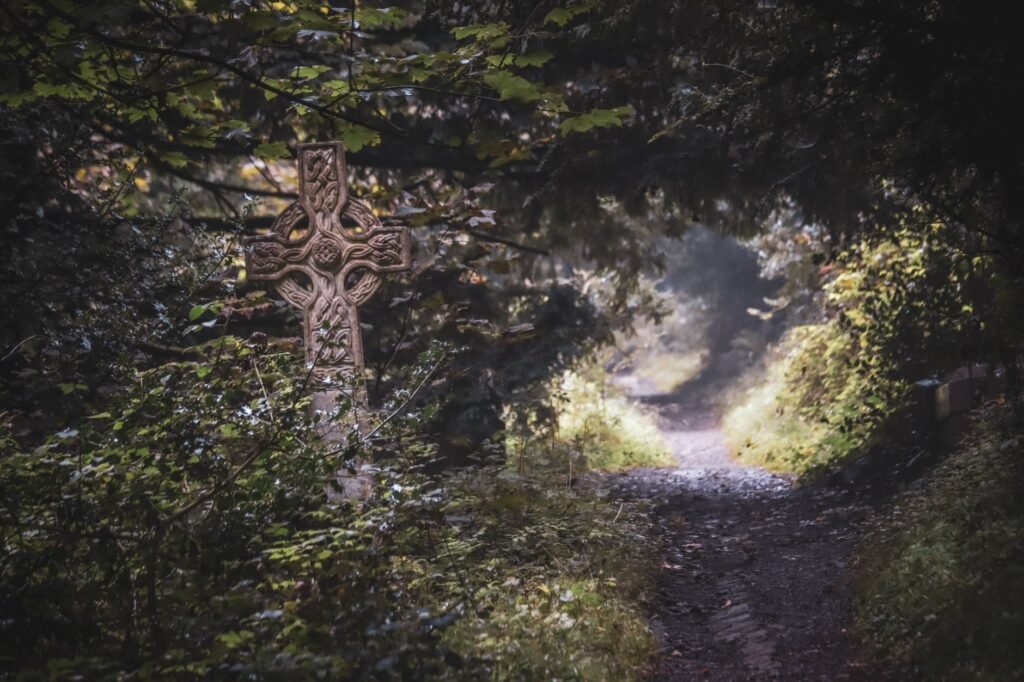
The phrase “Green Man” is a modern English term. It is not an attested ancient name for a pre-Christian deity. The figure itself appears in art and architecture as a face surrounded by or formed from leaves, vines, or other vegetal forms. In some cases, foliage seems to sprout from the mouth, eyes, or ears; in others, the face is entirely enveloped by plant matter.
Etymology
The name combines:
- Green, referring to plants, vegetation, and living growth
- Man, referring to the human face or figure represented in the motif
The term gained currency in modern scholarship and popular writing, especially in relation to church carvings and folk symbolism. It does not prove an ancient cult title.
Historical Origin
The imagery has multiple possible roots:
- Medieval architectural ornament in churches and cathedrals
- Classical and late antique leaf masks
- Folkloric figures associated with spring, fertility, or the wild
- Renaissance and later decorative art, where leafy faces were used as ornament
Because similar imagery appears across different regions and periods, scholars are cautious about assigning a single origin. The Green Man may represent a family of related motifs rather than one continuous religious figure.
Historical Context
The Green Man’s meaning depends heavily on the historical setting in which he appears.
Medieval Christian Context
Many of the best-known Green Man carvings are found in churches, monasteries, and cathedrals in Britain and elsewhere in Europe. These are often dated to the Romanesque, Gothic, and later medieval periods. Their presence in Christian buildings does not automatically mean they are Christian symbols in a doctrinal sense. Medieval churches frequently incorporated inherited decorative forms, symbolic warnings, or localized artistic traditions.
Possible interpretations include:
- A decorative motif with no strong theological meaning
- A reminder of the natural world under God’s creation
- A symbol of transience, death, and rebirth
- A surviving ornamental image with pre-Christian resonances
Folklore and Seasonal Imagery
In later European folklore, especially from the early modern period onward, “green” often signified life, spring, fertility, and the power of vegetation. This made the Green Man a useful symbol for stories about:
- The return of spring
- The vitality of forests
- The regeneration of crops
- The mysterious power of wild places
Modern Revival
The Green Man became especially prominent in the 19th and 20th centuries, when antiquarians, folklore collectors, artists, and neopagan writers began to reinterpret older carvings. In modern usage, he is often treated as a nature spirit or vegetation god, sometimes linked to Celtic traditions even when the historical evidence is limited.
Main Characteristics
The Green Man is identified mainly by his visual features rather than by a fixed mythological narrative.
Common Traits
- A human face
- Leaves, vines, shoots, or branches surrounding the face
- Vegetation emerging from the mouth, nostrils, eyes, or ears
- Sometimes a face made entirely of foliage
- Occasionally a mask-like or grotesque expression
Variants
Scholars and art historians often distinguish several common forms:
| Type | Description | Common Context |
|---|---|---|
| Leaf Mask | A face framed by foliage | Classical, medieval, and decorative art |
| Foliate Head | Human features integrated with leaves and vines | Church sculpture, manuscripts |
| Dismembered or Sprouting Face | Vegetation appears to grow from openings in the face | Later medieval and folklore imagery |
| Tree Man | A human body or head merged with a tree | Renaissance and modern art |
Symbolic Meaning
The figure is usually linked to:
- Growth
- Renewal
- Vital force
- The wild
- Seasonal change
- The interdependence of humans and nature
Because these meanings are broad, the Green Man has been adapted by many cultures and movements.
Family and Genealogy
Unlike gods from structured mythological pantheons, the Green Man has no universally accepted genealogy. There is no single ancient myth that clearly names his parents, spouse, or children.
In Celtic and Related Interpretations
When modern writers place the Green Man into a Celtic framework, he is sometimes associated with:
- Vegetation deities
- Forest spirits
- Horned gods
- Sovereignty figures
- Seasonal dying-and-reborn gods
However, these are comparative interpretations, not established genealogies.
Related Legendary Figures
The Green Man is sometimes compared with:
- Cernunnos, the horned deity known from Gaulish iconography
- The Dagda, a major Irish deity associated with abundance and sovereignty
- Lugh, a figure connected with skill and light, though not specifically with the Green Man motif
- Jack in the Green, a seasonal folkloric character from later English tradition
These comparisons are useful for understanding symbolic overlaps, but they should not be confused with direct identification.
Symbols
The Green Man is primarily a symbolic and visual figure, and his associated symbols are strongly rooted in botanical imagery.
Common Symbols
- Leaves: life, growth, renewal
- Vines and ivy: persistence, binding life-force, cyclical growth
- Branches: arboreal vitality, connection with forests
- Oak leaves: strength, endurance, sacred groves in some European traditions
- Mouth and breath imagery: the circulation of life through the body and the natural world
Associated Colors
The dominant color is naturally green, but other symbolic colors may appear in modern interpretations:
- Brown: earth, woodland, decay returning to soil
- Gold: sunlight, harvest, seasonal abundance
- White: spring blossoms, purity, or ritual renewal in later symbolism
Symbolic Importance
The Green Man often suggests a tension between:
- Human identity
- Vegetative life
- Wild nature
- Death and regeneration
This makes him especially powerful in environmental and seasonal symbolism.
Sacred Animals
There is no fixed set of sacred animals universally associated with the Green Man in ancient sources. Still, modern and comparative traditions often connect him with woodland and fertility animals.
Animals Commonly Linked in Later Traditions
- Stags and deer: forests, virility, wild sovereignty
- Hares and rabbits: fertility, spring
- Birds: seasonal return, nesting, song
- Boars: wildness and forest power in some Celtic contexts
- Serpents: earth energy, renewal, hidden life
Symbolic Significance
These animals are not part of a single canonical cult of the Green Man. Rather, they reflect the broader symbolic field of woodland life and regenerative nature. In modern Pagan and artistic use, the Green Man is often imagined in companionship with animals that embody wilderness and seasonal change.
Sacred Plants
Plants are central to Green Man symbolism, though there is no universally agreed ancient list of sacred species.
Frequently Associated Plants
- Oak: endurance, strength, long-lived forest power
- Ivy: attachment, survival, evergreen life
- Holly: winter resilience, protection
- Vines: growth, fruitfulness, interlacing life
- Leaves and spring foliage: renewal and abundance
- Branches and buds: emergence after dormancy
Importance of Plant Imagery
The Green Man is often described not as a botanical deity in a strict sense, but as a humanized expression of vegetation itself. In art, the face encircled by leaves visually merges human and plant life, suggesting that nature is alive, active, and spiritually significant.
Sacred Places
There are no verified ancient temples dedicated specifically to the Green Man as a named deity. Nevertheless, the figure is strongly associated with particular kinds of places.
Common Settings
- Churches and cathedrals with carved foliate heads
- Woodlands and forests in folklore and modern spirituality
- Gardens and parks in contemporary art and public sculpture
- Hills, groves, and springs in romantic and neopagan imagination
Celtic Resonances
In Celtic studies, sacred natural places often include:
- Groves
- Sacred trees
- Well sites
- Hilltops
- River landscapes
Because the Green Man is often tied to vegetation and land spirit symbolism, modern interpreters sometimes place him in these landscapes. Yet this is an interpretive association rather than a documented ancient cult geography.
Powers and Attributes
The Green Man is usually seen as a figure of natural power rather than a deity with a fixed mythic office.
Common Attributes
- Regrowth
- Fertility
- Seasonal transformation
- Wildness
- Protection of the natural world
- Link between humanity and vegetation
In Modern Spirituality
In contemporary Paganism and nature-centered spirituality, the Green Man may be treated as:
- A forest spirit
- A personification of the life force
- A symbol of masculine nature energy
- A counterpart to the Goddess in earth-centered religion
These are modern spiritual interpretations and should not be projected uncritically onto antiquity.
Main Myths
There is no single ancient myth cycle about the Green Man comparable to the stories of Zeus, Odin, or Cernunnos. Instead, the Green Man is best understood through recurring motifs and later legends.
Recurring Narrative Themes
- A face emerges from leaves or trees
- Human life is inseparable from the plant world
- The forest embodies hidden vitality
- Nature dies and returns in seasonal cycles
- The wild is both beautiful and untamed
Folkloric Parallels
The Green Man is often grouped with seasonal characters such as:
- Jack in the Green
- The Garland King
- The Wild Man
- May King rituals
- Maypole festivities
These traditions vary by region and period. Some may preserve older ritual patterns, while others are relatively late customs shaped by local celebration and social display.
The Celtic Question
If the Green Man is called “Celtic,” it is usually because his symbolism resembles themes present in Celtic art and lore: sacred trees, otherworldly forests, seasonal renewal, and nature spirits. Yet resemblance is not proof of direct descent.
Relationship with Other Mythological Figures
The Green Man is often compared with figures from Celtic and wider European mythologies, but these relationships are interpretive rather than fixed by ancient texts.
Comparable Figures
| Figure | Tradition | Relationship to Green Man |
|---|---|---|
| Cernunnos | Gaulish/Celtic | Shared association with nature and animals; not the same figure |
| The Green Knight | Arthurian literature | Later literary echo of vegetal or wild symbolism |
| Jack in the Green | English folklore | Seasonal, leafy figure with close thematic overlap |
| The Wild Man | European folklore | Represents untamed nature, sometimes conflated with Green Man imagery |
| Dionysus | Greek tradition | Linked to vegetation and ecstatic life, but culturally distinct |
Important Distinction
Some modern authors merge these figures too freely. A careful scholarly approach keeps their cultural origins separate while acknowledging common themes such as fertility, wildness, and seasonal renewal.
Worship and Cult
There is no confirmed ancient cult of the Green Man in the way there were cults for documented deities.
Medieval and Later Uses
His images appear in:
- Church sculpture
- Marginal manuscript decoration
- Architectural ornament
- Folk festivals
- Modern ritual and neo-pagan practice
Offerings and Rituals
In contemporary settings, some people honor the Green Man through:
- Seasonal celebrations in spring or at Maytime
- Leafy garlands and floral decorations
- Nature walks or woodland rituals
- Environmental or ecological symbolism
These practices are modern devotional or commemorative forms, not direct survivals from a demonstrable ancient cult.
Festival Connections
The Green Man is often associated with:
- May Day
- Beltane in modern Paganism
- Spring equinox celebrations
- Harvest festivals in some modern symbolic frameworks
Again, these associations are mostly modern reconstructions or comparative links.
Ancient Sources
There are no classical authors who clearly describe the Green Man as a named deity in the way ancient writers describe Greek or Roman gods. That absence is important.
What Ancient and Medieval Sources Do Show
Primary sources that help contextualize the motif include:
- Classical art and decorative masks that show foliate or vegetal faces
- Medieval church carvings across Europe
- Manuscript illumination with leaf-human hybrids
- Folklore collections from later centuries
Classical and Near-Classical Parallels
While not direct evidence for the Green Man, related imagery can be studied in:
- Roman decorative leaf masks
- Late antique vegetal ornament
- Classical nature symbolism
- Medieval bestiaries and marginalia
Scholarly Caution
Because there is no single authoritative ancient text on the Green Man, any claim that he was definitely a Celtic god in antiquity should be treated with caution.
Roman Equivalent
There is no exact Roman equivalent to the Green Man. However, some Roman figures and motifs are sometimes discussed alongside him.
Possible Comparisons
- Silvanus: Roman god associated with woods and countryside
- Faunus: pastoral and wild associations
- Priapus: fertility symbolism, though quite different in character
- Leaf masks and vegetative ornament in Roman art
These parallels are partial at best. The Green Man is not simply the Roman Silvanus under another name. The visual and symbolic overlap is useful, but the equivalence is not precise.
Influence on Modern Culture
The Green Man has become a major figure in modern culture, especially in Britain, Ireland, and other parts of the English-speaking world.
Literature
The Green Man appears in:
- Fantasy fiction
- Gothic literature
- Environmental poetry
- Neo-folklore writing
- Children’s fantasy and myth retellings
Writers often use him as a symbol of:
- Nature’s resilience
- Ancient wisdom
- The tension between civilization and wilderness
Art and Architecture
Modern artists and architects use Green Man imagery in:
- Sculpture
- Stained glass
- Public murals
- Garden design
- Decorative ironwork and woodcarving
Television, Film, and Games
The Green Man has inspired or influenced:
- Fantasy films and television
- Role-playing games
- Video game creature design
- Comic books and graphic novels
He is often used as a visual shorthand for ancient woodland power, hidden nature magic, or old-world mystery.
Environmental Symbolism
In recent decades, the Green Man has also become a popular symbol for:
- Conservation
- Ecological awareness
- Human responsibility toward the environment
This modern usage is one reason he remains culturally relevant.
Curiosities
Interesting Facts
- The Green Man is often found in churches, which surprises many people who assume he must be purely pagan.
- The term “Green Man” is modern; older carvings were not necessarily called that by their original makers.
- Similar foliate faces appear in many parts of Europe, not only in Celtic regions.
- Some examples are so stylized that it is difficult to tell whether they represent a person, a mask, or pure ornament.
- The Green Man is frequently confused with Jack in the Green, but they are not identical traditions.
- In modern folklore, he is sometimes treated as a guardian of forests rather than a historical god.
- The figure’s popularity grew significantly during the 19th-century antiquarian revival.
Frequently Asked Questions
1. Is the Green Man a Celtic symbol?
Not definitively. The Green Man is often associated with Celtic themes such as nature, trees, and seasonal renewal, but the figure is not securely proven to be an ancient Celtic symbol. He is better described as a widespread European motif later interpreted through Celtic and neopagan lenses.
2. Was the Green Man a Celtic god?
There is no conclusive evidence that the Green Man was a specific Celtic god. Some modern interpretations connect him to nature deities or forest spirits, but this remains speculative.
3. Why is the Green Man found in churches?
Many medieval churches contain Green Man-style carvings because the motif was part of the decorative vocabulary of the period. The exact meaning varies by place and context, and not every example has the same symbolism.
4. What does the Green Man represent?
He usually represents growth, fertility, renewal, the life force, and the cycle of nature. In some contexts, he also symbolizes the relationship between humanity and the natural world.
5. Is the Green Man the same as Cernunnos?
No. Cernunnos is a distinct deity known from Gaulish iconography and inscriptions. The Green Man and Cernunnos are sometimes compared because both are linked with nature, but they are not the same figure.
6. Is the Green Man pagan or Christian?
He is not strictly one or the other. The motif appears prominently in Christian medieval art, but it is often interpreted as having pagan or pre-Christian resonances. His meaning depends on context.
7. Where can Green Man carvings be found?
They are found in churches, cathedrals, abbeys, and other historic buildings, especially in Britain and across parts of Europe. They also appear in modern public art and gardens.
8. Why do people connect the Green Man with Celtic culture?
Because Celtic traditions often emphasize sacred trees, landscapes, and seasonal transformation, the Green Man fits well into those themes. However, this connection is interpretive rather than firmly established by ancient Celtic texts.
Conclusion
The Green Man is one of the most enduring and adaptable figures in European symbolic culture. He is strongly associated with vegetation, renewal, and the living power of nature, which explains why many people link him to Celtic symbolism. Yet the historical record does not support a simple answer that the Green Man is an ancient Celtic symbol in a strict sense.
A more accurate conclusion is that the Green Man is a widespread folkloric and artistic motif with possible pre-Christian resonances, later embraced by Celtic revivalism, Pagan spirituality, and environmental symbolism. His importance lies precisely in this layered history: he is at once medieval, folkloric, artistic, and modern. The Green Man continues to fascinate because he expresses a timeless human concern — the relationship between humanity, the wild, and the renewing force of the natural world.

Orin Vale has spent the better part of two decades tracing the threads that connect the world’s oldest stories — from the halls of Asgard to the banks of the Nile, from Olympus to the jungles of the Maya. What began as a childhood fascination with flood myths and trickster gods grew into years of independent study across comparative mythology and ancient religion, always chasing the same question: what did these stories mean to the people who first told them? Orin writes for readers who want more than trivia — the ones looking for the beliefs, fears, and truths that myths were built to carry.