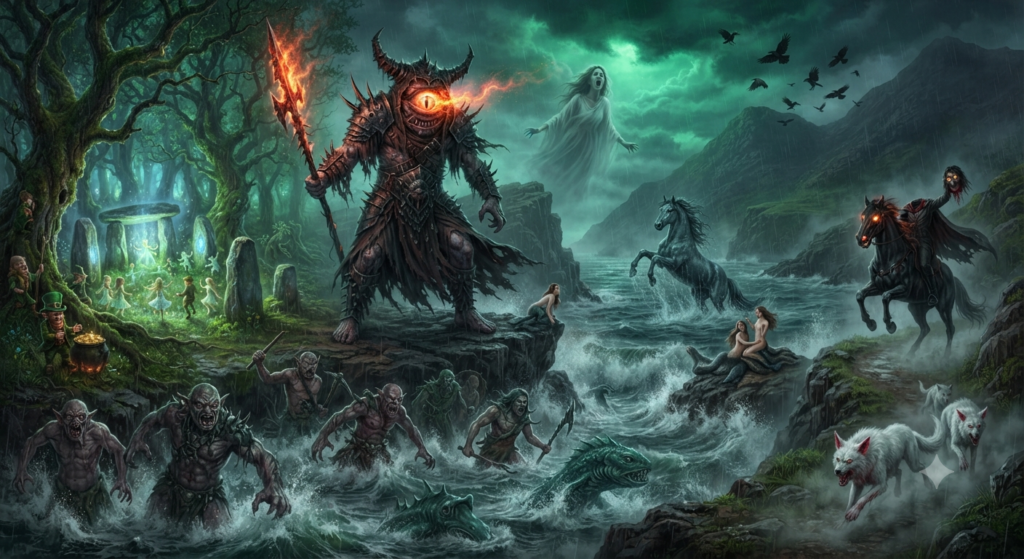
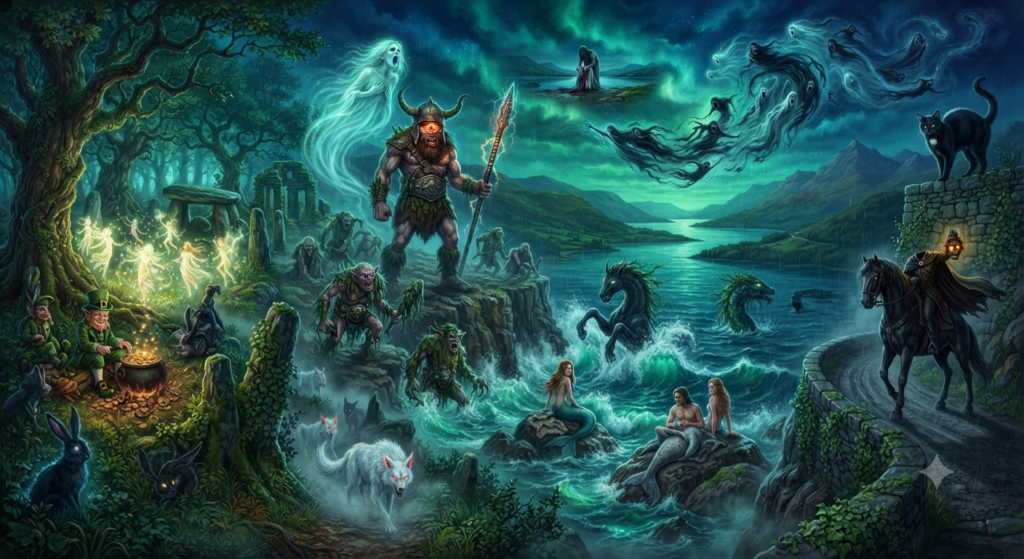
Celtic mythology’s creatures range from monstrous giants locked in cosmic conflict with the gods to the death omens, water spirits, and fairy folk that populate the rich folklore of Ireland, Scotland, and Wales. This guide brings together the essential creatures of the Celtic world, from Balor’s deadly eye to the mischievous leprechaun.
Giants and Ancient Adversaries
Balor
Balor, king of the monstrous Fomorians, possessed a single enormous eye capable of destroying anything in its gaze, ultimately defeated by his own grandson Lugh at the Second Battle of Mag Tuired.
Fomorians
The Fomorians were a race of chaotic, often monstrous beings associated with the sea and destruction, locked in recurring mythological conflict with the divine Tuatha Dé Danann for control of Ireland.
Afanc
The Afanc was a monstrous creature said to dwell in Welsh lakes, dragging unwary victims beneath the water, with various legends describing attempts to capture or banish it using oxen or chains.
Water Bull (Tarbh Uisge)
The Water Bull, or Tarbh Uisge, was a shapeshifting creature of Scottish and Irish loch folklore, generally considered less overtly malevolent than the kelpie but still a powerful and mysterious water spirit.
Death Omens and Spirits of the Otherworld
Banshee
The banshee is a spirit whose mournful wailing was believed to foretell an impending death within a family, particularly those of old Irish lineage.
Dullahan
The Dullahan is a headless rider of Irish folklore who carries his own head and is believed to appear as an omen of imminent death, calling out the name of the person destined to die.
Bean Nighe
The Bean Nighe, or “washerwoman,” was a Scottish death omen spirit seen washing the bloodstained clothing of those about to die, closely related to the Irish banshee tradition.
Sluagh
The Sluagh were a host of restless, unforgiven dead believed to fly through the night sky in Scottish folklore, sometimes said to seek out and carry away vulnerable souls.
Cŵn Annwn
The Cŵn Annwn were spectral white hounds with red ears belonging to Arawn, king of the Welsh Otherworld, said to hunt across the night sky as harbingers of death.
Dearg Due
The Dearg Due is an Irish folkloric figure said to rise from the grave to seek revenge on those who wronged her in life, often described in terms that closely parallel later vampire folklore.
Water and Shapeshifting Creatures
Selkie
Selkies were seal-folk of Scottish and Irish folklore who could shed their sealskin to walk on land as humans, their stories often involving tragic love and eventual return to the sea.
Kelpie
The kelpie was a shapeshifting water spirit of Scottish folklore, often appearing as a beautiful horse to lure unwary travelers onto its back before dragging them beneath the water.
Each Uisge
Considered even more dangerous than the kelpie, the Each Uisge haunted sea lochs and coastal waters, capable of devouring its victims entirely except for the liver, which would wash ashore afterward.
Merrow
Merrows were Irish mermaid and merman figures said to wear a magical red cap allowing them to travel between the sea and land, with tales often describing marriages between merrows and mortal fishermen.
Glaistig
The Glaistig was a Scottish spirit appearing as a woman with goat-like lower legs hidden beneath long robes, capable of both protective kindness toward livestock and dangerous, deceptive behavior toward men.
Fairy Folk and Tricksters
Aos Sí (Fairy Folk)
The Aos Sí, or “fairy folk,” were supernatural beings believed to dwell in ancient mounds and hills, generally regarded in later folklore as diminished, reimagined descendants of the once-worshipped Tuatha Dé Danann.
Púca
The Púca was a shapeshifting trickster spirit of Irish folklore, capable of taking animal or human form, known for playful mischief as well as occasional helpful guidance toward wayward travelers.
Leprechaun
The leprechaun, traditionally depicted as a solitary fairy shoemaker guarding hidden treasure, developed gradually through Irish folklore and later became one of the most internationally recognized, if heavily commercialized, Celtic folkloric figures.
Cat Sìth
The Cat Sìth was a large black fairy cat of Scottish folklore, believed capable of stealing the soul of the recently deceased if allowed to pass over their body before burial.
Cú Sídhe
The Cú Sídhe was a massive fairy hound of Otherworldly origin, said to hunt silently across the land and only bark three times before catching its prey, giving little warning to those in its path.
Clarifications and Distinctions
Banshee vs. Dullahan
While both are death omens in Irish folklore, the banshee is typically tied to a specific family line and announces death through wailing, while the Dullahan is a more general, actively pursuing figure who calls out the doomed person’s name directly.
Kelpie vs. Each Uisge
While often used interchangeably, the kelpie is generally associated with a single loch or river, while the Each Uisge roams more widely across sea lochs and coastal waters and is considered the more dangerous of the two water horses.
Is the Leprechaun Authentic Celtic Mythology?
While the leprechaun has genuine roots in medieval Irish fairy folklore, much of its familiar modern image, including the now-iconic green suit, developed through later folklore evolution and eventual popular and commercial reinterpretation.
Aos Sí: Fairy Folk vs. Gods
Later Irish folklore reimagined the once openly worshipped Tuatha Dé Danann as the Aos Sí, or fairy folk, a diminished but still supernaturally powerful class of beings dwelling within the land rather than openly ruling as gods.
Frequently Asked Questions
What is the most famous Celtic monster?
Balor, with his single destructive eye, and the banshee, as a widely recognized death omen, are among the most famous figures in Celtic monster and spirit folklore.
Are Celtic creatures gods or spirits?
Most Celtic creatures are spirits, monsters, or fairy folk rather than gods, though some, like the Fomorians and the Aos Sí, have complex origins connected to earlier divine or semi-divine traditions.
Why are there so many death omen spirits in Celtic folklore?
Death omens like the banshee, Dullahan, and Bean Nighe reflect a broader Celtic cultural preoccupation with fate, mortality, and the thin boundary between the living and the Otherworld.
What is the difference between a Celtic monster and a Celtic fairy?
Monsters like Balor or the Fomorians are generally dangerous adversaries defeated within myth, while fairy folk like the Aos Sí occupy a more ambiguous space, capable of both helping and harming those who encounter them.
Are water horses common across Celtic folklore?
Yes — water horse legends like the kelpie and Each Uisge appear widely across Scottish and Irish folklore, reflecting the cultural importance and inherent danger of lochs, rivers, and coastal waters.
Did every Celtic region have the same folklore creatures?
No — while common themes recur, specific creatures varied by region, with the Cŵn Annwn tied specifically to Wales and the Sluagh and Bean Nighe more closely associated with Scotland.
How did Christianity affect Celtic monster folklore?
Following Christianization, many Celtic supernatural beings were reframed as fairies, demons, or folkloric spirits rather than openly worshipped gods, though the underlying stories often persisted in altered form.
Do Celtic creatures still appear in modern popular culture?
Yes — figures like the banshee, kelpie, and leprechaun remain widely recognized today, frequently appearing in literature, film, and games drawing on Celtic folklore.

Orin Vale has spent the better part of two decades tracing the threads that connect the world’s oldest stories — from the halls of Asgard to the banks of the Nile, from Olympus to the jungles of the Maya. What began as a childhood fascination with flood myths and trickster gods grew into years of independent study across comparative mythology and ancient religion, always chasing the same question: what did these stories mean to the people who first told them? Orin writes for readers who want more than trivia — the ones looking for the beliefs, fears, and truths that myths were built to carry.