Kagutsuchi
Introduction
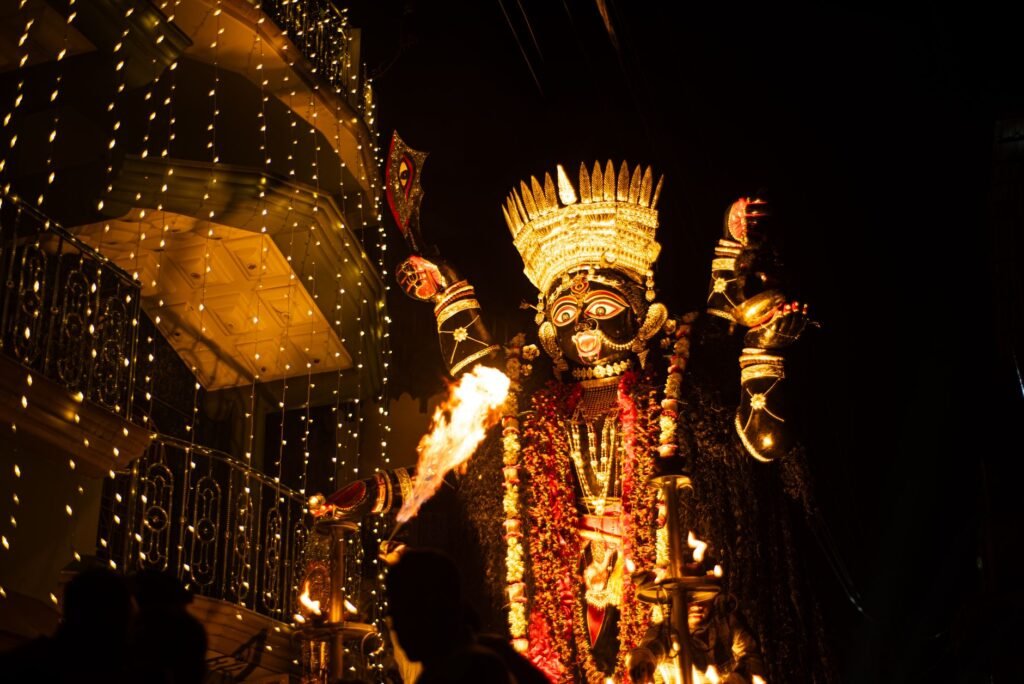
Kagutsuchi is a fire deity in Japanese mythology, best known as the god whose birth brings both creation and catastrophe. In the Kojiki and Nihon Shoki, two foundational early Japanese texts, Kagutsuchi’s emergence is tied to one of the most dramatic episodes in the mythic cycle: the death of the creator goddess Izanami and the origin of fire in the world.
As a kami of fire, Kagutsuchi occupies an important place in Shinto tradition and in the broader cultural imagination of Japan. He represents the dual nature of fire itself: a force that enables life through warmth, cooking, and industry, but also one that destroys homes, forests, and human lives. This ambivalence makes Kagutsuchi one of the most symbolically powerful figures in Japanese mythology.
Origin and Meaning
The name Kagutsuchi is usually written with kanji that suggest “blazing” or “shining” fire, though the exact etymology is debated. In classical sources, the deity is also called Homusubi (火之迦具土神 / 火産霊神 in various forms), a name often interpreted as meaning a fire-producing or fire-generating spirit.
Because early Japanese textual traditions were compiled from older oral material, scholars caution against treating the name as a fixed linguistic relic with a single secure derivation. Instead, the name reflects a mythic understanding of fire as both a physical element and a divine force.
Name Variants
Different sources preserve different forms of the fire deity’s name:
- Kagutsuchi
- Homusubi
- Hi no Kagutsuchi no Kami (“Fire-Blazing Deity”)
- Other orthographic variants in later religious and literary traditions
These variations reflect the fluidity of early Japanese myth and the merging of local fire cults into the classical pantheon.
Historical Context
Kagutsuchi belongs to the mythological world recorded in Japan’s earliest surviving historical and religious texts, especially the Kojiki (712) and Nihon Shoki (720). These works were compiled during the Nara period, when the Yamato court was consolidating political authority and shaping a shared cultural narrative that connected imperial legitimacy with divine ancestry.
Fire was central to early agrarian societies, but it was also dangerous and difficult to control. In premodern Japan, as elsewhere, communities depended on fire for daily survival while fearing its destructive power. This made fire deities especially significant in ritual life. Kagutsuchi is therefore not merely a mythological character; he is part of a larger religious framework in which natural forces were understood as kami requiring respect, appeasement, and ritual management.
Religious and Cultural Setting
Kagutsuchi appears in a religious context shaped by several overlapping ideas:
- Shinto reverence for kami, the spirits or divine presences associated with natural phenomena, places, and ancestral powers
- Court-centered mythography, in which myths were recorded to support political and ritual order
- Purification and fire rites, which treated fire as both sacred and dangerous
- Local cult practices, especially those related to hearths, cooking, metalwork, and protection from conflagration
Main Characteristics
Kagutsuchi is usually identified as the kami of fire. His most important trait is his connection with the destructive and generative aspects of flame. Unlike many mythic fire figures who are primarily cultural benefactors or tricksters, Kagutsuchi is strongly associated with the catastrophic consequences of uncontrolled fire.
Core Characteristics
| Feature | Description |
|---|---|
| Domain | Fire, flames, heat, destruction, purification |
| Nature | Ambivalent; both life-giving and dangerous |
| Mythic role | Cause of Izanami’s death; source of additional deities after his dismemberment |
| Ritual significance | Associated with protection from fire and with fire-related offerings |
| Symbolic meaning | Transformative power, danger, purification, renewal |
Kagutsuchi’s mythology emphasizes that fire is not a neutral tool. It is sacred because it transforms matter, but it also demands caution and reverence.
Family and Genealogy
Kagutsuchi’s genealogy is one of the best-known episodes in Japanese myth.
Parents
According to the classical myth, Kagutsuchi is born to:
- Izanagi
- Izanami
These two primordial deities are the divine couple who create many islands and deities in the Japanese archipelago.
Birth and the Death of Izanami
Kagutsuchi’s birth is violent. In the myth, Izanami suffers fatal burns while giving birth to him. This episode explains why fire is linked to danger and loss. Izanami’s death becomes one of the central turning points in the creation narrative, leading Izanagi into the underworld in search of her.
Children and Descendants
Classical sources do not preserve a large or uniform genealogy for Kagutsuchi’s descendants. Instead, his main mythic significance lies in the deities born from his dismembered body after his death. In some traditions, these fragmentary births symbolize the division of fire’s force into distinct sacred manifestations.
Spouses
No universally accepted spouse is associated with Kagutsuchi in the classical mythic record.
Symbols
Kagutsuchi is symbolically associated with the imagery of flame, burning, and transformation. As with many kami, symbols are not standardized in the same way as in later iconographic systems, but several motifs recur.
Common Symbols
- Fire and flame
- Burning embers
- The hearth
- Forge-related imagery
- Purifying heat
- Volcanic or eruptive force in broader symbolic interpretation
Symbolic Colors
In artistic and religious contexts, fire deities are often associated with:
- Red
- Orange
- Gold
- White, in ritual purification contexts
These colors reflect heat, brilliance, and sacred purity.
Sacred Objects
Objects linked to Kagutsuchi or fire worship more broadly may include:
- Fire implements
- Hearth vessels
- Ritual torches
- Protective amulets against fire
- Offerings made at fire altars
Sacred Animals
There is no single universally established sacred animal for Kagutsuchi in the way that some deities are closely identified with specific creatures. However, in broader Japanese symbolic thought, several animals are sometimes connected with fire, protection, or ritual power.
Associated Animals in Broader Tradition
| Animal | Symbolic association |
|---|---|
| Phoenix-like birds | Renewal, rising from flame, sacred brilliance |
| Hounds or guardian beasts | Protection against destructive forces |
| Snakes | Transformation and dangerous elemental power in some contexts |
These associations are interpretive rather than strictly canonical. Kagutsuchi is primarily a deity of elemental force rather than animal symbolism.
Sacred Plants
No plant is uniquely and universally dedicated to Kagutsuchi in the classical mythological texts. However, plants used in fire rituals or in purification contexts are relevant to his cultic environment.
Commonly Relevant Plants
- Sacred evergreen branches used in Shinto ritual settings
- Rice plants, because rice cultivation depended on controlled fire in the broader agrarian world
- Bamboo, often used in ritual implements and linked to protective or purifying practices
- Cypress, associated with sacred construction and ritual purity
These plants are not exclusive emblems of Kagutsuchi but are part of the wider religious ecology in which fire rites took place.
Sacred Places
Kagutsuchi is connected not to one universally accepted holy site but to a network of shrines and ritual spaces devoted to fire, protection, and purification.
Types of Sacred Places
- Fire shrines dedicated to fire protection and hearth worship
- Shrines linked to Hifuri or fire-ritual traditions
- Mountain sites associated with volcanic or subterranean fire in local cults
- Household hearth spaces, which functioned as domestic sacred centers
Examples in Japanese Religious Practice
Specific fire-related shrines may differ by region and historical period. In Japan, fire kami are often honored at shrines connected with preventing fires in urban centers, protecting kitchens and homes, and blessing cooking or metalworking.
Because local cult traditions vary, it is more accurate to speak of fire shrines and regional sanctuaries than to assign Kagutsuchi to a single fixed temple in the way some deities are anchored to one famous cult center.
Powers and Attributes
Kagutsuchi’s powers are rooted in the elemental nature of fire. In myth and ritual, these powers are both beneficial and dangerous.
Principal Powers
- Creation through transformation
- Destruction by burning
- Purification through heat
- Protection of hearth and home
- Symbolic renewal after devastation
Areas of Influence
Fire in Japanese religious thought touches multiple domains:
- Domestic life
- Cooking and nourishment
- Craftsmanship and metalwork
- Agricultural clearing and land management
- Ritual purification
- Protection from disaster
Kagutsuchi governs fire in all these senses, though his mythology foregrounds its perilous side.
Main Myths
The central myth of Kagutsuchi is one of the most memorable in Japanese tradition.
Birth of Kagutsuchi
In the creation narrative, Izanami and Izanagi continue generating deities and parts of the Japanese world. When Kagutsuchi is born, however, his fire burns Izanami so severely that she dies. This death triggers a chain of mythic events.
Izanagi’s Grief and Retribution
Overcome by grief and anger, Izanagi kills Kagutsuchi. The deity’s body is said to be cut into pieces, and from those pieces, additional gods or divine manifestations arise. Different versions of the story explain the precise number and identity of these deities differently.
This episode is highly significant because it presents a mythic logic in which death and destruction are followed by further creation. The violent birth and death of Kagutsuchi symbolize the inseparable link between fire, mortality, and regeneration.
Dismemberment and Secondary Births
In some accounts, Kagutsuchi’s blood, head, limbs, or body parts generate other deities. These details vary by source. The overall pattern, however, is consistent: the death of a fire god becomes the origin of new divine forces.
Thematic Meaning
The myth is often interpreted as explaining:
- Why fire is sacred and dangerous
- Why birth can bring death
- Why transformation often requires destruction
- Why ritual purity is needed when dealing with elemental power
Relationship with Other Mythological Figures
Kagutsuchi’s mythic relationships are concentrated around the primordial creator deities and the cycle of life and death.
Izanami
Kagutsuchi’s most important relationship is with Izanami, his mother. Her death during his birth makes him a tragic divine figure. In mythic terms, Kagutsuchi is the cause of maternal death, which gives fire a profound association with rupture and loss.
Izanagi
Izanagi, Kagutsuchi’s father, kills him in retaliation for Izanami’s death. This act is one of the defining moments in the early Japanese cosmogonic cycle. It also establishes Izanagi as a figure who responds to pollution, death, and grief through action and separation.
Other Fire and Purification Deities
Kagutsuchi is related in function, though not always by direct genealogy, to other Japanese deities associated with:
- Hearth fire
- Kitchen fire
- Metalworking fire
- Purification rites
- Volcanoes and natural fire
These relationships are often regional or cultic rather than strictly mythological.
Worship and Cult
Worship of fire deities in Japan includes both formal shrine traditions and household practice. Kagutsuchi’s cult is part of a wider set of rituals intended to honor fire and prevent disaster.
Forms of Worship
Common forms of devotion to fire kami include:
- Offerings at shrines
- Prayers for fire prevention
- Purification rites
- Household respect for the hearth
- Ritual use of fire in seasonal ceremonies
Ritual Significance
Fire had to be managed carefully in premodern Japan, especially in densely populated settlements and wooden buildings. As a result, fire worship was not abstract. It had practical value in everyday life.
Offerings
Offerings associated with fire deities typically include:
- Rice
- Sake
- Salt
- Food prepared with ritual care
- Wooden votive plaques in some shrine traditions
Festivals and Fire Rites
Japan is known for numerous fire festivals and rituals, though not all are specifically devoted to Kagutsuchi. These events often emphasize:
- Purification
- Protection from fire
- Renewal
- Communal solidarity
Ancient Sources
Kagutsuchi is most clearly attested in the earliest Japanese mythological chronicles.
Key Primary Sources
| Source | Importance |
|---|---|
| Kojiki (712) | Contains one of the best-known accounts of Kagutsuchi’s birth and death |
| Nihon Shoki (720) | Preserves variant versions of the myth |
| Later Shinto and medieval commentaries | Expand on fire symbolism and cultic interpretations |
Literary Context
Unlike classical Greek or Roman gods, Kagutsuchi is not discussed by authors such as Homer, Hesiod, or Ovid, because he belongs to an entirely different religious and literary tradition. In the Japanese canon, the Kojiki and Nihon Shoki are the foundational sources for understanding him.
Variations Among Sources
The details of Kagutsuchi’s birth, death, and the deities produced from his body differ across textual traditions. These variations are important and should not be smoothed over. They show that Japanese myth was transmitted in multiple forms rather than in a single fixed version.
Roman Equivalent
There is no direct Roman equivalent to Kagutsuchi.
If a rough comparison is useful, scholars and readers sometimes note analogies with Roman fire-related deities or concepts, such as:
- Vulcan, god of fire and craftsmanship
- Vesta, goddess of the hearth and domestic fire
However, these are only partial parallels. Kagutsuchi is not a simple equivalent of either figure. Unlike Vulcan, he is not primarily a smith god, and unlike Vesta, he is not chiefly a guardian of the civic hearth. His myth centers on the violent, cosmic consequences of fire’s birth.
Influence on Modern Culture
Kagutsuchi has had significant influence on modern Japanese media, especially through the continued popularity of Shinto mythology and its adaptation in fiction, games, and anime.
Literature and Scholarship
Kagutsuchi appears in modern retellings of Japanese myth and in academic studies of Shinto, folklore, and comparative mythology. He is often used as an example of how Japanese myth represents elemental forces in morally ambivalent ways.
Games and Anime
Fire deities and mythic references to Kagutsuchi appear frequently in modern entertainment, including:
- Role-playing games
- Fighting games
- Fantasy anime
- Visual novels
- Mobile and collectible-card franchises
In these contexts, his name is often used to evoke ultimate fire power, divine wrath, or destructive transformation.
Art and Popular Imagination
Kagutsuchi also appears in contemporary art and design as a symbol of:
- Flame and regeneration
- The beauty of destruction
- Ancient Japanese mythic heritage
Because the name sounds powerful and archaic, it is often selected for characters, weapons, attacks, or supernatural forms in fictional works.
Curiosities
Not a “gentle” fire god
Unlike hearth deities who mainly protect domestic life, Kagutsuchi is strongly associated with the dangerous side of fire. His story begins with harm rather than comfort.
A myth of creation through violence
Kagutsuchi’s death is not the end of the story. In the mythic logic of the Kojiki and Nihon Shoki, destruction becomes a source of further divine generation.
Important for understanding purification
Fire is not only destructive in Japanese tradition. It also purifies. Kagutsuchi helps explain why fire can be feared and honored at the same time.
Regional diversity matters
There is no single uniform cult of Kagutsuchi. Fire worship in Japan has varied by region, shrine tradition, and historical period.
A deity with textual instability
The different names and narrative forms associated with Kagutsuchi show that ancient Japanese mythology was not fixed at the moment of composition. It remained plural and evolving.
Frequently Asked Questions
1. Who is Kagutsuchi?
Kagutsuchi is a Japanese fire deity, a kami associated with flames, heat, destruction, and purification. He is best known from the Kojiki and Nihon Shoki.
2. Why is Kagutsuchi important in Japanese mythology?
He is important because his birth causes the death of Izanami, one of the creator deities, and his death leads to the birth of additional gods. He symbolizes the dangerous and transformative power of fire.
3. Is Kagutsuchi the same as Homusubi?
The two names are often treated as referring to the same fire deity or closely related manifestations of fire kami, but traditions and textual forms vary. The relationship is not always presented identically in every source.
4. What does Kagutsuchi represent?
Kagutsuchi represents fire as both life-giving and destructive. He also symbolizes purification, transformation, and the idea that creation and destruction are interconnected.
5. Where is Kagutsuchi worshipped?
He is honored in fire-related shrine traditions and in rituals connected to hearth protection, fire prevention, and purification. Worship is not limited to one fixed sacred site.
6. Does Kagutsuchi have a Roman equivalent?
There is no exact Roman equivalent. Vulcan and Vesta are the closest partial analogies, but neither fully matches Kagutsuchi’s mythological role.
7. What ancient sources mention Kagutsuchi?
The most important early sources are the Kojiki and the Nihon Shoki. Later Japanese religious commentaries and shrine traditions also preserve related interpretations.
Conclusion
Kagutsuchi is one of the most striking figures in Japanese mythology because he embodies the paradox of fire itself: he is both necessary and dangerous, creative and destructive, sacred and fearful. His birth and death form a pivotal episode in the creation myths of Japan, linking elemental power to mortality, purification, and divine transformation.
Through the Kojiki, the Nihon Shoki, and later religious traditions, Kagutsuchi remains a powerful symbol of the forces humans must respect but cannot fully control. His enduring presence in ritual life, scholarship, and modern culture demonstrates the lasting importance of fire as both a practical necessity and a profound mythic image.

Orin Vale has spent the better part of two decades tracing the threads that connect the world’s oldest stories — from the halls of Asgard to the banks of the Nile, from Olympus to the jungles of the Maya. What began as a childhood fascination with flood myths and trickster gods grew into years of independent study across comparative mythology and ancient religion, always chasing the same question: what did these stories mean to the people who first told them? Orin writes for readers who want more than trivia — the ones looking for the beliefs, fears, and truths that myths were built to carry.