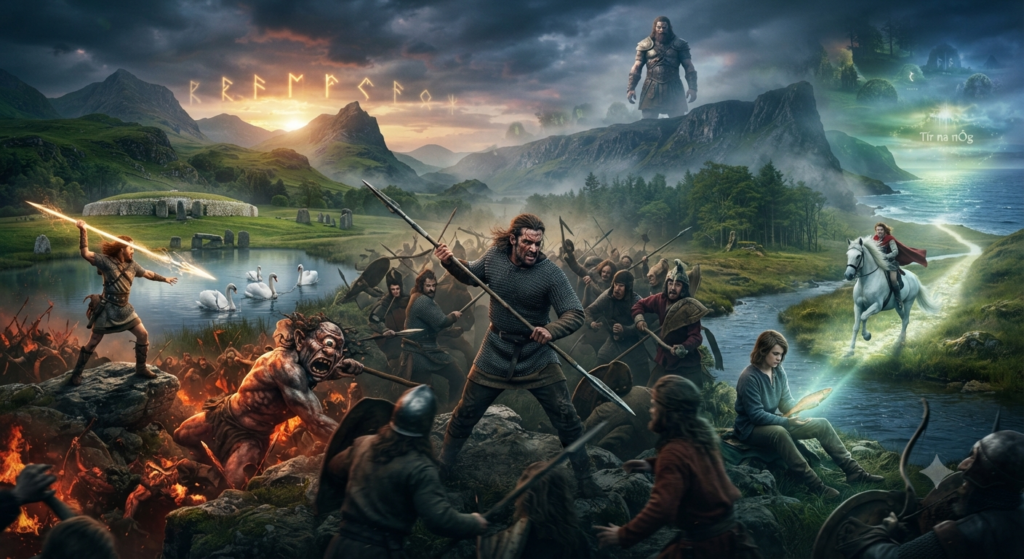
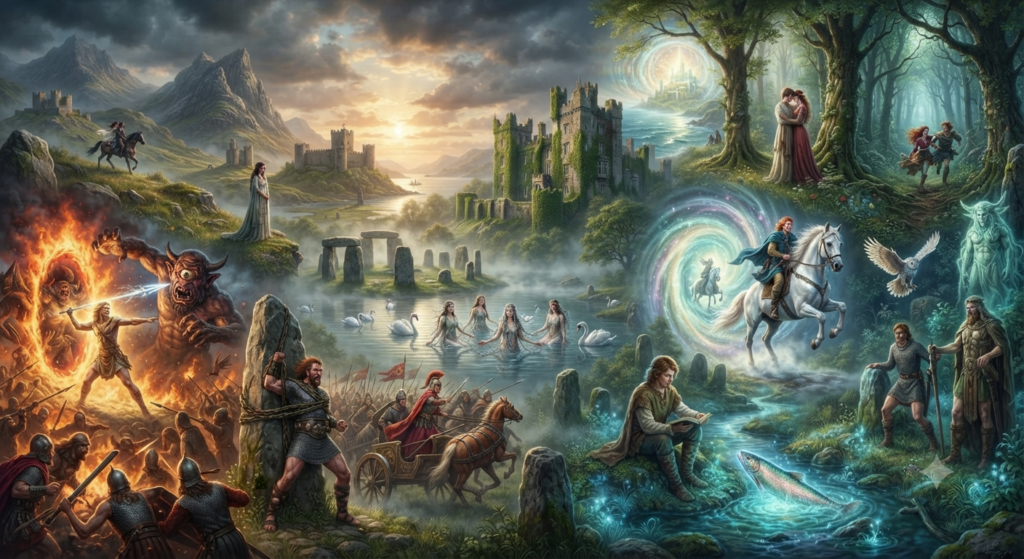
Celtic mythology’s greatest stories are organized into distinct cycles — the divine Mythological Cycle, the heroic Ulster Cycle, the adventurous Fenian Cycle, and the Welsh Mabinogi — each exploring different facets of fate, heroism, and the Otherworld. This guide brings together the essential myths and legends of the Celtic world, from the tragic swans of Lir to the magical trials of the Mabinogi.
The Mythological Cycle
The Second Battle of Mag Tuired
The Second Battle of Mag Tuired saw the Tuatha Dé Danann, led by Lugh, decisively defeat the monstrous Fomorians and their king Balor, securing divine rule over Ireland.
The First Battle of Mag Tuired
In the First Battle of Mag Tuired, the Tuatha Dé Danann defeated the Fir Bolg for control of Ireland, though King Nuada lost his arm in the fighting, setting the stage for his temporary loss of kingship.
The Children of Lir
Cursed by their jealous stepmother, the four Children of Lir were transformed into swans for nine hundred years, one of Irish mythology’s most beloved and sorrowful tales of family tragedy.
Tochmarc Étaíne (The Wooing of Étaín)
One of Irish mythology’s most elaborate tales, Tochmarc Étaíne follows Étaín through jealousy-driven transformation, centuries of rebirth, and an eventual dramatic reunion involving disguise and a game of chance.
The Voyage of Bran
Bran mac Febail sailed to a series of wondrous, dreamlike Otherworldly islands after receiving a mysterious invitation, his voyage embodying the classic Irish tradition of Otherworld sea journeys known as immrama.
The Ulster Cycle
The Táin Bó Cúailnge (Cattle Raid of Cooley)
The Táin Bó Cúailnge tells of Queen Medb’s invasion of Ulster to seize a legendary bull, single-handedly opposed by the young hero Cú Chulainn in Ireland’s greatest epic saga.
Cú Chulainn’s Boyhood Deeds
As a young boy, Cú Chulainn earned his name after killing the fierce guard hound of the smith Culann, offering to take the hound’s place until a replacement could be trained.
The Death of Cú Chulainn
Mortally wounded in his final battle, Cú Chulainn bound himself upright to a standing stone so he could die facing his enemies, and only the arrival of the Morrigan in raven form confirmed to his foes that he had finally fallen.
The Wooing of Emer
To win the hand of the clever and demanding Emer, Cú Chulainn had to complete a series of difficult trials and heroic feats, including advanced training under the legendary warrior woman Scáthach.
The Tragic Story of Deirdre
Prophesied at birth to bring great sorrow, Deirdre’s forbidden love and tragic fate became one of the most poignant tales of the Ulster Cycle, exploring themes of fate, beauty, and doomed love.
The Curse of Macha
After being forced to race against the king’s horses while pregnant, Macha cursed the men of Ulster to suffer labor-like weakness at their times of greatest need, an affliction that famously left Ulster’s warriors helpless during the events of the Táin.
The Fenian Cycle
The Pursuit of Diarmuid and Gráinne
When Gráinne fell in love with the young warrior Diarmuid instead of her intended husband Fionn mac Cumhaill, the couple fled across Ireland in a long pursuit that ended only with Diarmuid’s tragic death.
Fionn mac Cumhaill and the Salmon of Knowledge
While cooking the legendary Salmon of Knowledge for his teacher, the young Fionn mac Cumhaill burned his thumb and instinctively put it in his mouth, accidentally gaining all the world’s wisdom for himself.
Oisín in Tír na nÓg
The poet-warrior Oisín journeyed to the eternal Otherworldly land of Tír na nÓg, only to discover upon his eventual return to Ireland that centuries had passed in what felt to him like mere years.
The Four Branches of the Mabinogi
Pwyll and Rhiannon
The First Branch of the Mabinogi follows Pwyll, Prince of Dyfed, through his exchange of places with Arawn, king of Annwn, and his subsequent pursuit and marriage to the mysterious Rhiannon.
Branwen and the War with Ireland
The Second Branch of the Mabinogi tells of Branwen’s mistreatment in Ireland and the devastating war her brother Bran the Blessed waged in response, ending in tragedy for nearly everyone involved.
Manawydan
The Third Branch of the Mabinogi follows Manawydan as he navigates a magically deserted Wales, eventually breaking a curse placed upon his companions through clever persistence and negotiation.
Math fab Mathonwy
The Fourth Branch of the Mabinogi centers on the magician Gwydion and the complex, often tragic story of Lleu Llaw Gyffes, including his magical birth, betrayal, and eventual restoration.
Other Welsh Legends
Blodeuwedd: The Woman Made of Flowers
Created from flowers by the magicians Math and Gwydion to be Lleu Llaw Gyffes’s wife, Blodeuwedd’s eventual betrayal and transformation into an owl forms one of the most memorable tales within the Mabinogion.
Culhwch and Olwen
One of the earliest surviving Welsh Arthurian tales, Culhwch and Olwen follows the hero Culhwch as he completes a series of nearly impossible tasks set by a giant in order to win the hand of his daughter Olwen.
Clarifications and Distinctions
Difference Between the Mythological Cycle and the Ulster Cycle
The Mythological Cycle centers on the divine Tuatha Dé Danann and Ireland’s earliest legendary history, while the Ulster Cycle focuses on mortal heroes like Cú Chulainn set in a later, more historically grounded era.
Is Cú Chulainn a God or a Hero?
Cú Chulainn is generally classified as a semi-divine hero rather than a god, said to be the son of Lugh, but remaining fundamentally mortal and ultimately meeting death like other heroes of the Ulster Cycle.
Difference Between Irish and Welsh Legendary Cycles
Irish legendary tradition is organized into distinct cycles, including the Mythological, Ulster, and Fenian Cycles, while Welsh legendary tradition centers primarily on the Four Branches of the Mabinogi and related early Arthurian tales.
Frequently Asked Questions
What is the most important Celtic myth?
The Táin Bó Cúailnge is widely regarded as Ireland’s greatest epic saga, though the Mabinogi holds equivalent importance within Welsh mythological tradition.
How many cycles are there in Irish mythology?
Irish mythology is traditionally organized into four cycles: the Mythological Cycle, the Ulster Cycle, the Fenian Cycle, and the Historical Cycle, though later scholarship treats these divisions as useful rather than strict.
What is the Mabinogi?
The Mabinogi refers to four interconnected medieval Welsh tales, known as the Four Branches, that form the core of surviving Welsh mythological tradition.
Why are so many Celtic myths tragic?
Themes of fate, forbidden love, and inevitable loss recur throughout Celtic mythology, reflecting a broader cultural fascination with the tension between free will and destiny.
Are these myths based on real historical events?
While myths like the Táin are set within a legendary historical framework, most scholars regard the events themselves as literary and mythological rather than literal historical record.
What role does the Otherworld play in these stories?
The Otherworld frequently intrudes upon these narratives through magical islands, enchanted mounds, and supernatural beings, blurring the boundary between the mortal world and the world of gods and fairies.
Who wrote down these Celtic myths?
Most surviving versions were recorded by medieval Christian monks and scribes centuries after the stories originated, preserving oral tradition even as it was reshaped through a Christian literary lens.
Do these Celtic legends influence modern fantasy literature?
Yes — figures and themes from Irish and Welsh mythology, including the Otherworld, shapeshifting, and legendary heroes, have deeply influenced modern fantasy literature and popular culture.

Orin Vale has spent the better part of two decades tracing the threads that connect the world’s oldest stories — from the halls of Asgard to the banks of the Nile, from Olympus to the jungles of the Maya. What began as a childhood fascination with flood myths and trickster gods grew into years of independent study across comparative mythology and ancient religion, always chasing the same question: what did these stories mean to the people who first told them? Orin writes for readers who want more than trivia — the ones looking for the beliefs, fears, and truths that myths were built to carry.