Shinto tradition speaks of Yaoyorozu no Kami, or “eight million gods,” reflecting a worldview in which sacred spirits inhabit nature, ancestral lines, and everyday life. This guide brings together the essential gods and goddesses of Japanese mythology, from the radiant sun goddess Amaterasu to the beloved Seven Lucky Gods of popular tradition.
The Creator Gods and the Three Noble Children
Izanagi
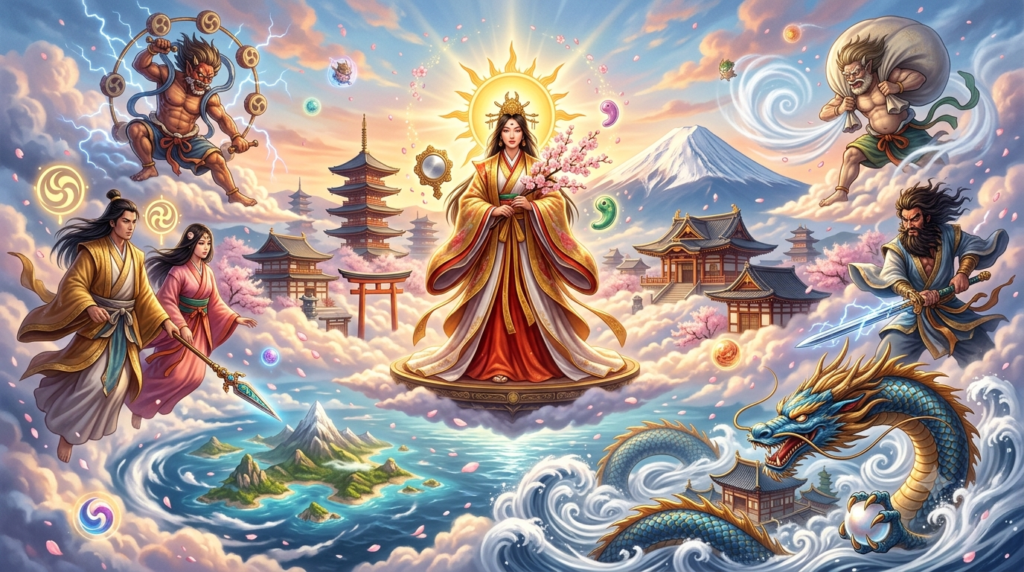
Izanagi, alongside his sister-wife Izanami, created the islands of Japan by stirring the primordial ocean with a jeweled spear, later fathering many of Shinto’s most important deities.
Izanami
Izanami died giving birth to the fire god Kagutsuchi and became ruler of Yomi, the land of the dead, after a failed attempt by her husband Izanagi to bring her back to the world of the living.
Amaterasu
Amaterasu, the radiant sun goddess, is the supreme deity of the Shinto pantheon and the mythical ancestor of the Japanese imperial line, famously coaxed out of a cave to restore light to the world.
Susanoo
Susanoo, the impulsive storm god, was banished from heaven after conflict with his sister Amaterasu, later redeeming himself by slaying the monstrous eight-headed serpent Yamata no Orochi.
Tsukuyomi
Tsukuyomi, god of the moon, became permanently separated from his sister Amaterasu after killing the food goddess Uke Mochi in disgust, an act said to explain why the sun and moon never share the sky.
Gods of Nature and Elements
Raijin
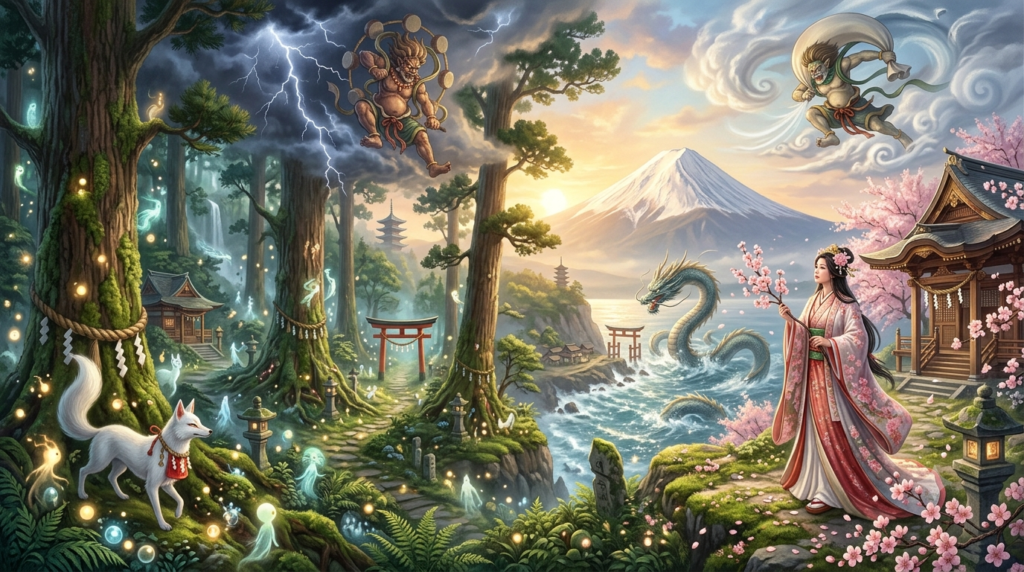
Raijin, god of thunder and lightning, is traditionally depicted surrounded by drums that produce his signature thunderclaps, often paired with the wind god Fujin in Japanese religious art.
Fujin
Fujin, god of wind, is depicted carrying a large bag containing the winds of the world, traditionally paired alongside the thunder god Raijin as twin guardians of the natural forces.
Kagutsuchi
Kagutsuchi, god of fire, caused his mother Izanami’s death simply by being born, leading his grieving father Izanagi to kill him in anguish, an act from which several other deities were said to emerge.
Ryujin
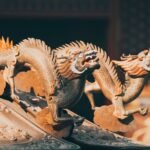
Ryujin, the dragon god of the sea, ruled from a magnificent underwater palace and controlled the tides using magical jewels, appearing in numerous Japanese folktales involving fishermen and sea journeys.
Konohanasakuya-hime
Konohanasakuya-hime, goddess associated with Mount Fuji and cherry blossoms, symbolizes the fleeting beauty of earthly life, her mythology tied closely to fertility and the delicate, brief nature of blossoming flowers.
The Seven Lucky Gods
Ebisu
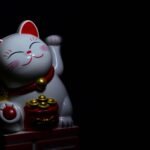
Ebisu, one of the Seven Lucky Gods and the only one of purely native Japanese origin, is the patron deity of fishermen and prosperity, traditionally depicted smiling with a fishing rod and sea bream.
Daikokuten
Daikokuten, god of wealth and commerce, carries a magic mallet said to grant wishes with each strike, his origins blending native Japanese tradition with the Buddhist deity Mahakala.
Benzaiten
Benzaiten, goddess of music, knowledge, and water, originated from the Hindu goddess Saraswati before being incorporated into Japanese religious tradition as one of the Seven Lucky Gods.
Bishamonten
Bishamonten, god of warriors and fortune in battle, derives from the Buddhist guardian deity Vaisravana, traditionally depicted in armor holding a pagoda representing treasure and protection.
Fukurokuju
Fukurokuju, god of wisdom and longevity, is recognizable by his distinctively elongated head, his origins tracing back to Chinese Taoist tradition before becoming one of Japan’s Seven Lucky Gods.
Jurojin
Jurojin, god of longevity, is often depicted alongside a crane, deer, or tortoise, all symbols of long life, his character closely paralleling and sometimes merging with the wisdom god Fukurokuju.
Hotei
Hotei, god of contentment and abundance, is based on a historical Chinese Chan Buddhist monk and is recognized by his cheerful demeanor, round belly, and large cloth sack of treasures.
Guidance, War, and Wisdom
Hachiman
Hachiman, god of war and divine protector of Japan, became especially venerated by the samurai class as a guardian of archery, warfare, and the nation itself.
Sarutahiko
Sarutahiko, a kami of guidance and crossroads, famously guided Ninigi’s descent from heaven to earth, later becoming associated with martial arts and clear direction in life’s important decisions.
Omoikane
Omoikane, god of wisdom and intelligence, devised the clever plan that ultimately lured the sun goddess Amaterasu out of hiding, restoring light to a darkened world.
Tenjin
Tenjin, god of learning and scholarship, was originally the historical scholar and statesman Sugawara no Michizane, deified after his death and widely venerated today by students seeking academic success.
Divine Lineage and the Imperial Line
Ninigi
Ninigi, grandson of the sun goddess Amaterasu, descended from heaven to rule the earth, carrying the three sacred imperial treasures and becoming the mythical ancestor of Japan’s imperial line.
Toyotama-hime
Toyotama-hime, daughter of the dragon god Ryujin, married a mortal prince but returned to the sea after he broke his promise not to look upon her true dragon form during childbirth.
Ame-no-Uzume
Ame-no-Uzume, goddess of dawn, mirth, and dance, performed a wild, comedic dance that made the gods laugh so loudly it drew the hidden sun goddess Amaterasu out to investigate, restoring light to the world.
Inari
Inari, deity of rice, fertility, and prosperity, is closely associated with fox spirits known as kitsune, and remains one of the most widely worshipped kami in Japan today, honored at thousands of shrines nationwide.
Understanding the Shinto Pantheon
How Many Gods Are There in Shinto (Yaoyorozu no Kami)
Shinto tradition speaks of Yaoyorozu no Kami, or “eight million gods,” a symbolic expression conveying the belief that countless spirits inhabit nature, objects, and ancestral lines rather than a literal fixed number.
Who Is the Supreme Deity in Shinto?
Amaterasu, the sun goddess, is generally regarded as the supreme deity of Shinto and the mythological ancestor of Japan’s imperial line, though Shinto’s structure remains far less strictly hierarchical than many other pantheons.
Are the Seven Lucky Gods All Originally Japanese?
Only Ebisu among the Seven Lucky Gods is of purely native Japanese origin; the others derive from Buddhist, Hindu, and Taoist traditions absorbed into Japanese religious culture over centuries.
Difference Between Shinto Kami and Buddhist Deities in Japan
Shinto kami are native nature and ancestral spirits worshipped at shrines, while Buddhist deities entered Japan later from the broader Buddhist tradition; the two systems historically blended closely through a process known as shinbutsu-shūgō.
Is the Emperor of Japan Considered Descended From the Gods?
Traditional Shinto mythology traces the Japanese imperial line back to the sun goddess Amaterasu through her grandson Ninigi, though the emperor’s formal claim to literal divine status was officially renounced in 1946.
Difference Between a Kami and a God in the Western Sense
Unlike the personified, narrative-heavy gods of Greek or Norse mythology, kami often represent a broader range of sacred presence, including natural phenomena, ancestral spirits, and abstract qualities, not always possessing detailed individual mythologies.
Frequently Asked Questions
What is the most important text for Japanese mythology?
The Kojiki, compiled in 712 CE, is the oldest and most important surviving source for Japanese mythology, alongside the slightly later Nihon Shoki.
Is Shinto mythology still practiced today?
Yes — Shinto remains an actively practiced religion in Japan, with shrines dedicated to kami like Amaterasu and Inari continuing to receive regular worship and seasonal festivals.
Why does the sun goddess Amaterasu matter so much in Japanese culture?
Amaterasu’s connection to the imperial line gave her mythology lasting political and cultural significance, and her image remains deeply tied to Japanese national identity.
What are kitsune, and how do they relate to Shinto gods?
Kitsune are fox spirits closely associated with the god Inari, believed to serve as Inari’s messengers and sometimes possessing their own independent magical abilities in folklore.
How did Buddhism influence Japanese mythology?
Buddhism, introduced from the Asian mainland, blended extensively with native Shinto beliefs, contributing several deities, including most of the Seven Lucky Gods, to the broader Japanese religious landscape.
Why do many Japanese myths involve caves and hiding?
The story of Amaterasu hiding in a cave reflects broader mythological themes of light versus darkness and the community’s collective effort to restore cosmic and social order.
Are Japanese gods associated with specific places?
Yes — many kami are closely tied to specific mountains, shrines, or natural landmarks, such as Konohanasakuya-hime’s association with Mount Fuji.
Do Japanese gods appear in modern popular culture?
Yes — figures like Amaterasu, Susanoo, and Inari appear frequently in modern anime, video games, and literature, reflecting their continued cultural resonance in Japan and internationally.

Orin Vale has spent the better part of two decades tracing the threads that connect the world’s oldest stories — from the halls of Asgard to the banks of the Nile, from Olympus to the jungles of the Maya. What began as a childhood fascination with flood myths and trickster gods grew into years of independent study across comparative mythology and ancient religion, always chasing the same question: what did these stories mean to the people who first told them? Orin writes for readers who want more than trivia — the ones looking for the beliefs, fears, and truths that myths were built to carry.