Introduction
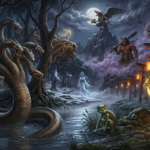
Tochmarc Étaíne (The Wooing of Étaín) is one of the most important narratives in the medieval Irish mythological tradition. It belongs to the corpus of Irish saga literature preserved in manuscripts from the Middle Ages, and it combines themes of kingship, divine love, transformation, jealousy, memory, and fate. The story is especially significant because it presents the goddess-like figure Étaín as a central character in a complex cycle involving the Tuatha Dé Danann, the supernatural people of early Irish myth, and the mortal kings of Ireland.
The tale is valued both as a work of literature and as a source for understanding early Irish ideas about sovereignty, otherworldly beings, and the relationship between the human and divine worlds. It is also notable for its layered structure: different episodes of the narrative appear to preserve older mythic material, later literary composition, and possible oral traditions. For scholars of Celtic studies, Tochmarc Étaíne is a key text for studying how medieval Irish authors reworked myth into sophisticated prose storytelling.
Origin and Meaning
The title Tochmarc Étaíne is Irish and is usually translated as “The Wooing of Étaín.” The word tochmarc means a wooing, courtship, or formal suit for marriage. Étaín is the name of the heroine, though her identity shifts across the story through a series of supernatural transformations and rebirths.
The tale survives in medieval Irish manuscripts, especially in versions found in the Lebor na hUidre and the Yellow Book of Lecan, with later manuscript witnesses preserving related material. As with many early Irish texts, it is not possible to date the original composition precisely. Scholars generally regard the extant versions as products of Old and Middle Irish literary tradition, compiled and edited in monastic and learned settings over centuries.
The story probably reflects older mythological material that predates the manuscripts in which it is preserved. At the same time, the surviving text shows the influence of medieval literary artistry, including polished prose, dialogue, and narrative framing.
Historical Context
Medieval Irish learning and manuscript culture
Tochmarc Étaíne belongs to the world of medieval Irish learned culture, where monks and professional scholars copied, preserved, and sometimes adapted older vernacular narratives. These texts were written in a society shaped by Christianity, but they often retained material about pagan gods, otherworld beings, and pre-Christian heroic traditions.
Myth and kingship
The tale is also deeply connected to the Irish tradition of sovereignty, in which the legitimacy of a king is linked to right order, sacred marriage, and contact with the land’s otherworldly powers. Kings in Irish legend frequently interact with supernatural women who embody fertility, authority, or the blessing of rule. Étaín’s story is one of the most elaborate examples of this pattern.
The Tuatha Dé Danann in Christian-era literature
The Tuatha Dé Danann are presented in later tradition as a powerful pre-human or otherworldly race, often interpreted as gods or demigods in modern scholarship. In Tochmarc Étaíne, figures such as Midir and Bóand belong to this supernatural realm, even as the narrative intersects with mortal dynasties and heroic lineages. The tale therefore stands at the meeting point of mythic memory and medieval literary transmission.
Main Characteristics
Several features make Tochmarc Étaíne distinctive:
- It is a multi-episode narrative rather than a single straightforward romance.
- It centers on Étaín, a woman whose identity persists across transformation, death, rebirth, and displacement.
- It combines love story, rivalry, and supernatural metamorphosis.
- It links the otherworldly Tuatha Dé Danann with the human kings of Ireland.
- It explores themes of jealousy, loss, memory, and rightful return.
- It preserves one of the most famous examples of metempsychosis or reincarnated identity in Irish literature.
The tale is also unusual in the way it treats time and identity. Étaín is not merely courted by a man; she is drawn into an extended supernatural history in which one life echoes another. This gives the story a mythic depth that is not typical of simple courtly romance.
Family and Genealogy
The genealogy in Tochmarc Étaíne is important, though different versions and related traditions sometimes emphasize different relationships.
Étaín
Étaín is the central figure. In the story, she is associated with beauty, desirability, and continuity across transformation. She becomes the wife of Midir, a member of the Tuatha Dé Danann, and later the wife of Eochaid Airem, a mortal king.
Midir
Midir is Étaín’s supernatural husband. He is a member of the Tuatha Dé Danann and is often portrayed as an otherworldly king or noble. His love for Étaín drives much of the story.
Eochaid Airem
Eochaid Airem is a mortal High King of Ireland in the narrative. He becomes Étaín’s second husband after she is separated from Midir. His role is central to the human political dimension of the tale.
Etar and the mortal family line
In one phase of the story, Étaín is reborn or transformed into the daughter of Etar, a mortal woman. She later marries Eochaid Airem. This phase emphasizes her return to the human world under a different identity.
The child and the hidden lineage
Different retellings and interpretations vary in details, but one important feature of the tale is that Étaín’s union with Eochaid Airem leads to a child whose lineage becomes crucial to the mythic and dynastic significance of the story. The tale ultimately connects divine and mortal bloodlines, though the precise genealogical emphasis can differ across related traditions.
Symbols
Because Tochmarc Étaíne is a literary mythological narrative rather than a cultic manual, it does not provide a fixed symbolic system in the way a later iconography might. Even so, several recurring symbols are important.
| Symbol / Motif | Meaning in the tale |
|---|---|
| Water | Transformation, crossing between states, loss and rebirth |
| Wells and springs | Connection with the otherworld and renewal |
| Birds | Messenger imagery, enchantment, and altered form in broader Celtic tradition |
| Beauty and radiance | Étaín’s supernatural attractiveness and royal desirability |
| Bridges, roads, and thresholds | Movement between the human world and the otherworld |
| Wine and hospitality | Social exchange, desire, and the testing of loyalty |
The most important symbolic pattern is metamorphosis. Étaín’s transformations into different states of being symbolize continuity of identity despite radical change. The story also uses the motif of enchanted memory, suggesting that the self can endure even when appearance and social role are altered.
Sacred Animals
The text is not organized around a formal set of sacred animals, and it should not be read as a zoological cult narrative. However, animals appear as part of the wider symbolic environment of Irish myth.
Birds
Birds are important in the broader mythology of the Tuatha Dé Danann and in Irish otherworld literature. In Tochmarc Étaíne, avian imagery contributes to the sense of enchantment and distance from ordinary human life.
Horses
Horses are significant in Irish royal and heroic symbolism, though they are not the central animal of this tale. In Irish tradition more broadly, horses often mark sovereignty, status, and movement between worlds.
Otherworld animals
As with many Celtic narratives, the tale belongs to a symbolic universe in which animals can act as signs of supernatural power, fertility, or boundary crossing. Still, no single animal functions as the story’s dominant sacred emblem.
Sacred Plants
The surviving text of Tochmarc Étaíne does not establish a formal sacred plant system. Nonetheless, the broader Irish mythic world often associates plants with healing, magic, and the otherworld.
Flowers and blossoming
Étaín herself is often read as a figure of beauty and flowering life, though this is more interpretive than explicit. Floral imagery in Celtic literature commonly evokes youth, fertility, and otherworldly attractiveness.
Trees and groves
Trees are essential in Irish myth and kingship traditions, even when not foregrounded in this tale. Sacred trees can mark territory, continuity, and the life of the land. Their absence in the main action of Tochmarc Étaíne does not diminish their importance in the cultural background of the story.
Sacred Places
The tale moves between several significant locations, some mortal and some otherworldly.
Otherworld locations
The world of the Tuatha Dé Danann is often described in terms that imply an otherworldly residence, not a fixed geographical kingdom in the modern sense. Midir’s realm belongs to this realm beyond ordinary human space.
Royal Ireland
The mortal world of the tale is linked to the seat of High Kingship in Ireland, especially through Eochaid Airem. The story’s royal setting emphasizes the political significance of Étaín’s marriage.
Brí Léith
Midir is associated in tradition with Brí Léith, a site in Leinster that appears in Irish literary memory as connected with otherworldly or supernatural kingship. This place is especially relevant in discussions of the tale’s mythic geography.
Tara and sovereign landscapes
While specific place references vary by version and scholarly interpretation, the story belongs to the broader world of Irish royal topography, where sites such as Tara and other seats of kingship carry symbolic force.
Powers and Attributes
Étaín is not a goddess in a rigid classical sense, but she has a strongly supernatural or mythic character in the tale.
Étaín’s principal attributes
- extraordinary beauty
- persistence of identity across transformations
- connection to love and desire
- association with otherworldly memory
- role as a bridge between divine and mortal worlds
Midir’s principal attributes
- supernatural status
- command over enchantment and transformation
- role as a lover and rival
- otherworldly authority
The tale’s thematic powers
Rather than listing divine powers in the manner of a pantheon, the story emphasizes narrative forces:
- transformation
- reincarnation or return
- desire
- memory
- sovereignty
- fate
These powers shape the action more than direct miracles or divine interventions.
Main Myths
The narrative of Tochmarc Étaíne is complex, but its central mythic episodes can be summarized in sequence.
1. Midir’s love for Étaín
Étaín is first associated with Midir, a supernatural figure of the Tuatha Dé Danann. Their union represents an otherworldly marriage, but it becomes the cause of conflict.
2. Fúamnach’s jealousy and transformation
Midir’s former wife or rival, often named Fúamnach, is jealous of Étaín. Through magical hostility, Étaín is driven into a series of transformations and wanderings. In some accounts, she is turned into water, a worm, a fly, or is otherwise subjected to repeated change. The exact sequence varies, but the essential pattern is one of degradation followed by survival.
3. Étaín’s wandering and rebirth
Despite her suffering, Étaín endures. She eventually passes through a form of rebirth or restoration, entering the mortal world as a human woman connected to a new family line.
4. Étaín and Eochaid Airem
As a mortal woman, Étaín becomes the wife of Eochaid Airem, the High King. This union places her within the human political world and sets the stage for the story’s most famous conflict.
5. Midir’s return and the challenge of remembrance
Midir later appears in the mortal world and seeks Étaín. He asks her to leave her husband and return with him. She is caught between worlds and obligations.
6. The contest and the revelation
One of the best-known episodes in the tale involves Midir and Eochaid competing in a formal challenge or board game, often understood as fidchell. The contest ends with supernatural triumph and the revelation of Étaín’s deeper identity.
7. Étaín’s flight or restoration
The story concludes with the restoration of Midir and Étaín’s bond, though the outcome is also tied to the broader dynastic and mythic implications of the tale. The ending underscores the persistence of the otherworld in human life.
Relationship with Other Mythological Figures
Midir and Fúamnach
This is one of the central rivalries in the tale. Fúamnach’s jealousy triggers Étaín’s suffering. The conflict reflects a recurring mythic pattern in which a supernatural woman is opposed by another figure with magical power.
Étaín and Eochaid Airem
Their relationship represents the mortal dimension of the tale. Eochaid is not simply a rival; he embodies legitimate kingship in the human world, making the story a meditation on what it means for a king to possess, or fail to possess, what is rightfully his.
Étaín and the Tuatha Dé Danann
Étaín’s connection to the Tuatha Dé Danann places her between human and divine categories. She is not merely an outsider to either world. Instead, she reveals how the two realms overlap in Irish myth.
Étaín and sovereignty figures
The tale resonates with the wider Irish mythic theme of the sovereignty woman, a figure whose union with a king symbolizes rightful rule. Étaín’s story, however, complicates this pattern by making her both lover and returned otherworldly being.
Worship and Cult
There is no clear evidence of a formal historical cult or worship of Étaín comparable to the documented worship of deities in some ancient religions. The surviving evidence comes primarily from literary texts rather than ritual manuals or archaeological cult remains.
That said, the story may preserve traces of older beliefs about:
- otherworldly women linked to sovereignty
- sacred marriage and legitimation of kings
- magical transformation and renewal
- the endurance of the soul or self
These elements suggest mythic and religious significance, but scholars generally distinguish carefully between literary myth and documentable cult practice. Because the sources are medieval and Christian-era, any reconstruction of pre-Christian worship remains speculative.
Ancient Sources
Unlike Greek or Roman mythology, where multiple classical authors can be named with relative confidence, the primary sources for Tochmarc Étaíne are medieval Irish manuscripts.
Major manuscript sources
- Lebor na hUidre (Book of the Dun Cow)
- Yellow Book of Lecan
- Related later manuscripts preserving the tale or its variants
Scholarly tradition
The text has been studied through the work of modern editors and Celtic scholars who compare manuscript versions and assess linguistic layers. Because the saga survives in medieval copies, the surviving text is a literary witness to older tradition rather than a straightforward recording of an ancient oral original.
Comparative context
Although there is no direct classical author equivalent, the tale is often discussed alongside other mythological narratives because of its themes of divine love, transformation, and dynastic legitimacy.
Roman Equivalent
There is no direct Roman equivalent to Tochmarc Étaíne. Étaín is not a Celtic version of a Roman goddess, and Midir is not simply an adaptation of a Roman deity. The tale belongs to the native Irish mythological tradition.
If a broad comparison is useful, Étaín may be loosely compared to figures associated with beauty, love, transformation, or sovereignty in other Indo-European traditions, but such comparisons are interpretive rather than historical. Any claim of a one-to-one Roman counterpart would be misleading.
Influence on Modern Culture
Literary influence
Tochmarc Étaíne has had lasting influence on modern Irish literature, Celtic studies, and myth-based fiction. Its themes of transformation and return make it attractive to writers interested in layered identity and reincarnation.
Academic and cultural significance
The tale is a cornerstone of Irish mythological scholarship. It is frequently discussed in university courses on medieval literature, folklore, and myth. It also contributes to modern understandings of pre-Christian Ireland and the literary sophistication of early Irish prose.
Art and adaptation
The story has inspired:
- retellings in modern poetry and fiction
- scholarly translations and annotated editions
- references in fantasy writing and Celtic-inspired art
- discussions of women’s roles in myth, memory, and sovereignty
While it is not as universally known as some Greek myths, it is highly influential within Celtic revival and Irish cultural studies.
Popular culture
Elements of Étaín’s story—especially transformation, lost memory, and supernatural love—appear in modern fantasy and speculative fiction motifs. Direct adaptations are less common than thematic borrowings.
Curiosities
- Étaín’s identity survives change. The tale is notable for treating identity as something that can persist through transformations of body and social status.
- The story blends romance and myth. It is both a love story and a sovereignty myth.
- The board game episode is famous. The contest between Midir and Eochaid is one of the best-known scenes in Irish narrative literature.
- The tale has multiple layers. It likely draws on older mythic material while also reflecting medieval literary composition.
- Fúamnach’s role is crucial. Although less famous than Étaín and Midir, she is central to the plot’s conflict.
- It is one of the great Irish “otherworld” stories. The tale repeatedly crosses the boundary between the mortal and supernatural realms.
- Scholars debate its origins. As with many early Irish texts, the precise relationship between oral tradition, pre-Christian myth, and medieval redaction remains uncertain.
Frequently Asked Questions
1. What is Tochmarc Étaíne?
Tochmarc Étaíne is an early Irish mythological tale usually translated as “The Wooing of Étaín.” It tells the story of Étaín, her supernatural lover Midir, and her later marriage to the mortal king Eochaid Airem.
2. Is Étaín a goddess?
The text does not present Étaín in a simple, systematic theological way. She is often treated by modern readers as a goddess-like or mythic figure, but the surviving sources are literary and do not provide a formal cultic description.
3. What is the main theme of the story?
The main themes are love, jealousy, transformation, memory, and sovereignty. The tale also explores the relationship between the otherworld and the human world.
4. What does the title mean?
The title means “The Wooing of Étaín.” The Irish word tochmarc refers to a formal wooing or courtship.
5. Where does the story come from?
It survives in medieval Irish manuscripts, especially the Lebor na hUidre and the Yellow Book of Lecan. It likely preserves older mythological material, though the surviving form is medieval.
6. Why is the tale important?
It is important because it is one of the richest surviving Irish mythological narratives and a major source for understanding Tuatha Dé Danann tradition, sacred kingship, and Irish literary style.
7. Is there a Roman or Greek equivalent to Étaín?
There is no exact equivalent. Comparisons can be made with goddesses or heroines associated with love, beauty, and transformation, but these are only approximate analogies.
8. What makes the story distinctive in Irish literature?
Its combination of otherworldly romance, reincarnation-like transformation, royal politics, and poetic narrative structure makes it one of the most distinctive texts in the Irish mythological corpus.
Conclusion
Tochmarc Étaíne stands as one of the most celebrated works of medieval Irish literature and one of the most important surviving mythological tales from early Ireland. Through Étaín’s transformations, Midir’s longing, and Eochaid Airem’s royal struggle, the story explores enduring concerns about identity, desire, memory, and legitimate rule.
Its significance lies not only in its plot but also in what it reveals about the medieval Irish imagination: a world in which the human and otherworldly realms remain closely connected, and where love can carry profound cosmic and political consequences. As a mythic, literary, and cultural document, Tochmarc Étaíne continues to attract scholars and readers because it captures the complexity and beauty of early Irish narrative tradition.

Orin Vale has spent the better part of two decades tracing the threads that connect the world’s oldest stories — from the halls of Asgard to the banks of the Nile, from Olympus to the jungles of the Maya. What began as a childhood fascination with flood myths and trickster gods grew into years of independent study across comparative mythology and ancient religion, always chasing the same question: what did these stories mean to the people who first told them? Orin writes for readers who want more than trivia — the ones looking for the beliefs, fears, and truths that myths were built to carry.