Historical and Geographic Context
Celtic culture and religion spread across much of pre-Roman Iron Age Europe, from Gaul and Britain to Ireland, rooted in the Hallstatt and La Tène cultures of the first millennium BCE. Roman conquest and Christianization gradually displaced native Celtic religious practice across most of continental Europe and Britain, leaving continental Gaulish mythology known to us largely through Roman writers rather than native sources. Ireland and Wales, less directly Romanized, preserved far richer mythological traditions, though even these survive only through medieval Christian manuscripts recorded centuries after the stories originated. As a result, Celtic mythology today is best understood not as one unified system but as a family of related regional traditions, chiefly Irish and Welsh, shaped by both their pre-Christian roots and the Christian scribes who ultimately preserved them.
Explore Celtic Mythology by Category
Celtic Gods and Goddesses
From the paternal Dagda and the war goddess Morrigan of Irish tradition to the magicians and horse goddesses of the Welsh Mabinogi, the Celtic pantheon reflects two closely related but distinct regional divine traditions. See the full guide: Celtic Gods and Goddesses: The Complete Guide.
Celtic Symbols
Sacred objects like the Four Treasures of the Tuatha Dé Danann and enduring designs like the triskele and triquetra gave visible form to Celtic spiritual life, alongside sacred trees and animals woven throughout the tradition. See the full guide: Celtic Symbols: The Complete Guide to the Sacred Objects and Signs of Celtic Mythology.
Celtic Creatures and Monsters
From the monstrous one-eyed giant Balor to the death-omen banshee and the shapeshifting kelpie, Celtic mythology’s creatures blend cosmic conflict with the rich folklore of Ireland, Scotland, and Wales. See the full guide: Celtic Creatures and Monsters: The Complete Guide.
Celtic Myths and Legends
Organized into distinct cycles — the divine Mythological Cycle, the heroic Ulster Cycle, the adventurous Fenian Cycle, and the Welsh Mabinogi — Celtic mythology’s greatest narratives explore fate, heroism, and the ever-present boundary with the Otherworld. See the full guide: Celtic Myths and Legends: The Complete Guide.
How the Four Categories Connect
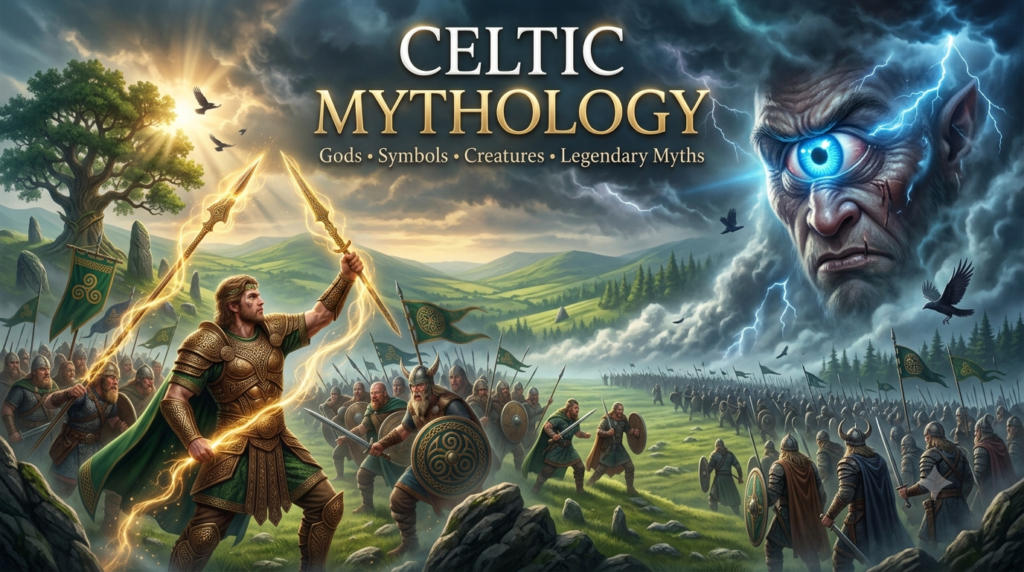
Celtic mythology’s four categories are tightly woven around its central conflict between order and chaos. The monstrous giant Balor, king of the Fomorians, was slain at the Second Battle of Mag Tuired using the Spear of Lugh, one of the legendary Four Treasures of the Tuatha Dé Danann, wielded by the god Lugh himself. In this single episode, a creature, a myth, a symbol, and a god converge to explain how divine order was secured over the forces of chaos — a pattern echoed throughout Celtic mythology’s many regional traditions.
Frequently Asked Questions
What is Celtic mythology?
Celtic mythology is the body of myths, gods, and legendary traditions belonging to the Celtic peoples of ancient Ireland, Britain, and continental Europe, most fully preserved today through Irish and Welsh sources.
Is there a single, unified Celtic mythology?
No — Celtic mythology exists as a family of related regional traditions, chiefly Irish and Welsh, rather than one centralized mythological system, with continental Gaulish tradition surviving only in fragments.
How much of Celtic mythology survives today?
A substantial body survives through medieval Irish sagas and the Welsh Mabinogi, though continental Celtic mythology survives only fragmentarily, largely through the accounts of Roman and Greek writers.
What is the difference between Celtic mythology and Celtic religion?
Celtic mythology refers to the surviving narrative tradition of gods and legendary figures, while Celtic religion encompasses the actual pre-Christian ritual and worship practices, most of which were never directly recorded by the Celts themselves.
Why do Irish and Welsh mythology differ so much?
Irish and Welsh mythology developed as related but distinct regional traditions, preserved through different manuscript traditions and reflecting the particular concerns and history of each culture.
Did the Romans influence how we understand Celtic mythology?
Yes — much of what is known about continental Celtic religion comes filtered through Roman writers like Julius Caesar, who often equated Celtic gods with Roman counterparts, likely simplifying a more complex native tradition.
Why do gods and fairies overlap in Celtic tradition?
Following Christianization, many once openly worshipped Celtic deities, such as the Tuatha Dé Danann, were gradually reimagined in folklore as fairies or the Aos Sí, allowing their stories to survive in a form more acceptable to the new religious order.
Is Celtic mythology still practiced today?
While the original Celtic religions are not practiced in continuous, unbroken form, modern movements such as Neo-Druidism draw on and reinterpret surviving Celtic mythological tradition for contemporary spiritual practice.

Orin Vale has spent the better part of two decades tracing the threads that connect the world’s oldest stories — from the halls of Asgard to the banks of the Nile, from Olympus to the jungles of the Maya. What began as a childhood fascination with flood myths and trickster gods grew into years of independent study across comparative mythology and ancient religion, always chasing the same question: what did these stories mean to the people who first told them? Orin writes for readers who want more than trivia — the ones looking for the beliefs, fears, and truths that myths were built to carry.