The question of who is Arete, the Greek personification of virtue? leads us to a concept that was so fundamental to ancient Greek thought that it permeated every aspect of their culture, from philosophy and education to mythology and art. Arete (ἀρετή) was the goddess and personification of excellence, virtue, and moral goodness . However, unlike the more fully-realized Olympian deities, Arete existed primarily as a philosophical ideal given divine form—a personification of the very quality that the Greeks believed was the highest human potential . This article will serve as a definitive guide to Arete, exploring her origins as a philosophical concept, her rare appearances in myth, her family, and her enduring legacy as the embodiment of the classical Greek aspiration to live a life of excellence.
Arete: The Concept and the Goddess
To understand the goddess Arete, one must first understand the concept that she personified. The ancient Greek word areté (ἀρετή) was a term of immense significance, referring to “excellence” of any kind . It was the fulfillment of a person or thing’s inherent function—the act of living up to one’s full potential . In the Homeric world, arete primarily described the prowess and effectiveness of heroes and nobles, encompassing strength, bravery, and cunning . It was closely associated with courage and effectiveness in battle, and the man or woman of arete was one who used all of their faculties to achieve real results .
Over time, the meaning of arete evolved to include quieter virtues such as dikaiosyne (justice) and sophrosyne (self-restraint) . It became a central concept in the ethical systems of philosophers like Plato and Aristotle. Plato, for instance, linked arete to knowledge, arguing that “virtue is knowledge” . Aristotle gave the doctrine of arete its most complete expression, defining it as the mean between two vices—a balance between excess and deficiency . In this philosophical sense, arete was the pinnacle of human achievement, the state of being the best one could possibly be.
The goddess Arete was the occasional personification of this profound concept . She represented the ideal of virtue and excellence made manifest. As a personification, her function was to embody the abstract ideal that philosophers wrote about and that all virtuous individuals aspired to. She was not a figure with an extensive mythology but a divine symbol of the highest human potential . Her Roman equivalent was Virtus, the personification of valor and virtue .
Family and the Praxidikai
Arete’s genealogy establishes her as a figure of righteous authority. According to the surviving traditions, Arete was the daughter of Praxidice (the goddess of justice) and Soter (the god of safety, preservation, and deliverance from harm) . She had one sister, Homonoia, the goddess of concord, unanimity, and oneness of mind .
Together, Arete and Homonoia were known as the Praxidikai (Πραξιδίκαι), meaning “Exacters of Justice” . This epithet reflects their function as divine forces that ensured the maintenance of justice and social order. The Praxidikai were the keepers of the moral law, and Arete, as one of their number, was specifically associated with the virtue that made justice possible. Her name, derived from the root of aristos (meaning “noble” or “excellent”), connects her conceptually to the aristocratic class, who were presumed to be the exemplars of arete .
The Myth of Heracles at the Crossroads
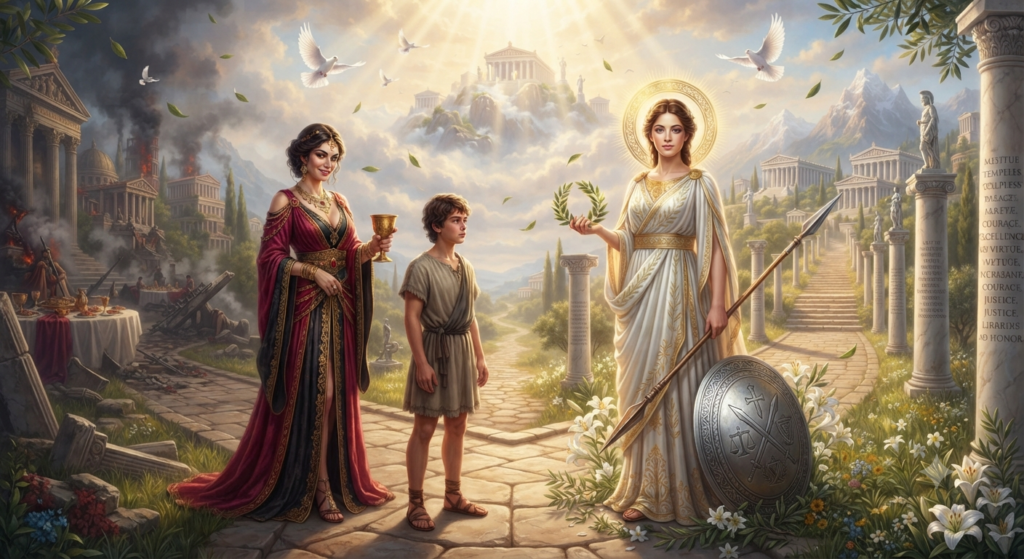
The only surviving mythological story involving Arete was told by the 5th-century BCE sophist Prodicus and preserved by the philosopher Xenophon . Known as the “Choice of Heracles” or “Heracles at the Crossroads,” it concerns the early life of the hero Heracles .
According to the tale, when Heracles was transitioning from boyhood to youth, he went out to a quiet place to contemplate which path to take in life. There, he encountered two women of great stature . The first was Arete (Virtue), who appeared as a modest maiden, fair to see and of high bearing, dressed in white . The second was Kakia (Vice), who was plump, soft, and dressed to disclose all her charms, representing a life of ease and pleasure .
Arete offered Heracles a life of struggle, glory, and moral excellence. She warned him that the gods give nothing good without toil and effort: if he wanted the favor of the gods, he must worship them; if he desired the love of friends, he must do good to them; if he coveted honor from a city, he must aid that city . Kakia, in contrast, promised him a short and easy road to happiness, free from wars and worries, where he could enjoy the fruits of others’ toil .
Heracles chose to follow the path of Arete, embracing the life of hardship and noble achievement over the fleeting pleasures of vice . This myth became a powerful allegory for the moral choice between virtue and vice, a theme that was later adopted by Christian writers such as Justin Martyr and Clement of Alexandria .
Artistic Representations
Arete was occasionally represented in ancient Greek art, though these depictions are relatively rare. The limited iconographic evidence suggests that she was recognized as a distinct personification, but she did not achieve the widespread visual popularity of figures like Nike or Athena .
According to the Roman author Pliny the Elder, the personification of Arete was represented in a wall painting by the painter Parrhasios and in a colossal bronze statue by the sculptor Euphranor, which was perhaps paired with a statue of Hellas (Greece) . Additionally, an Amazon figure labelled “ARETE” (ΑΡΗΤΗ) appears on a bilingual lekythos dating to around 430-420 BCE, attributed to the Eretria Painter . These references suggest that Arete was recognized as a visual symbol, but the fact that they are so few in number reinforces her status as a minor and somewhat abstract figure.
Frequently Asked Questions About Who is Arete, the Greek personification of virtue?
What does the name Arete mean?
The name Arete is the ancient Greek word for “excellence,” “virtue,” or “moral goodness.” The root of the word is the same as aristos, the word which shows superlative ability and superiority .
Who were the parents of Arete?
According to the mythological tradition, Arete was the daughter of Praxidice, the goddess of justice, and Soter, the god of safety. She had one sister, Homonoia (Concord), and together they were known as the Praxidikai (“Exacters of Justice”) .
What is the story of Heracles at the Crossroads?
The “Choice of Heracles” is a myth in which the young hero Heracles is confronted by two women: Arete (Virtue), who offers him a life of toil and glory, and Kakia (Vice), who offers him a life of ease and pleasure. Heracles chooses the path of Arete .
Who is the opposite of Arete in Greek mythology?
Arete’s opposite is Kakia (or Cacia), the goddess of immorality, vice, and badness. In the “Choice of Heracles” myth, Kakia represents the easy path of pleasure and corruption .
What is the Roman equivalent of Arete?
The Roman equivalent of Arete is Virtus, the personification of valor, virtue, and excellence .
Is Arete mentioned in Homer’s works?
The concept of arete is frequently referenced in Homer’s Iliad and Odyssey, but it is used as a noun to describe excellence and effectiveness rather than as a personified goddess. The term is applied to heroes like Achilles as well as major female figures like Penelope .
Conclusion
Arete, the Greek personification of virtue, stands as a unique bridge between the abstract world of Greek philosophy and the narrative world of mythology. The question of who is Arete, the Greek personification of virtue? reveals not a fully-realized goddess with an extensive biography, but a potent symbol of the highest human potential. She was the embodiment of excellence itself, the quality that all Greeks—from Homeric heroes to Athenian citizens—were expected to cultivate. Her story, the “Choice of Heracles,” is one of the most enduring moral allegories from the ancient world, a testament to the belief that true happiness comes not from ease, but from the struggle to achieve virtue. As one of the Praxidikai, she was a force for justice and righteousness. Though her cult was small and her mythology sparse, the concept she personified was one of the most powerful forces in shaping the Greek character and, by extension, Western civilization.

Orin Vale has spent the better part of two decades tracing the threads that connect the world’s oldest stories — from the halls of Asgard to the banks of the Nile, from Olympus to the jungles of the Maya. What began as a childhood fascination with flood myths and trickster gods grew into years of independent study across comparative mythology and ancient religion, always chasing the same question: what did these stories mean to the people who first told them? Orin writes for readers who want more than trivia — the ones looking for the beliefs, fears, and truths that myths were built to carry.