The question of who are Erato’s sister Muses in Greek mythology? leads us to the very heart of artistic and intellectual inspiration in the ancient world. Erato, the Muse of lyric and love poetry , was one of nine divine sisters who presided over the arts and sciences . As the daughters of Zeus and the Titaness Mnemosyne (Memory) , these goddesses were the wellspring of creativity for poets, musicians, historians, and astronomers alike. This article will serve as a definitive guide to Erato’s sisters, exploring their origins, their individual domains, and their collective importance in Greek mythology and culture.
The Nine Muses: An Overview
The Muses were a group of nine sister goddesses who were the patrons of the arts and sciences . Originally, their influence was primarily in poetry and music, but over time, their roles expanded to encompass all the liberal arts . The poet Hesiod, in the 8th century BCE, provided the canonical list of their names that became the standard in later times .
According to myth, the Muses were born in Pieria, at the foot of Mount Olympus, after Zeus slept with Mnemosyne for nine consecutive nights . They were known to dwell on Mount Helicon in Boeotia, where they had sacred springs of inspiration such as the Hippocrene . Apollo, the god of music and poetry, was a close companion of the Muses, and he led them in their singing and dancing on Olympus .
Erato: The Muse of Love Poetry
Before examining Erato’s sisters, it is important to understand Erato herself. Her name, meaning “lovely” or “desired” , perfectly encapsulates her domain. She is the Muse of lyric and love poetry, often depicted with a lyre or kithara, the instruments that would accompany the recitation of romantic and erotic verse . In some myths, she is also associated with mimicry .
Siblings
Erato and her sisters shared the same divine parentage. They were the daughters of Zeus, the king of the gods, and Mnemosyne (Memory), a Titan goddess . This genealogy is significant, as it links the ability to create art directly to the power of memory—without memory, there could be no poetry, no history, no music .
Erato’s Sister Muses: A Definitive List
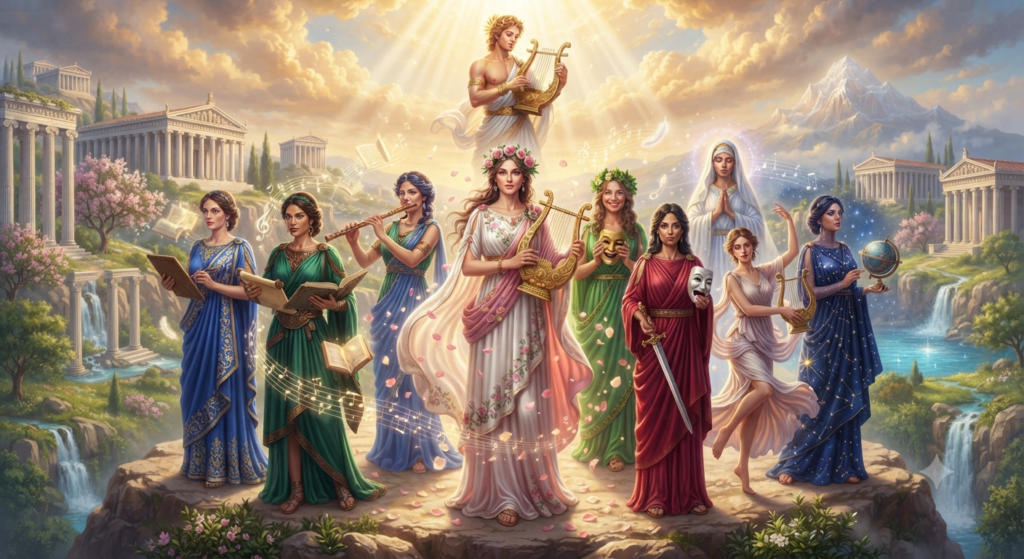
According to Hesiod and the canonical tradition, the nine Muses are :
Calliope: The Chief Muse
Calliope is the Muse of epic poetry and eloquence, and she is considered the chief among her sisters . Her name means “She of the Beautiful Voice” . She is often depicted holding a writing tablet and stylus . She is the mother of the legendary musician Orpheus and was the favored Muse of Homer .
Clio: The Muse of History
Clio is the Muse of history . Her name means “the Proclaimer” . She is often depicted with a scroll, representing the recording of historical events . She is sometimes credited with introducing the Phoenician alphabet into Greece .
Euterpe: The Muse of Music
Euterpe is the Muse of music and lyric poetry, specifically associated with the flute . Her name means “the Well Pleasing” or “the Giver of Pleasure” . She is credited with the invention of the double aulos, a type of flute . She is depicted holding this instrument .
Thalia: The Muse of Comedy
Thalia is the Muse of comedy and idyllic poetry . Her name means “the Blooming” or “the Flourishing” . She is depicted holding a comic mask and a shepherd’s staff, and she often wears a crown of ivy .
Melpomene: The Muse of Tragedy
Melpomene is the Muse of tragedy . Her name means “the Songstress” . She is often depicted holding a tragic mask and sometimes carries a club or sword, and she wears the boots (cothurnes) of tragic actors .
Polyhymnia: The Muse of Sacred Poetry
Polyhymnia (sometimes spelled Polymnia) is the Muse of sacred poetry, religious dance, and hymns . Her name means “She of the Many Hymns” . She is often depicted with a pensive, veiled look, or in a pose of deep thought, and she is associated with mime, geometry, and meditation .
Terpsichore: The Muse of Dance
Terpsichore is the Muse of dancing and choral song . Her name means “Whirler of the Dance” or “Delighting in the Dance” . She is often depicted dancing and holding a lyre . She was the mother of the Sirens with the river god Achelous .
Urania: The Muse of Astronomy
Urania is the Muse of astronomy . Her name means “the Heavenly” . She is often depicted holding a globe and is dressed in a cloak embroidered with stars .
Frequently Asked Questions About Erato’s Sister Muses
Who are Erato’s sisters?
Erato’s sisters are Calliope, Clio, Euterpe, Thalia, Melpomene, Polyhymnia, Terpsichore, and Urania. Together, they form the nine Muses of Greek mythology .
Who is the chief of the Muses?
Calliope, the Muse of epic poetry, is considered the chief among the nine Muses .
What is the symbol of Erato?
Erato is most often associated with the lyre or kithara, reflecting her role as the Muse of lyric and love poetry .
How were the Muses born?
The Muses were the daughters of Zeus, the king of the gods, and the Titaness Mnemosyne (Memory) . Zeus lay with Mnemosyne for nine consecutive nights, leading to the birth of the nine Muses .
Conclusion
The Muses were a powerful symbol of the ancient Greek belief that creativity, art, and knowledge were divine gifts, bestowed upon humanity by the gods themselves. Erato, with her lyre and her love of romantic verse, was part of a sisterhood of inspiration that has shaped Western culture for millennia. The question of who are Erato’s sister Muses in Greek mythology? reveals a family of goddesses whose influence can still be felt in our language, in our arts, and in our understanding of the human capacity for creation.

Orin Vale has spent the better part of two decades tracing the threads that connect the world’s oldest stories — from the halls of Asgard to the banks of the Nile, from Olympus to the jungles of the Maya. What began as a childhood fascination with flood myths and trickster gods grew into years of independent study across comparative mythology and ancient religion, always chasing the same question: what did these stories mean to the people who first told them? Orin writes for readers who want more than trivia — the ones looking for the beliefs, fears, and truths that myths were built to carry.