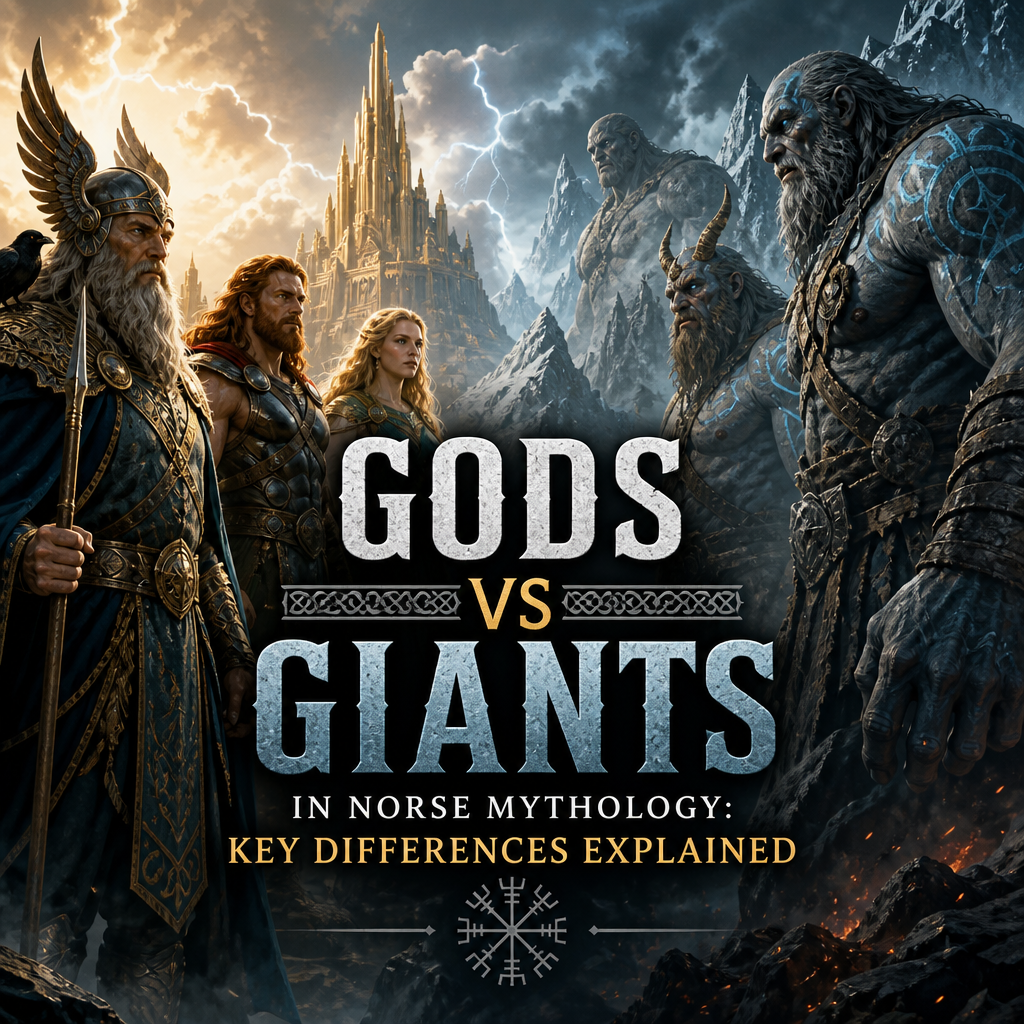
What Is the Difference Between a God and a Giant in Norse Mythology?

In Norse mythology, the line between gods and giants is not as simple as “good versus evil.” The question what is the difference between a god and a giant in Norse mythology has a complex answer because the two groups are deeply connected. They marry each other, make alliances, share ancestry, and often behave in surprisingly similar ways.
The main difference is not that gods are always noble and giants are always monstrous. Instead, the difference has more to do with social order, cosmic roles, and where each group belongs in the mythological worldview.
The Main Groups in Norse Mythology
Norse myths describe several kinds of powerful beings, but the two most important groups for this topic are the gods and the giants.
The Gods
The gods are usually divided into two major families:
- The Æsir, including Odin, Thor, Frigg, Baldr, and Tyr
- The Vanir, including Freyr, Freyja, and Njord
The Æsir are often associated with kingship, war, wisdom, law, and protection. The Vanir are more closely connected with fertility, wealth, nature, and prosperity. After a war between the two divine families, the Æsir and Vanir make peace and live together, especially in Asgard.
The Giants
The giants are often called jötnar in Old Norse. The singular form is jötunn. While “giant” suggests enormous size, not all jötnar are described as physically huge. Some appear beautiful, wise, magical, or even godlike.
Giants often live in Jotunheim, a realm outside the ordered world of gods and humans. They are associated with wilderness, chaos, ancient knowledge, danger, and primal forces.
Gods Represent Order
One of the clearest differences between gods and giants is symbolic. The gods generally represent order, structure, and civilization. They build halls, make laws, defend boundaries, and protect the worlds from destructive forces.
Asgard, the home of many gods, is a place of feasting, authority, and social hierarchy. The gods are not perfect, but they work to maintain a cosmic balance. Thor, for example, often fights giants to defend both Asgard and Midgard, the world of humans.
This does not mean the gods are always morally good. Odin can be deceptive, Loki is famously unpredictable, and even noble gods make mistakes. Still, their role in the myths is usually tied to preserving the world as it exists.
Giants Represent Chaos and the Wild
Giants often represent what lies beyond the boundaries of order. They are linked with mountains, ice, fire, storms, darkness, and untamed nature. Many giants are dangerous enemies of the gods, and some are destined to fight against them at Ragnarök, the final battle.
However, “chaos” in this context does not mean pure evil. It means raw, uncontrolled power. Giants are ancient beings connected to the forces that existed before the ordered cosmos was formed.
In fact, the first being in Norse creation myth is Ymir, a primordial giant. The gods Odin, Vili, and Vé kill Ymir and create the world from his body. This shows that the ordered world of the gods is literally built from giant nature.
Family Ties Between Gods and Giants
A major reason the distinction is complicated is that gods and giants are often related.
Odin himself has giant ancestry. Thor, the great defender against giants, is the son of Odin and Jörd, a personification of the earth who is often counted among the giantesses. Loki, who lives among the gods, is the child of giants.
The gods also frequently marry or desire giantesses. Freyr falls in love with the giantess Gerðr, and Njord marries the giantess Skaði. These relationships show that giants are not simply outsiders or monsters. They are part of the same mythological family network.
Appearance Is Not the Main Difference
Modern readers often imagine giants as huge, ugly creatures. In Norse mythology, some giants are indeed enormous or terrifying, but many are not described that way.
Some giantesses are renowned for their beauty. Some giants are wise, such as Mímir, who is associated with deep knowledge. Others possess magical items, prophetic insight, or great skill.
Likewise, the gods are not always radiant and flawless. They can be violent, fearful, jealous, or dishonest. Appearance and morality are not reliable ways to separate gods from giants.
Social Role Matters More Than Species
A useful way to understand the difference is to think in terms of social role rather than biology. A being may be called a god because they belong to the divine community of Asgard and take part in maintaining cosmic order. A being may be called a giant because they belong to the outside world of the jötnar, connected with wilderness, ancestry, and threatening forces.
This is why Loki is so difficult to classify. By birth, he is connected to the giants. By association, he lives among the gods. Yet he eventually becomes an enemy of the gods and plays a key role in Ragnarök.
Loki shows that identity in Norse mythology is flexible. What matters is not only what a being is, but where they stand in relation to the gods and the cosmic order.
Giants at Ragnarök
At Ragnarök, many giants become the enemies of the gods. The fire giant Surtr leads forces from Muspelheim and brings destruction with his flaming sword. Loki’s children, including Fenrir and Jörmungandr, also fight against the gods.
This final conflict reinforces the idea that giants are associated with forces that can break down the world. Yet Ragnarök is not just a battle of good against evil. It is also a cycle of destruction and renewal. After the old world ends, a new world rises.
So, What Is the Difference?
The simplest answer is this: gods are the divine powers who maintain order, while giants are ancient beings associated with chaos, wilderness, and primal forces. But the full answer is more nuanced.
Gods and giants are not completely separate species. They share ancestry, marry into each other’s families, and often possess similar powers. The difference lies mainly in their roles within the mythic cosmos.
Key Differences
- Gods usually live in Asgard and protect cosmic order.
- Giants usually live in Jotunheim or other wild realms.
- Gods are linked with law, society, and divine rule.
- Giants are linked with nature, chaos, ancestry, and danger.
- Gods and giants often intermarry and share bloodlines.
- Neither group is purely good or purely evil.
Conclusion
Understanding what is the difference between a god and a giant in Norse mythology means looking beyond simple categories. The gods and giants are rivals, relatives, lovers, and enemies. They define each other through conflict and connection.
The gods stand for the fragile order of the cosmos, while the giants represent the powerful forces outside and before that order. Norse mythology becomes richer when we see both groups not as opposites, but as intertwined parts of the same mythic world.

Orin Vale has spent the better part of two decades tracing the threads that connect the world’s oldest stories — from the halls of Asgard to the banks of the Nile, from Olympus to the jungles of the Maya. What began as a childhood fascination with flood myths and trickster gods grew into years of independent study across comparative mythology and ancient religion, always chasing the same question: what did these stories mean to the people who first told them? Orin writes for readers who want more than trivia — the ones looking for the beliefs, fears, and truths that myths were built to carry.