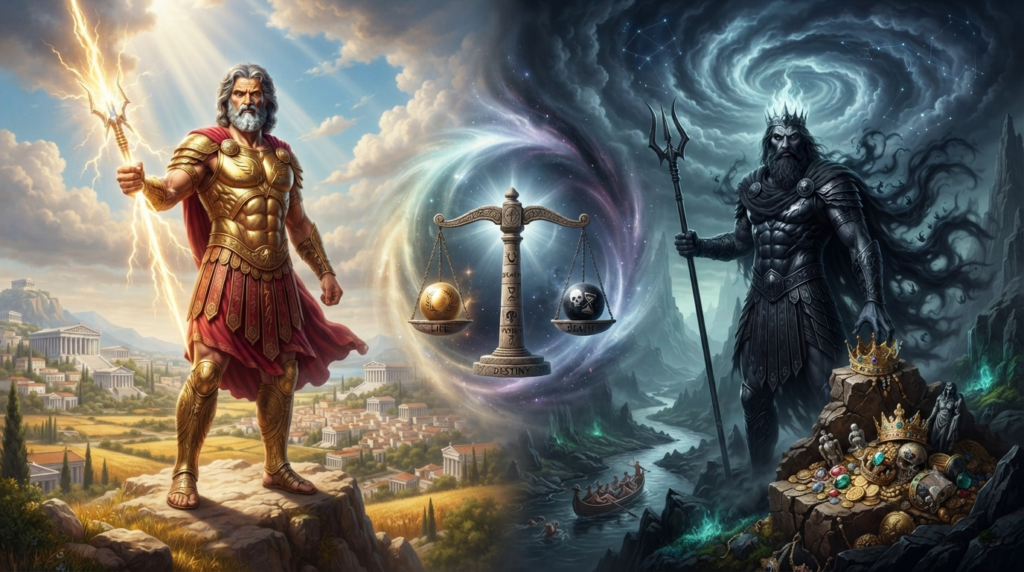
Anyone asking is Hades stronger than Zeus is exploring a genuinely legitimate comparison, since both figures belong to the same Greek mythological tradition as brothers who divided the cosmos between themselves following their shared victory over Cronus and the Titans. Within the broader Olympian hierarchy, Zeus holds formal supreme authority as king of the gods, yet Hades commands essentially absolute, uncontested power within his own specific domain, making is Hades stronger than Zeus a question that depends significantly on which specific criteria are being applied. Understanding is Hades stronger than Zeus requires examining both the formal hierarchy established between the brothers and the genuine, largely uncontested authority Hades maintained within his own particular sphere of rule.
How the Brothers Divided the Cosmos
Following their shared victory over Cronus and the Titans during the Titanomachy, Zeus, Poseidon, and Hades divided rule over the cosmos through a drawing of lots, establishing the foundational structure essential for understanding is Hades stronger than Zeus within its proper mythological and historical context.
Zeus received dominion over the sky, Poseidon received the sea, and Hades received the underworld, while the earth itself remained common ground shared among all three brothers rather than being exclusively controlled by any single deity within this significant division of cosmic authority.
This division established each brother as supreme within his own specific domain, providing essential context for is Hades stronger than Zeus, since this arrangement suggests a form of parallel authority among the three brothers rather than Hades occupying an inherently subordinate position purely by virtue of receiving the underworld specifically.
Understanding this foundational division proves essential to accurately addressing is Hades stronger than Zeus, establishing that Hades’s rule, while different in character from Zeus’s broader authority, reflected a genuinely significant and comparable position within the overall structure established following their shared victory over the Titans.
Zeus’s Position as King of the Gods
Despite this division suggesting parallel authority among the three brothers, Zeus specifically held the additional, distinct position of king of the gods, maintaining supreme authority over Olympian affairs generally and functioning as final arbiter in disputes, directly relevant to fully understanding is Hades stronger than Zeus regarding overall hierarchical position.
This broader kingship extended Zeus’s practical authority beyond his own specific sky-based domain, positioning him above his brothers in matters concerning the overall Olympian order, even though Poseidon and Hades each maintained genuine, largely independent authority within their own respective spheres of rule.
Zeus’s documented victories against significant threats, including the Titans and later Typhon, further reinforced his position as the ultimately dominant figure among the gods, providing substantial evidence relevant to is Hades stronger than Zeus regarding demonstrated combat capability and secured overall authority.
This combination of broader kingship and demonstrated combat success confirms that Zeus held genuine overall supremacy within the general Olympian hierarchy, providing essential context for is Hades stronger than Zeus before examining the specific, largely uncontested authority Hades maintained within his own particular domain.
Hades’s Absolute Authority Over the Underworld
Within his own specific domain, Hades maintained essentially uncontested, absolute authority, with even Zeus generally refraining from direct interference in underworld affairs, providing significant evidence relevant to is Hades stronger than Zeus regarding genuine, largely independent power within a clearly defined sphere.
Hades also held the epithet Plouton, connecting him directly to underground wealth and mineral resources, reflecting an additional dimension of authority and significance often overlooked in popular discussions relevant to is Hades stronger than Zeus, since this connection reinforced his considerable, multifaceted domain beyond simply ruling over the dead.
Hades’s relatively limited direct involvement in the more frequent conflicts and dramatic narratives featuring Zeus and other Olympians does not reflect weakness, but rather the specific, largely self-contained nature of his particular domain, an important distinction relevant to accurately addressing is Hades stronger than Zeus.
Recognizing this genuine, largely uncontested authority within his own specific sphere significantly enriches is Hades stronger than Zeus, confirming that Hades maintained authentic, substantial power comparable in its own domain to Zeus’s broader authority throughout the rest of the Olympian cosmic structure.
Why Hades Is Often Misunderstood as “Weaker” or “Evil”
Popular culture frequently conflates Hades with Christian concepts of Satan or hell, creating significant misunderstanding directly relevant to is Hades stronger than Zeus, since this conflation often unfairly diminishes Hades’s genuine mythological standing by associating him inaccurately with malevolence absent from his original Greek characterization.
Within authentic ancient Greek mythology, Hades is not portrayed as an evil or villainous figure, but rather as a serious, largely fair ruler overseeing the necessary, inevitable process governing the dead, an important distinction essential for accurately addressing is Hades stronger than Zeus without importing unrelated later religious assumptions.
This important difference between “ruling over the dead” and “being malevolent” proves essential for correcting common misconceptions relevant to is Hades stronger than Zeus, ensuring that his genuine mythological standing receives accurate representation rather than being diminished through inaccurate modern conflation with unrelated religious traditions.
Recognizing and correcting this popular misconception significantly improves understanding of is Hades stronger than Zeus, allowing for a more historically accurate comparison based on genuine ancient Greek mythological characterization rather than later, unrelated cultural assumptions about Hades’s character and standing.
So, Is Hades Stronger Than Zeus?
Based on this examination, addressing is Hades stronger than Zeus requires recognizing two distinct, equally valid answers depending on the specific criteria applied: within the overall Olympian hierarchy, Zeus holds clear formal supremacy as king of the gods, while within his own specific domain, Hades maintains essentially absolute, largely uncontested authority.
This nuanced answer reflects genuine mythological accuracy rather than an oversimplified conclusion, confirming that is Hades stronger than Zeus depends significantly on whether the comparison focuses on broader hierarchical authority or specific, domain-based power within each brother’s own particular sphere of rule.
Rather than declaring a single definitive winner, this comparison reveals that both brothers held genuinely significant, if differently structured, forms of power, reinforcing that is Hades stronger than Zeus benefits from nuanced understanding rather than a simplified ranking that fails to capture the genuine complexity present within their actual mythological relationship.
This balanced conclusion provides the most historically and mythologically accurate answer available to is Hades stronger than Zeus, respecting both Zeus’s genuine overall supremacy and Hades’s equally genuine, substantial authority within his own significant and largely independent domain.
FAQ — Quick Answers About Hades and Zeus
Is Hades stronger than Zeus?
Zeus holds overall supreme authority as king of the gods, while Hades maintains essentially absolute, uncontested power specifically within his own domain, the underworld.
How did Zeus and Hades divide their power?
Following their victory over the Titans, Zeus, Poseidon, and Hades divided the cosmos by lot, with Zeus receiving the sky and Hades receiving the underworld.
Is Hades evil in Greek mythology?
No, Hades is not portrayed as evil in authentic Greek mythology, unlike popular conflations with Christian concepts of Satan or hell.
Does Zeus have authority over the underworld?
Generally, Zeus refrains from direct interference in underworld affairs, respecting Hades’s largely independent authority within his own domain.
Why is Hades often misunderstood as weaker than Zeus?
Hades appears less frequently in dramatic conflicts than Zeus, and popular culture often inaccurately associates him with malevolence, leading to this common misconception.
Conclusion
Anyone who sets out to answer is Hades stronger than Zeus finds a nuanced, genuinely mythologically grounded answer: Zeus holds clear overall supremacy as king of the gods, while Hades maintains essentially absolute authority within his own specific domain, the underworld, following their shared division of the cosmos.
Correcting popular misconceptions that unfairly diminish Hades through inaccurate association with later, unrelated concepts of evil allows for a more accurate, historically grounded comparison between these two significant Olympian brothers and their genuinely substantial respective forms of power.
Ultimately, is Hades stronger than Zeus finds its most accurate answer not in declaring one brother simply stronger, but in recognizing that each held genuine, significant authority, Zeus over the broader Olympian order and Hades absolutely within his own considerable domain.

Orin Vale has spent the better part of two decades tracing the threads that connect the world’s oldest stories — from the halls of Asgard to the banks of the Nile, from Olympus to the jungles of the Maya. What began as a childhood fascination with flood myths and trickster gods grew into years of independent study across comparative mythology and ancient religion, always chasing the same question: what did these stories mean to the people who first told them? Orin writes for readers who want more than trivia — the ones looking for the beliefs, fears, and truths that myths were built to carry.