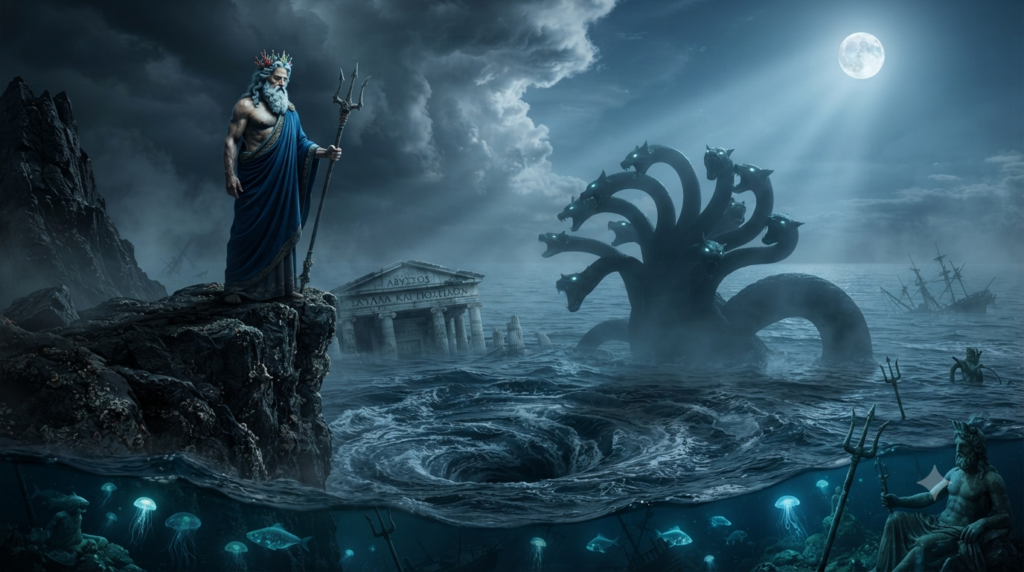
No source within Greek mythology ever describes Poseidon as being scared of Scylla, and the very premise behind is Poseidon scared of Scylla runs against one of the most basic principles governing the relationship between Olympian gods and the monsters that populate their world. Scylla, however dangerous she proves to be for mortal sailors, poses no meaningful threat to a god of Poseidon’s stature, making fear an implausible response for him to have toward her.
Rather than fear, the far more interesting and textually supported relationship between the two involves Poseidon’s indirect connection to Scylla’s origin story itself, a myth that reveals far more about power dynamics among the gods than any question of who fears whom. Understanding this connection requires setting aside the fear-based premise entirely and instead examining what ancient sources actually say about the two figures.
This distinction matters because conflating a monster’s danger to mortals with a threat to the gods themselves misrepresents how Greek mythology consistently structures its hierarchy of power. Scylla terrifies sailors navigating a narrow strait, but her influence never extends into the kind of cosmic authority that would make an Olympian deity like Poseidon feel genuinely threatened by her presence.
What follows examines why Poseidon has no reason to fear Scylla, the actual mythological connection between the sea god and her transformation into a monster, and where this misconception about fear likely originates within modern retellings of Greek mythology.
Why Poseidon Has No Reason to Fear Scylla
Scylla exists within Greek mythology as a localized threat, confined to a single narrow strait where she preys on sailors unfortunate enough to pass within reach of her many heads. This geographic and functional limitation defines the entire scope of her danger, since her power operates exclusively against mortal ships and crews rather than extending into any broader capacity to challenge divine authority.
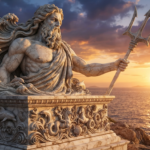
Poseidon, by contrast, governs the entirety of the sea itself, commanding storms, currents, and the very waters Scylla inhabits as part of his fundamental domain as an Olympian god. This enormous disparity in scale and authority makes the idea of is Poseidon scared of Scylla structurally implausible, since a being confined to threatening passing ships holds no comparable power capable of intimidating the god who rules the ocean in its entirety.
Greek mythology consistently reserves genuine fear among the gods for threats operating on a cosmic scale, such as Typhon’s challenge to Zeus’s rule over Olympus itself, rather than for localized monsters whose danger applies specifically to mortals. Scylla simply does not belong in the same category of threat capable of producing fear in an Olympian deity like Poseidon.
This structural reality provides the clearest possible answer to is Poseidon scared of Scylla: no, since the power imbalance between a god who commands the entire sea and a monster confined to a single strait leaves no plausible basis for genuine fear on Poseidon’s part.
The Real Connection Between Poseidon and Scylla’s Origin
While fear plays no role in their relationship, ancient sources do preserve a genuine and far more compelling connection between Poseidon and Scylla’s transformation into a monster. According to the Roman mythographer Hyginus, Scylla originally existed as a beautiful sea nymph whom Poseidon loved, a relationship that ultimately led to her transformation through the jealousy of another goddess entirely.
In this version of the myth, Amphitrite, Poseidon’s wife, learns of his affection for Scylla and responds with jealousy severe enough to transform the nymph into the monstrous, multi-headed creature later encountered by sailors like Odysseus. This origin story ties Poseidon directly into the reason Scylla exists as a monster at all, offering a far richer narrative connection than any premise involving fear.
It is worth noting that this version of Scylla’s origin differs from the more widely known myth involving the sorceress Circe, who transforms Scylla out of jealousy after the sea god Glaucus falls in love with her instead. Ancient Greek and Roman sources frequently preserved multiple, sometimes contradictory versions of the same myth, and Scylla’s transformation stands as a clear example of this variation across different traditions.
Regardless of which version a reader encounters, both accounts share a common thread relevant to is Poseidon scared of Scylla: in each case, Poseidon or a figure closely associated with him plays a role in her tragic transformation, positioning him as connected to her origin story rather than as someone with any reason to fear the monster she became.
Scylla’s Role in the Odyssey: A Separate Threat from Poseidon
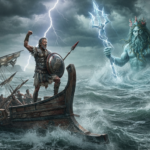
Within Homer’s Odyssey, Scylla functions as an entirely separate danger from Poseidon’s ongoing pursuit of Odysseus, even though both threats occur within the same broader narrative of the hero’s journey home. Odysseus must navigate past Scylla’s strait as one obstacle among many, distinct from the storms and delays Poseidon inflicts on him as punishment for blinding the Cyclops Polyphemus.
This separation matters because modern readers sometimes conflate every danger Odysseus faces at sea with Poseidon’s direct involvement, assuming the god orchestrates every threat encountered throughout the voyage. Scylla’s danger, however, exists independently of Poseidon’s wrath, rooted instead in her own transformation myth and her established role as a hazard to any sailor passing through her strait, regardless of Poseidon’s personal feelings toward Odysseus specifically.
Recognizing this distinction helps clarify why is Poseidon scared of Scylla misunderstands not just the power dynamic between the two figures, but also their actual narrative relationship within the Odyssey itself. Poseidon never intervenes regarding Scylla one way or another during Odysseus’s passage, treating her as a separate hazard entirely outside his own campaign of vengeance against the hero.
This separation reinforces the broader pattern already established: Poseidon’s relationship with Scylla centers on his connection to her transformation story, not on any interaction, confrontation, or emotional response occurring during the events of the Odyssey itself.
Where the “Scared” Misconception Might Come From
The premise behind is Poseidon scared of Scylla likely originates from modern retellings of Greek mythology, particularly video games and films that frequently reimagine gods as vulnerable to monsters for dramatic effect, in ways that ancient sources never actually describe. These contemporary adaptations often introduce direct confrontations between gods and monsters that serve narrative tension rather than reflecting authentic mythological tradition.
This pattern of confusion mirrors similar misconceptions already addressed elsewhere regarding Poseidon’s mythology, such as questions asking whether Odysseus killed Poseidon or whether Thor killed Zeus, both of which stem from applying modern storytelling conventions or cross-mythology blending to source material that never depicted such events. In each case, the underlying issue involves importing assumptions from popular culture into stories governed by very different ancient rules.
Search behavior around figures like Scylla may also reflect a natural curiosity about power dynamics among mythological figures, prompting questions that attempt to rank or compare threats even when the original sources never framed their relationship in those terms. This curiosity, while understandable, ultimately requires correction when the underlying mythology simply does not support the premise being searched.
Understanding this origin helps explain why is Poseidon scared of Scylla persists as a search query despite having no basis in classical mythology, reflecting a broader pattern where modern adaptations reshape ancient stories into more dramatically confrontational versions than the original sources ever intended.
What Poseidon’s Relationship with Sea Monsters Reveals About His Character
Poseidon’s mythology connects him to the origins of several sea creatures beyond Scylla alone, reflecting a broader pattern in which the god’s domain over the ocean extends into influence over the monstrous as well as the majestic. This recurring involvement in the creation or transformation of marine beings reinforces his authority over every aspect of the sea, rather than suggesting any vulnerability to the creatures connected to his mythology.
This pattern of dominance rather than fear appears consistently throughout Poseidon’s broader mythology, where his relationships with sea creatures typically position him as a source of creation, punishment, or transformation rather than as a target of threat from the beings themselves. Scylla’s origin story fits neatly within this established pattern, with Poseidon connected to her transformation through love and jealousy rather than through any confrontation involving fear.
Considering is Poseidon scared of Scylla within this broader context makes clear how thoroughly the premise misunderstands Poseidon’s established role throughout Greek mythology. Far from fearing the creatures associated with the sea, Poseidon consistently appears as the authority behind their origins, reinforcing his supreme command over every aspect of the marine world he governs.
This consistent characterization ultimately confirms that Poseidon’s relationship with Scylla, like his relationships with other sea creatures throughout mythology, reflects dominance and connection rather than fear, positioning him as the origin of her transformation rather than someone with any reason to be intimidated by what she became.
Frequently Asked Questions
Is Scylla stronger than Poseidon?
No, Poseidon is immensely more powerful than Scylla, whose danger is limited to mortal sailors passing through her narrow strait rather than posing any real threat to an Olympian god.
Did Poseidon create Scylla?
Indirectly, according to one version of the myth recorded by Hyginus, in which Amphitrite transforms Scylla out of jealousy over Poseidon’s affection for her.
Did Poseidon ever protect sailors from Scylla?
No surviving myth describes Poseidon directly intervening to protect sailors from Scylla during their passage through her strait.
Conclusion
The answer to is Poseidon scared of Scylla remains a clear no, grounded in the vast disparity of power between an Olympian god who rules the entire sea and a monster confined to threatening mortal sailors within a single strait. The real relationship between the two, tied instead to Poseidon’s connection to Scylla’s tragic transformation, offers a far more revealing and mythologically accurate story than any premise involving fear on the sea god’s part.

Orin Vale has spent the better part of two decades tracing the threads that connect the world’s oldest stories — from the halls of Asgard to the banks of the Nile, from Olympus to the jungles of the Maya. What began as a childhood fascination with flood myths and trickster gods grew into years of independent study across comparative mythology and ancient religion, always chasing the same question: what did these stories mean to the people who first told them? Orin writes for readers who want more than trivia — the ones looking for the beliefs, fears, and truths that myths were built to carry.