Anyone encountering the phrase may Zeus strike me down in modern conversation, often used humorously to emphasize that someone is telling the truth, might reasonably wonder whether this expression carries any genuine connection to actual Greek mythology. Unlike some modern idioms that only superficially resemble mythological references, may Zeus strike me down draws on a genuinely documented ancient Greek practice: swearing oaths specifically in Zeus’s name, invoking his thunderbolt as the ultimate consequence for dishonesty. Understanding may Zeus strike me down requires examining both its contemporary, often lighthearted usage and its authentic historical roots in ancient Greek oath-taking practice and religious tradition.
The Modern Use of “May Zeus Strike Me Down”
In contemporary usage, may Zeus strike me down typically functions as an emphatic, often humorous way of asserting sincerity, similar to expressions like “cross my heart” or “I swear to God,” used specifically to underscore that a statement is genuinely truthful rather than exaggerated or false.
This modern phrase frequently appears within informal conversation and digital communication, often deployed with deliberate hyperbole or irony rather than genuine religious conviction, reflecting how thoroughly this specific mythological reference has become embedded within everyday casual English expression regardless of the speaker’s actual religious beliefs.
The popularity of may Zeus strike me down within online and informal digital contexts specifically reflects broader contemporary comfort with casually referencing mythological figures for rhetorical effect, using Zeus’s recognizable authority and power as convenient shorthand for emphasizing genuine sincerity within everyday communication.
This contemporary usage, while typically lighthearted, nonetheless draws directly on Zeus’s established mythological association with truth-telling and divine punishment, connecting this seemingly casual modern phrase to considerably older, genuinely significant ancient Greek religious and cultural practice.
Zeus Horkios — Guardian of Oaths in Ancient Greece
Zeus held the specific epithet Horkios within ancient Greek religious tradition, directly identifying him as guardian and protector of oaths, establishing genuine historical foundation for why may Zeus strike me down carries authentic mythological weight rather than representing purely modern invention disconnected from actual ancient practice.
Ancient Greeks genuinely swore oaths specifically in Zeus’s name, using this practice as a serious method for reinforcing the truthfulness of important statements, agreements, and legal or personal commitments, reflecting real religious and social significance rather than casual expression within actual ancient Greek cultural practice.
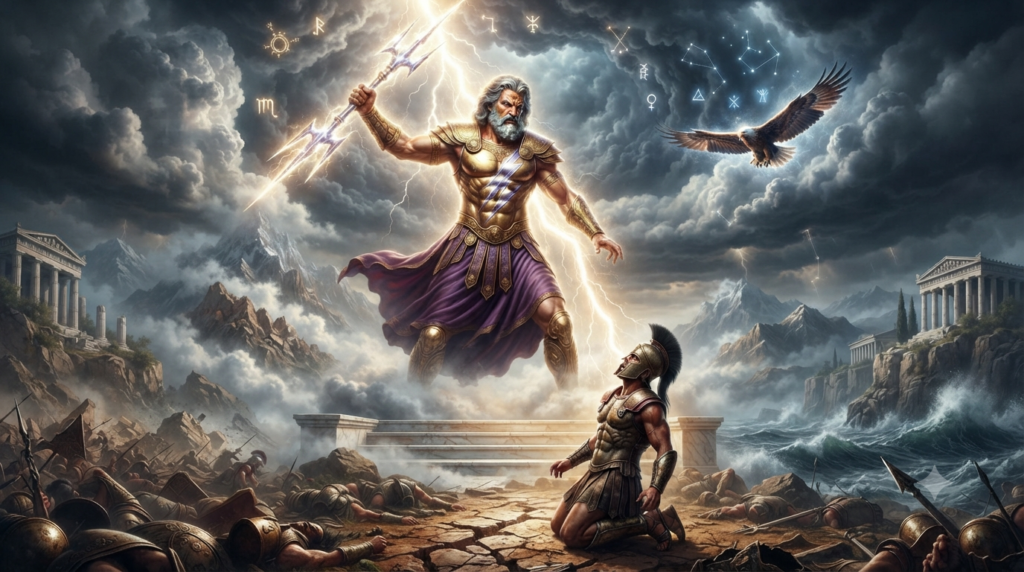
This practice of swearing by Zeus specifically connected the potential consequence of dishonesty directly to his considerable divine power, with his thunderbolt functioning as the specific implied punishment awaiting anyone who violated a solemn oath sworn genuinely in his name throughout ancient Greek religious tradition.
This documented historical practice provides essential context for understanding may Zeus strike me down, confirming that this modern phrase, despite its typically casual contemporary usage, directly echoes genuine, serious ancient Greek religious practice surrounding oath-taking and Zeus’s specific role protecting truthful speech.
Why the Thunderbolt Became a Symbol of Truth and Punishment
Zeus’s thunderbolt consistently represented decisive, overwhelming divine judgment throughout Greek mythology, making it a natural and immediately understood symbol for the ultimate consequence awaiting anyone who violated a sacred oath, directly relevant to understanding why may Zeus strike me down specifically invokes this particular weapon.
This association between the thunderbolt and divine punishment appears consistently throughout broader Greek mythological tradition, reinforcing why ancient Greeks specifically chose this particular symbol, rather than any other aspect of Zeus’s considerable power, when establishing the implied consequence for dishonesty within sworn oaths.
This cultural logic reflects a broader pattern in which invoking a deity’s most feared and immediately recognizable power served as the strongest possible guarantee of sincerity available within ancient religious practice, explaining why may Zeus strike me down specifically references this particular weapon rather than any other aspect of his mythology.
Understanding this symbolic connection between the thunderbolt and truthful speech reinforces why may Zeus strike me down remains such a fitting, historically grounded expression, drawing directly on established ancient Greek religious symbolism surrounding both punishment and the serious weight of sworn truth.
How the Ancient Practice Echoes in the Modern Phrase
The conceptual continuity between ancient oath-swearing and the modern phrase may Zeus strike me down remains genuinely striking, demonstrating how thoroughly this specific ancient religious practice has survived, in adapted form, within contemporary casual English expression many centuries after its original serious religious context.
This continuity exists alongside significant contextual difference, as ancient Greek oath-swearing represented genuine religious conviction and serious social practice, while the modern phrase typically functions as lighthearted emphasis rather than authentic religious invocation, reflecting how thoroughly the original context has shifted over time.
This linguistic survival, despite this significant shift in seriousness and context, demonstrates the remarkable staying power of Greek mythology within everyday modern language, illustrating how ancient religious practice can persist meaningfully within contemporary expression long after its original devotional significance has faded considerably.
Recognizing this connection between ancient practice and modern phrase reveals what makes may Zeus strike me down particularly interesting compared to other seemingly mythological expressions, confirming genuine historical grounding rather than a purely modern, disconnected invention referencing Greek mythology casually.
FAQ — Quick Answers About This Expression
Does “may Zeus strike me down” have real historical roots?
Yes, this phrase echoes the genuine ancient Greek practice of swearing oaths specifically in Zeus’s name as guardian of truthful speech.
What does “Zeus Horkios” mean?
Zeus Horkios refers to Zeus’s specific role as guardian and protector of oaths within ancient Greek religious tradition.
Why is the thunderbolt connected to this expression?
The thunderbolt represented Zeus’s most feared power, making it the natural symbol for divine punishment against those who violated sworn oaths.
Is “may Zeus strike me down” used seriously today?
No, the phrase is typically used humorously or hyperbolically today, unlike its genuinely serious original context in ancient Greek religious practice.
Are there similar modern expressions?
Yes, phrases like “cross my heart” or “I swear to God” serve a similar function, emphasizing sincerity through invoking a higher power.
Conclusion
Anyone who encounters may Zeus strike me down today discovers a phrase carrying genuine historical weight, tracing directly back to Zeus Horkios and the authentic ancient Greek practice of swearing serious oaths specifically in his name. This connection distinguishes it from idioms that merely sound mythological without any real historical grounding.
Understanding this connection between the thunderbolt’s symbolic association with divine punishment and truthful speech reveals how deeply Greek mythology embedded itself within concepts of sincerity and consequence, concepts that continue echoing, even in lighthearted form, within modern casual expression today.
Ultimately, may Zeus strike me down demonstrates the remarkable staying power of ancient Greek religious practice, confirming that even seemingly casual modern phrases can carry genuine, traceable connections to serious mythological and religious tradition many centuries after their original context.

Orin Vale has spent the better part of two decades tracing the threads that connect the world’s oldest stories — from the halls of Asgard to the banks of the Nile, from Olympus to the jungles of the Maya. What began as a childhood fascination with flood myths and trickster gods grew into years of independent study across comparative mythology and ancient religion, always chasing the same question: what did these stories mean to the people who first told them? Orin writes for readers who want more than trivia — the ones looking for the beliefs, fears, and truths that myths were built to carry.