Introduction
The Minotaur is one of the most famous creatures in Greek mythology: a monstrous being with the body of a man and the head of a bull. It appears in the legends of Crete, where it lived in the Labyrinth built by Daedalus and was eventually slain by the hero Theseus. Over time, the Minotaur became a lasting symbol of monstrosity, confinement, sacrifice, and the struggle between civilization and primal violence.
Its story matters not only because it is dramatic and influential, but also because it connects several major themes in ancient myth: royal power, divine punishment, human sacrifice, heroic trial, and the uneasy relationship between humans and animals. The Minotaur has also had a profound afterlife in art, literature, psychology, and modern popular culture.
Origin and Meaning
The word Minotaur comes from the Greek Μινώταυρος (Minṓtauros), usually understood as meaning “bull of Minos.” The name combines Minos, the legendary king of Crete, with tauros, the Greek word for bull.
The name reflects the creature’s mythic association with King Minos and the Cretan royal house. In the ancient sources, the Minotaur is not a separate species but a singular monstrous being born under extraordinary circumstances. The term itself is a later literary designation for the creature; ancient Greek traditions vary in how they describe and name him.
Historical Context
The Minotaur belongs to the mythic world of Minoan Crete, though the story as preserved in Greek literature is not a historical record of the Bronze Age. Modern scholars have often noted that the myth may preserve cultural memories or symbolic echoes of Cretan society, but such interpretations remain speculative.
Cretan background in myth
Crete was imagined in Greek tradition as a place of:
- ancient kingship
- powerful maritime influence
- sacred caves and mountain cults
- bull imagery and bull-related ritual
Bulls were especially important in Cretan iconography and later Greek imagination. Archaeological evidence from Bronze Age Crete includes depictions of bull-leaping and bull symbolism, which has encouraged comparisons with the Minotaur myth. However, no direct historical evidence proves a literal origin for the story.
Religious and cultural setting
In myth, the Minotaur story is bound to themes of divine punishment. Minos fails to honor Poseidon properly, and as a result his wife Pasiphaë is cursed to desire the divine bull. The resulting birth of the Minotaur is a mythic expression of disorder, taboo, and transgression.
The Labyrinth itself became a powerful cultural image: a complex structure that symbolizes entrapment, hidden danger, and the difficulty of escape. In later interpretations, it also became a metaphor for the human mind or for existential confusion.
Main Characteristics
The Minotaur is typically described as a hybrid creature with:
- the body of a man
- the head, or sometimes the head and features, of a bull
- great strength and ferocity
- a dwelling in the Labyrinth
- a dependence on human victims for survival in some later traditions
Different ancient and later sources emphasize different aspects of the monster. In some versions, the Minotaur is more beast-like; in others, he retains a largely human body with bull features.
Defining traits
| Feature | Description |
|---|---|
| Species | Mythic hybrid creature |
| Human element | Male body, sometimes fully human torso |
| Animal element | Bull head, bovine strength, violent nature |
| Habitat | The Labyrinth in Crete |
| Narrative role | Monster to be defeated by a hero |
| Symbolic value | Chaos, taboo, sacrifice, imprisonment |
The Minotaur is rarely given an independent personality in ancient texts. He functions primarily as the object of fear and the final challenge in Theseus’s heroic narrative. Later literature and art, however, sometimes humanize him or reinterpret him as a tragic being.
Family and Genealogy
The Minotaur’s genealogy is central to the myth and is unusually detailed.
Parents
According to the best-known version, the Minotaur was born to:
- Pasiphaë, wife of King Minos
- a divine bull, sent or associated with Poseidon
The story of his conception appears in several ancient traditions. Poseidon had sent a magnificent bull to Minos for sacrifice, but Minos kept it instead of offering it back to the god. As punishment, Poseidon caused Pasiphaë to fall in love with the bull. She then had Daedalus construct a wooden cow so that she could mate with the animal. The Minotaur was the result.
Other family relations
The Minotaur belongs to the royal family of Crete through his mother and foster-father:
- Minos: king of Crete, legal father or stepfather in the mythic sense
- Pasiphaë: mother
- Daedalus: artisan who helped facilitate Pasiphaë’s union with the bull
- Ariadne: half-sister in some genealogical traditions, daughter of Minos and Pasiphaë
- Asterion: in some sources, a name associated with Minos’s father or with the Minotaur himself depending on the author and tradition
Children and descendants
Ancient sources do not consistently assign children or descendants to the Minotaur. The creature’s mythic importance lies less in lineage than in his role within the royal house and the cycle of punishment and sacrifice.
Symbols
The Minotaur is associated with several enduring symbols, especially in Greek and later Western traditions.
Principal symbolic associations
- Bull: strength, fertility, violence, and sacred power
- Labyrinth: confusion, entrapment, hidden knowledge, and ordeal
- Blood sacrifice: tribute, violence, and political domination
- Hybrid body: boundary-crossing and instability between human and animal
- Cretan kingship: royal authority linked with divine favor and divine punishment
The bull is the most important symbol. In Greek culture, bulls often represented potency and sacrifice. The Labyrinth, by contrast, symbolizes both architectural wonder and psychological or moral entanglement.
Sacred Animals
Strictly speaking, the Minotaur is not the focus of an independent cult with sacred animals in the way some gods are. Still, the mythology around him connects strongly to animals, especially bulls.
Associated animals
| Animal | Symbolic significance |
|---|---|
| Bull | The creature’s animal form, strength, virility, sacrifice |
| Cow | Pasiphaë’s disguise and the means of the Minotaur’s conception |
| Cattle | Wealth, fertility, royal power, and sacrificial value |
| Ship-borne bull imagery | In broader Mediterranean myth, often linked to divine exchange and tribute |
The bull is not only an identifying feature but also the central vehicle of the myth’s religious logic. The divine bull is both a gift and a punishment, showing how sacred power can become destructive when violated or misused.
Sacred Plants
No plant is specifically sacred to the Minotaur in the surviving ancient tradition. Unlike deities or heroes with established cults, the Minotaur is not associated with a botanical cult or sacred grove.
That said, later artistic and literary retellings sometimes connect the Minotaur’s world to:
- olive trees, as part of the wider Cretan and Greek landscape
- vine imagery, in symbolic associations with Dionysian themes
- laurel and sacred groves, only indirectly through Greek religious settings
These associations are interpretive rather than traditional. They should not be treated as established ancient facts.
Sacred Places
The Minotaur is linked to a small number of highly important mythic locations.
Crete
Crete is the creature’s primary setting. In myth, it is the island kingdom ruled by Minos, a place of wealth, power, and divine connection.
The Labyrinth
The most famous place associated with the Minotaur is the Labyrinth built by Daedalus. It was designed to hold the creature and prevent escape. The Labyrinth has become one of the most enduring symbols in world mythology.
Its meanings include:
- imprisonment
- secrecy
- ritual complexity
- architectural ingenuity
- the difficulty of finding truth or escape
Knossos
Modern readers often associate the myth with Knossos, the major archaeological site on Crete. While Knossos is not explicitly named as the Minotaur’s home in every ancient source, it is commonly linked with Minos’s palace and the broader Cretan royal tradition.
Athens and the Aegean
The Minotaur myth also has a strong Athenian dimension, since Athens was said to send young men and women as tribute to Crete. This gives the story a political geography of domination and resistance across the Aegean world.
Powers and Attributes
The Minotaur does not have “powers” in the divine sense. He is not a god, nor is he usually described as magical. His significance comes from his monstrous nature and his role in myth.
Key attributes
- immense physical strength
- animal ferocity
- confinement to the Labyrinth
- threat to human life
- embodiment of unnatural birth and divine punishment
In later interpretations, the Minotaur may be understood symbolically as representing uncontrolled appetite, rage, or instinct. These are modern readings rather than ancient doctrinal claims.
Main Myths
The Minotaur appears in a set of related myths centered on the house of Minos.
The bull of Poseidon
The story begins when Minos asks Poseidon for a sign confirming his kingship. Poseidon sends a magnificent bull, but Minos keeps it rather than sacrificing it as promised. This act of disobedience sets the tragedy in motion.
Pasiphaë’s curse
To punish Minos, Poseidon causes Pasiphaë to desire the bull. Daedalus constructs a wooden cow, allowing her to conceal herself and mate with the animal. From this union comes the Minotaur.
The Labyrinth
Because the creature is dangerous and shameful, Minos orders Daedalus to build the Labyrinth, a vast and complex structure to confine the Minotaur.
The Athenian tribute
After a conflict involving the death of Minos’s son Androgeos, Athens is said to be forced to send seven young men and seven young women at intervals to Crete as tribute. These victims are fed to the Minotaur. The number varies by source and retelling.
Theseus and the monster
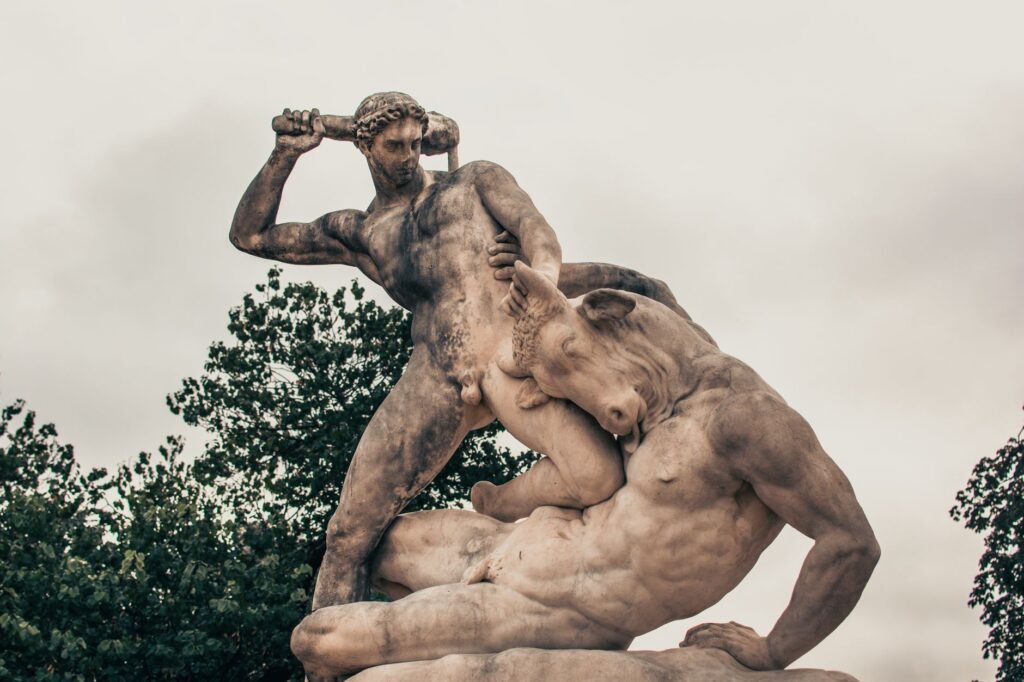
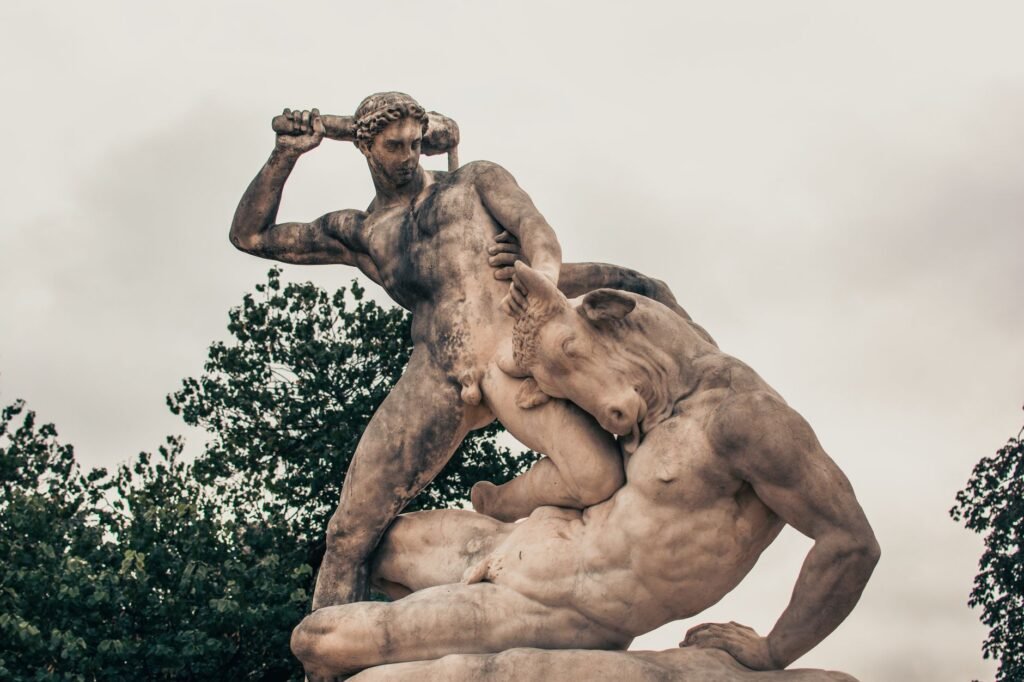
The hero Theseus volunteers to end the tribute. With the help of Ariadne, who provides a thread or ball of thread so he can find his way back, Theseus enters the Labyrinth and kills the Minotaur.
This episode is among the most famous in Greek myth and serves as a classic heroic narrative:
- a dangerous task
- assistance from a helper figure
- a descent into a hidden place
- a victorious return
Variations in the ending
Ancient and later versions differ on details. Some emphasize that Theseus killed the Minotaur in combat with a sword or club. Others focus more on the escape from the Labyrinth than on the slaying itself. In later retellings, the Minotaur may appear more tragic or more beastly depending on the author.
Relationship with Other Mythological Figures
The Minotaur’s myth is deeply relational and depends on several other characters.
Minos
Minos is central to the story as king, judge, and the creature’s royal father or stepfather figure. His failure to honor Poseidon leads to the curse that creates the Minotaur.
Pasiphaë
Pasiphaë is the Minotaur’s mother. Her relationship to the creature is essential to the myth’s structure and to its themes of divine punishment, shame, and inherited consequence.
Daedalus
Daedalus is the master craftsman who builds the wooden cow and later the Labyrinth. He is not a moral ally of the Minotaur but a facilitator of the circumstances that produce and contain him.
Ariadne
Ariadne is the heroine who helps Theseus escape the Labyrinth. Her role contrasts with the Minotaur’s and makes the defeat of the creature possible.
Theseus
Theseus is the Minotaur’s great enemy and slayer. Their confrontation became one of the defining scenes of Greek heroic tradition.
Poseidon
Poseidon is the divine source of the initial bull and the curse. In the myth, he represents the sacred power that has been offended and that restores balance through punishment.
Worship and Cult
There is no well-attested cult of the Minotaur as a deity in ancient Greek religion. The Minotaur is best understood as a mythic monster rather than an object of worship.
Ritual context in the myth
The story contains ritual elements, especially:
- sacrifice of the bull
- tribute of youths
- purification through the slaying of the monster
- divine punishment and restitution
These motifs reflect Greek concerns about proper offerings and the consequences of impiety. However, these are mythic and symbolic elements, not evidence of a Minotaur cult.
Possible ritual background
Some scholars have suggested that the story may preserve distant memories of bull ritual or royal power in Bronze Age Crete. Such ideas are possible but not demonstrable from the ancient evidence alone.
Ancient Sources
The Minotaur is mentioned in several major ancient sources, though details vary.
Key authors and texts
- Apollodorus, Bibliotheca: one of the clearest summaries of the myth, including Pasiphaë, the Labyrinth, and Theseus
- Plutarch, Life of Theseus: important for the Theseus tradition and related variants
- Ovid, Metamorphoses and other works: influential in Roman-era retellings
- Pausanias, Description of Greece: valuable for mythic and local traditions
- Hyginus, Fabulae: gives concise myth summaries
- Diodorus Siculus: includes historical or rationalized perspectives on Cretan traditions
Earlier literary background
While Homer and Hesiod do not present the Minotaur story in a fully developed form, Greek mythic tradition about Minos, Crete, and heroic adventures provided the background for later literary elaboration.
Variation across sources
Ancient sources disagree on some points:
- the exact number of tribute victims
- the relationship between Minos and the creature
- whether the Minotaur had a proper personal name
- details of the Labyrinth
- the manner of Theseus’s victory
These differences are normal in Greek mythology, which was transmitted through multiple local and literary traditions.
Roman Equivalent
There is no true Roman deity equivalent to the Minotaur, since it is a monster rather than a god. In Roman literature, however, the Minotaur is adopted as part of the broader Greek mythological tradition.
Roman writers such as Ovid helped preserve and transform the story for later audiences. Through Roman literature, the Minotaur became part of the shared Greco-Roman mythic canon.
Influence on Modern Culture
The Minotaur has had an exceptionally strong influence on modern culture. It appears across literature, visual art, philosophy, psychology, film, television, and games.
Literature
Writers have used the Minotaur as:
- a monster to be defeated
- a symbol of confinement
- a metaphor for inner conflict
- a figure of tragic otherness
Modern and postmodern authors often reinterpret the Minotaur with sympathy, giving the creature psychological depth absent from the oldest Greek accounts.
Art
The Minotaur has been a favorite subject in:
- vase painting
- sculpture
- Renaissance art
- modernist and surrealist art
- contemporary illustration
It is especially associated with Pablo Picasso, whose Minotaur imagery became a major part of his artistic symbolism.
Film and television
The story of Theseus and the Minotaur has appeared in many screen adaptations, from historical fantasy to animated and children’s retellings. The Labyrinth, in particular, is a recurring cinematic setting because it is visually and narratively compelling.
Games and fantasy fiction
In role-playing games, fantasy novels, and video games, minotaurs are commonly reimagined as:
- warrior races
- dungeon guardians
- beast-like antagonists
- tragic hybrids
These versions often diverge significantly from the ancient myth, but they preserve the creature’s essential association with strength and labyrinthine danger.
Psychology and criticism
The Minotaur has also become a symbol in psychoanalytic and literary criticism. The Labyrinth is often read as a metaphor for the unconscious, while the Minotaur may represent the repressed, the animal within, or destructive desire.
Curiosities
- The Minotaur is one of the few famous monsters in Greek myth with a precise royal genealogy.
- The story combines religion, politics, architecture, and heroism in a single narrative.
- The Labyrinth is often treated as if it were a maze, though ancient and modern interpretations may distinguish between a true labyrinth and a complex maze-like structure.
- In some later retellings, the Minotaur is given a more tragic identity, sometimes emphasizing loneliness rather than pure evil.
- The myth has inspired countless reinterpretations because it is adaptable: it can be read as a tale of monster-slaying, a political allegory, or a psychological drama.
- The Minotaur is closely tied to the broader Greek fascination with hybrids, alongside centaurs, satyrs, sirens, and other boundary-crossing beings.
- Unlike many mythological creatures, the Minotaur is not just “born monstrous”; his origin is framed as a consequence of human and divine error.
Frequently Asked Questions
What is the Minotaur in Greek mythology?
The Minotaur is a creature with the body of a man and the head of a bull, born in Cretan myth and confined in the Labyrinth. It was eventually slain by Theseus.
Why was the Minotaur created?
In the most common version, the Minotaur was the result of Poseidon’s punishment after King Minos failed to sacrifice a sacred bull as promised.
Who were the Minotaur’s parents?
The creature’s mother was Pasiphaë, wife of Minos. His father was a divine bull associated with Poseidon.
What is the Labyrinth?
The Labyrinth was an elaborate structure built by Daedalus to imprison the Minotaur. It became a symbol of confusion, entrapment, and hidden danger.
Who killed the Minotaur?
The hero Theseus killed the Minotaur, usually with the help of Ariadne, who provided thread so he could find his way out of the Labyrinth.
Was the Minotaur worshipped as a god?
No clear evidence shows that the Minotaur was worshipped as a god. It is best understood as a mythic monster, not a deity.
Is there a Roman version of the Minotaur?
There is no Roman equivalent deity, but Roman authors adopted and retold the Greek myth, especially through literature such as Ovid’s works.
Why is the Minotaur still important today?
The Minotaur remains important because it is a powerful symbol of fear, confinement, and the struggle between civilization and primal force. It also continues to inspire art and storytelling.
Conclusion
The Minotaur is one of the most enduring figures in Greek mythology because it brings together so many of the tradition’s central concerns: divine punishment, royal power, monstrous birth, human sacrifice, and heroic triumph. Its story links the island of Crete with Athens, the Labyrinth with the imagination, and the bull with both sacred strength and destructive violence.
Although no historical cult of the Minotaur is known, the creature’s cultural significance is immense. Ancient authors preserved the myth in varying forms, and later generations transformed it into a symbol of psychology, art, and narrative conflict. As a result, the Minotaur remains not only a famous monster, but also one of the most flexible and meaningful images in world mythology.

Orin Vale has spent the better part of two decades tracing the threads that connect the world’s oldest stories — from the halls of Asgard to the banks of the Nile, from Olympus to the jungles of the Maya. What began as a childhood fascination with flood myths and trickster gods grew into years of independent study across comparative mythology and ancient religion, always chasing the same question: what did these stories mean to the people who first told them? Orin writes for readers who want more than trivia — the ones looking for the beliefs, fears, and truths that myths were built to carry.