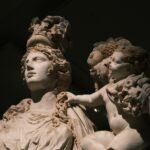
Sirens
Introduction

Sirens are among the most enduring figures in Greek mythology. They are best known as dangerous, enchanting beings whose song lured sailors to destruction, most famously in the Odyssey of Homer. Over time, sirens became a powerful symbol of temptation, deception, and the peril hidden behind beauty or irresistible sound.
In classical tradition, sirens occupy an important place in mythology, literature, visual art, and later folklore. They also illustrate how ancient cultures explained the dangers of the sea and the human vulnerability to seduction, curiosity, and false promises. Although modern popular culture often portrays sirens as mermaid-like creatures, ancient Greek sources usually describe them differently.
Origin and Meaning
The English word siren comes from Latin sīrēn, itself borrowed from Greek Seirḗn (Σειρήν, plural Seirênes). The precise etymology of the Greek word is uncertain and remains debated by scholars. Ancient authors did not preserve a clear explanation of its original meaning.
In modern scholarship, sirens are usually treated as figures from Greek myth rather than as a single historical cult or ethnic group. Their earliest surviving appearances are in archaic Greek poetry, especially Homer. From there, they spread into later Greek and Roman literature and became fixed in the Western imagination.
Historical Context
Sirens emerged in the mythological world of ancient Greece, where sea travel was both essential and dangerous. Greek sailors faced storms, reefs, rocks, and navigation challenges, and mythology often personified such threats in supernatural form. Sirens fit this environment perfectly: they are associated with a lethal shoreline and with the promise of knowledge or pleasure that masks death.
In Greek art, sirens were commonly represented as bird-bodied women, not as fish-tailed mermaids. This imagery appears in vase painting, funerary monuments, and other visual media. Their bird form may reflect associations with the air, song, and death, since birds were frequently linked with omens and the underworld in Greek thought.
Sirens also became part of wider Mediterranean and later European literary culture. Their meaning expanded from mythological monsters to a general symbol of dangerous allure, used in philosophy, poetry, and moral allegory.
Main Characteristics
Sirens are generally characterized by the following traits:
- Enchanting song or voice
- Lethal attraction
- Association with sea routes and rocky coasts
- Connection to knowledge, prophecy, or hidden truths in some traditions
- Hybrid appearance in art, often part woman and part bird
The ancient sources do not agree on every detail. Some describe sirens primarily as singers; others emphasize their role as prophetic beings or companions of the dead. Their appearance also varies across traditions, though the bird-woman form is the most common in early Greek art.
Common Features in the Tradition
| Feature | Typical Description |
|---|---|
| Form | Usually bird-bodied women in Greek art |
| Voice | Beautiful, irresistible, and deadly |
| Habitat | Rocky islands or coastal areas |
| Function | Lure sailors to shipwreck or death |
| Symbolism | Temptation, deception, and perilous knowledge |
Family and Genealogy
Sirens’ genealogy varies significantly depending on the source.
Main Traditions
Daughters of the river god Achelous and a Muse
This is one of the most influential traditions. Different Muses are named in different sources as their mother, often Melpomene, Terpsichore, or Calliope. Because the Muses are connected with song and poetry, this lineage helps explain the sirens’ musical power.Daughters of Phorcys or other sea deities
Some later or alternative traditions place them among monstrous sea-born beings. These versions align them more closely with other marine figures of Greek myth.
Number and Names
The number of sirens also varies. Some authors speak of two, others of three or more. A well-known triad includes:
- Parthenope
- Leucosia
- Ligeia
Other names also appear in ancient or later sources. Since the tradition is not uniform, no single list can be treated as definitive.
Children, Spouses, and Descendants
Ancient sources do not consistently assign sirens spouses or children. They are usually described as unmarried or as existing outside ordinary family structures. Their role is mythic and functional rather than genealogical in the normal heroic sense.
Symbols
Sirens are associated with several symbolic elements, though these are often inferred from art and literature rather than formal cult practice.
Main Symbols
- The lyre and song: representing music, persuasion, and artistic power
- Bird wings and feathers: indicating their hybrid form and link with the sky, death, or omen
- Ships and oars: symbolizing the maritime context of their danger
- Rocks and cliffs: representing shipwreck and the boundary between safety and ruin
Color symbolism is not standardized in the ancient record, but sirens are often imagined in visually striking, liminal terms—beautiful yet threatening, graceful yet predatory.
Sacred Animals
Strictly speaking, sirens do not belong to a clearly documented cult with sacred animals in the way major Olympian deities sometimes do. However, several animals are strongly associated with them in myth and iconography.
Birds
Birds are the most important animal association. In Greek art, sirens are commonly shown with:
- wings
- bird legs or bodies
- birdlike plumage
This form likely emphasizes their otherworldliness and their connection to song.
Seabirds
Although ancient sources do not always specify a species, seabird imagery suits their coastal habitat. Birds living near the shore naturally reinforced the link between sirens, the sea, and the dangers of navigation.
Sacred Plants
No plant is securely established as sacred to sirens in the way laurel is linked to Apollo or ivy to Dionysus. Ancient sources do not record a specific botanical cult attached to them.
However, literary tradition sometimes associates sirens with the broader imagery of fragrance, flowers, and seductive environments, especially in later poetic and artistic interpretations. These associations are symbolic rather than canonical.
Sacred Places
Sirens are associated with particular coastal locations in myth, especially in Italy and the Mediterranean world.
Key Locations
| Place | Significance |
|---|---|
| Sirenum Scopuli | The “rocks of the sirens,” traditionally linked to the Odyssey |
| Southern Italy | Later local traditions placed sirens near coastal sites in this region |
| Island settings | Sirens often inhabit isolated, inaccessible places |
Sirenum Scopuli
In Homer’s Odyssey, the sirens are located on a perilous shore that Odysseus must pass. Later tradition often identifies this place with rocks off the Italian coast, though precise ancient geography is not uniform.
Local Traditions
Several Mediterranean communities claimed associations with sirens, especially through place-names and local legends. For example, the figure of Parthenope became connected with Naples in later tradition, showing how myth could be anchored to a specific landscape.
Powers and Attributes
Sirens’ most famous power is their song, but the tradition gives them several related attributes.
Primary Powers
- Luring travelers
- Enchanting listeners
- Causing shipwreck and death
- Possibly revealing hidden knowledge
- Psychological manipulation through beauty and sound
The Meaning of Their Song
The sirens’ song is not simply pleasant music. It is often understood as a force that suspends judgment. Listeners are drawn toward them because they promise pleasure, knowledge, or fulfillment, yet the outcome is destruction.
In some versions, sirens know everything that happens on earth. This adds a further dimension: they tempt not only through beauty but through the desire for forbidden knowledge. This theme has made them especially influential in later philosophy and literature.
Main Myths
Odysseus and the Sirens
The most famous myth involving sirens appears in Homer’s Odyssey (Book 12). Odysseus is warned by Circe about the sirens’ deadly song. To survive, he follows this plan:
- his crew stops their ears with wax
- Odysseus himself is tied to the mast
- he listens safely while the ship passes the danger
This episode became a classic illustration of self-control, prudence, and the management of desire. It also shows the sirens’ enduring role as a test of human will.
The Argonauts and Orpheus
Another famous tradition connects sirens with the Argonauts. In this story, the crew of Jason would likely have been destroyed by the sirens if not for Orpheus, whose superior music drowned out their song. Different ancient accounts present this episode in slightly different ways, but the core motif is consistent: music defeats music.
The Sirens’ Defeat and Transformation
Several later traditions explain why the sirens became birdlike or how they came to be defeated. Some versions link their fate to a challenge involving the Muses. In one common motif, the sirens lose a musical contest and are transformed into birds or are made to suffer because of their failure. These stories are not uniform, and details vary across authors.
Association with Death and the Underworld
Sirens are sometimes linked to death, burial, and funerary imagery. In some artistic contexts, they appear at tombs or grave monuments, possibly as symbols of lamentation, passage, or the soul’s journey. This does not mean they belong to a single underworld cult, but it shows the breadth of their symbolic role.
Relationship with Other Mythological Figures
Sirens interact with a range of mythological figures, often in antagonistic or comparative ways.
Odysseus
Odysseus is their most famous human opponent. His survival depends on intelligence, preparation, and restraint. The story highlights the contrast between heroic discipline and fatal temptation.
Orpheus
Orpheus is the clearest mythic rival to the sirens in the realm of music. He defeats them not by force, but by superior song. This makes him one of the few figures whose art can counteract their spell.
The Muses
The sirens are often linked to the Muses through genealogy or artistic competition. This relationship is significant because it frames sirens as a dark reflection of legitimate poetic power. Both groups sing; one inspires civilization, the other destroys it.
Sea Deities and Monsters
In some traditions, sirens belong to the broader family of maritime beings, alongside other monsters and divine powers associated with the sea. Their exact placement varies, but they are frequently treated as liminal creatures occupying the border between land and water, life and death.
Worship and Cult
There is no strong evidence for a major, formal cult of the sirens in the same sense as a temple-based cult of Olympian gods. They are primarily mythological beings rather than objects of widespread worship.
Possible Forms of Veneration or Commemoration
- Local legends attached to coastal sites
- Funerary imagery on monuments and grave goods
- Literary invocation in poetry and learned writing
- Place-name traditions, especially where a siren was linked to a city or coast
Parthenope and Naples
The best-known local tradition involves Parthenope, one of the sirens, who in later myth and legend became associated with the founding or naming of Naples. This is not a universal Greek belief but a powerful example of how myth merged with local identity in the ancient Mediterranean.
Ancient Sources
Sirens are well attested in ancient literature and art. The following authors are especially important:
Homer
In the Odyssey, Homer provides the most famous literary account of the sirens. This text established the canonical image of their song and danger.
Hesiod
Hesiod’s tradition, preserved and expanded in later sources, helps place sirens within the wider genealogy of divine and semi-divine beings. Direct references are limited, but later mythographers draw on Hesiodic traditions.
Apollodorus
The Bibliotheca attributed to Apollodorus preserves mythographic summaries that include siren genealogy and related stories. It is valuable for comparing variant traditions.
Pausanias
Pausanias offers important evidence for local myths and cultic associations. His Description of Greece is useful for understanding regional traditions and artistic representations.
Ovid
Ovid’s Metamorphoses and related works helped shape the Roman and later European reception of sirens, especially through transformation motifs and literary elaboration.
Other Sources
- Apollonius Rhodius, for the Argonauts and Orpheus
- Euripides and later tragedians, indirectly through mythic themes
- Hellenistic and Roman poets, who expanded the siren’s symbolic role
Table of Selected Ancient References
| Author | Work | Importance |
|---|---|---|
| Homer | Odyssey | Earliest famous account of the sirens |
| Apollonius Rhodius | Argonautica | Orpheus versus the sirens |
| Apollodorus | Bibliotheca | Mythographic genealogy and summaries |
| Pausanias | Description of Greece | Local traditions and artistic references |
| Ovid | Metamorphoses | Roman literary transformation of the myth |
Roman Equivalent
There is no exact Roman deity or creature that fully matches the Greek sirens. The Romans generally adopted the Greek sirens directly, preserving their name and basic identity.
Roman literature and art, however, often blended sirens with broader notions of marine monsters and seductive beings. Over time, the Latin literary tradition contributed to the later conflation of sirens with mermaids and other hybrid female sea figures.
Influence on Modern Culture
Sirens have had a major influence on modern culture, far beyond classical studies.
Literature
Writers have used sirens as symbols of:
- temptation
- dangerous beauty
- seductive speech
- the conflict between reason and desire
They appear in poetry, novels, fantasy literature, and philosophical writing, often detached from their original bird-like form.
Visual Art
Artists from the medieval period onward frequently reimagined sirens as half-woman, half-fish creatures, contributing to the modern confusion with mermaids. In classical-inspired art, however, they may still appear with wings and bird features.
Cinema and Television
Film and television often use the siren idea loosely to describe any alluring but dangerous female figure. Fantasy and adventure media may also depict sirens as magical singers or marine beings.
Games and Popular Fiction
Video games, comics, and fantasy novels often portray sirens as enemies with hypnotic voices or as supernatural sea creatures. These depictions usually mix Greek myth, medieval folklore, and modern fantasy conventions.
Music and Branding
The word siren is also used metaphorically in music, fashion, and branding to suggest allure, power, or danger. This broad cultural use shows how firmly the myth has entered everyday language.
Curiosities
- In ancient Greek art, sirens were usually bird-women, not mermaids.
- Their song is one of the most famous examples in literature of dangerous knowledge.
- The sirens’ episode in the Odyssey is often read as a meditation on self-control and human curiosity.
- Orpheus is one of the few figures who successfully countered them through music.
- The modern emergency warning device called a siren takes its name from the mythological beings because of its piercing, attention-grabbing sound.
- Different ancient sources give different numbers of sirens, showing that the tradition was never completely fixed.
- Some later traditions connected a siren, especially Parthenope, with the founding legends of Naples.
Frequently Asked Questions
1. What are sirens in Greek mythology?
Sirens are mythical beings known for singing a deadly, alluring song that lured sailors to destruction. In Greek art, they are usually shown as bird-women.
2. Are sirens the same as mermaids?
No. In ancient Greek sources, sirens are generally not mermaids. The modern fish-tailed image developed later through artistic and literary blending of traditions.
3. Who were the sirens’ parents?
Their genealogy varies. A common tradition says they were daughters of the river god Achelous and one of the Muses, though other traditions exist.
4. How did Odysseus survive the sirens?
According to Homer, his crew stopped their ears with wax, while Odysseus was tied to the mast so he could hear the song without steering the ship toward danger.
5. What do sirens symbolize?
Sirens symbolize temptation, dangerous beauty, deceptive speech, and the peril of forbidden knowledge.
6. Did sirens have a cult in ancient Greece?
There is no evidence for a major, widespread cult of sirens. They appear mainly in myth, literature, art, and local legend.
7. Why are sirens sometimes linked to birds?
In ancient Greek iconography, sirens were often represented as bird-bodied women. The bird form likely reflects their association with song, the sky, and funerary symbolism.
8. What is the most famous siren myth?
The most famous myth is the encounter with Odysseus in the Odyssey, where he survives their song by having his crew bind him to the mast.
Conclusion
Sirens are among the most recognizable figures of Greek mythology, combining beauty, music, danger, and mystery. Their enduring importance lies not only in their role in ancient stories, but also in their symbolic power: they represent the allure of what may be desired but must not be trusted.
From Homeric epic to modern literature and popular culture, sirens have remained a vivid image of temptation and peril. Although traditions about their number, genealogy, and appearance vary, their core meaning has remained remarkably stable. They are a lasting reminder that the most enchanting voice is not always the safest to follow.

Orin Vale has spent the better part of two decades tracing the threads that connect the world’s oldest stories — from the halls of Asgard to the banks of the Nile, from Olympus to the jungles of the Maya. What began as a childhood fascination with flood myths and trickster gods grew into years of independent study across comparative mythology and ancient religion, always chasing the same question: what did these stories mean to the people who first told them? Orin writes for readers who want more than trivia — the ones looking for the beliefs, fears, and truths that myths were built to carry.