The question of who was in love with Daphnis in Greek mythology? opens a window into the rich and often tragic world of pastoral romance, where mortal beauty attracts the attention of both nymphs and gods, and where love is frequently a prelude to suffering. Daphnis (Δάφνις), the legendary Sicilian cowherd credited with inventing pastoral poetry, was a figure of extraordinary beauty whose amorous adventures were the stuff of legend . His lovers ranged from divine beings like the god Pan to mortal women and nymphs, and his story became the foundation for an entire literary tradition. This article will serve as a definitive guide to those who loved Daphnis, exploring his divine and mortal lovers, the consequences of these relationships, and his enduring legacy in Western literature.
The Divine Lovers: Pan and Apollo
Daphnis’s extraordinary beauty attracted the attention of the gods themselves, leading to relationships that would shape his destiny.
Pan: The God of the Wild
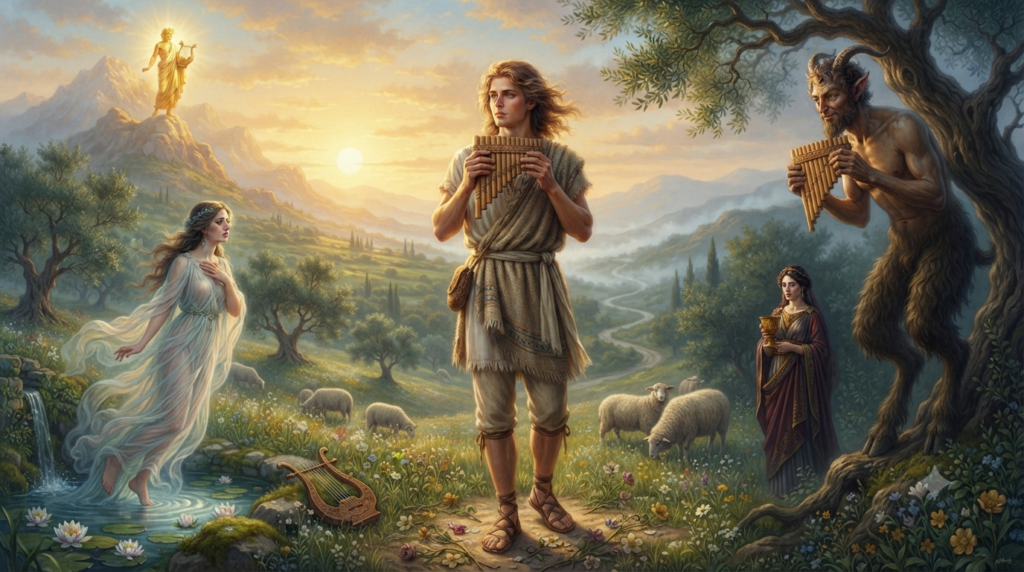
The rustic god Pan, who haunted the wilderness and was the patron of shepherds, was deeply enamored with Daphnis. In some versions of the myth, Pan not only fell in love with the beautiful cowherd but also took him as a lover and taught him how to play the panpipes (syrinx), an instrument that became central to his pastoral identity . This divine tutelage established Daphnis as the master of pastoral music and song, a skill that would define his legendary status.
According to some accounts, Daphnis was not merely Pan’s student but his beloved, and the god’s instruction in music was an expression of his affection . This divine patronage elevated Daphnis beyond the status of a mere mortal shepherd, positioning him as a figure of cultural significance whose songs would inspire generations of poets. The relationship with Pan also connects Daphnis to the wild, untamed forces of nature, reinforcing his identity as a pastoral hero who lived in harmony with the natural world.
Apollo: The God of Music
In some traditions, Apollo, the god of music, poetry, and prophecy, was also said to have loved Daphnis . This divine affection further underscores Daphnis’s exceptional beauty and his connection to the arts. Apollo’s interest in Daphnis aligns with the god’s role as the patron of music and poetry, suggesting that Daphnis’s talents were not merely mortal but divinely inspired. The association with Apollo, one of the most beautiful and powerful of the Olympian gods, places Daphnis in the company of other legendary youths who were beloved by the gods, such as Hyacinthus and Adonis .
The Nymph Lovers: Nomia and Echenais
The most significant and tragic relationships in Daphnis’s life were with nymphs, who fell in love with his beauty but punished him cruelly for his infidelity.
Nomia: The Arcadian Nymph
Nomia (Νομία) was a nymph of the Arcadian mountains, a wild and pastoral region where shepherds lived close to the ancient gods . According to this tradition, Nomia fell deeply in love with Daphnis, and he swore an oath of eternal fidelity to her, a serious vow sworn upon the nymphs’ sacred springs . Their love seemed destined for happiness until a mortal princess, who had become infatuated with Daphnis, seduced him by getting him drunk at a feast .
When Nomia discovered his betrayal, her punishment was swift and permanent: she blinded him . In Arcadian tradition, Daphnis wandered sightless through the mountains, singing the sorrowful songs that became the foundation of bucolic poetry, before eventually dying by falling from a cliff or wasting away from grief . The springs of the region were said to weep for him, and Nomia herself felt no remorse for her vengeance .
Echenais: The Naiad
In other versions of the myth, the nymph who loved Daphnis and punished his infidelity was named Echenais (Ἐχέναις) . Like Nomia, Echenais was a naiad (a freshwater nymph) who fell in love with Daphnis and extracted a promise of fidelity from him. She warned him that if he ever loved another woman, he would be struck blind . The warning was prophetic: when a Sicilian princess (or a king’s daughter) seduced him with wine, Echenais exacted her revenge by blinding him .
Some sources suggest that Echenais and Nomia may be the same figure, or that both names were used in different regional traditions to describe the same nymph . Both names appear in various ancient sources, and the core story remains consistent: a nymph’s love, a vow of fidelity, a seduction by wine, and a punishment of blindness.
The Mortal Lovers: The Princess and Xenea
Beyond the divine and nymph lovers, Daphnis also inspired passion in mortal women, often with tragic consequences.
The Sicilian Princess (or King’s Daughter)
The most consistent narrative about Daphnis involves a mortal princess, sometimes identified as the daughter of a king of Sicily, who fell in love with the beautiful shepherd and seduced him . Her seduction was accomplished through wine: she plied Daphnis with alcohol until he was intoxicated and then took him to her bed . This act of seduction, which may have been a deliberate attempt to steal him from his nymph lover, triggered Daphnis’s tragic fate. In some sources, the princess is explicitly identified as a “king’s daughter” who got him drunk and seduced him .
Xenea
In the works of the poet Theocritus, a different tradition emerges: Daphnis was tormented by an unrequited love for a woman named Xenea . According to Theocritus, Daphnis fell deeply in love with Xenea, but his passion was not returned, leading him to suffer the torments of unrequited love and wander through the woods in despair . In this version, the wrath of Aphrodite is the cause of his suffering, as he had offended the goddess of love . This account differs significantly from the nymph-and-princess narrative, suggesting that there were multiple, competing traditions about Daphnis’s love life.
The Divine Friend: Artemis
While not a romantic lover, Daphnis was also a beloved companion of the goddess Artemis (Diana). According to tradition, he became a follower of Artemis, accompanying her on hunts and entertaining her with his pastoral songs and music . This relationship underscores his purity and his connection to the wild, untamed aspects of nature, which Artemis personified. His devotion to the virgin goddess may have been a factor in the demands for fidelity made by his nymph lovers, as he was expected to maintain a state of chastity or at least faithfulness.
The Legacy of Daphnis’s Loves
The loves of Daphnis had a profound impact on Greek and Roman literature, establishing him as the archetypal pastoral figure whose tragic love story inspired generations of poets. Theocritus, the founder of pastoral poetry, wrote extensively about Daphnis’s love and death in his Idylls, and the tradition was continued by Virgil in his Eclogues . The story of Daphnis and Chloe, written by Longus in the 2nd century CE, represents a later, more romanticized version of the pastoral love story, though it draws on the same tradition .
The name “Daphnis” itself became synonymous with pastoral poetry, and his tragic fate—whether by blindness, death, or divine intervention—served as a cautionary tale about the dangers of love, infidelity, and the wrath of the gods. The motif of the beautiful youth who is loved by gods and mortals alike, only to be destroyed by passion, is a recurring theme in Greek mythology, and Daphnis stands alongside figures like Hyacinthus, Narcissus, and Adonis as a symbol of the fragile beauty of youth and the cruelty of fate .
Frequently Asked Questions About Who was in love with Daphnis in Greek mythology?
Who was Daphnis in Greek mythology?
Daphnis was a legendary Sicilian cowherd credited with inventing pastoral poetry. He was the son of Hermes and a nymph, and was renowned for his extraordinary beauty and his musical talents. His tragic love story, involving nymphs, princesses, and gods, became a foundational myth of the pastoral literary tradition .
Which nymph fell in love with Daphnis?
Two nymphs are associated with Daphnis in different traditions: Nomia (an Arcadian nymph) and Echenais (a naiad). Both fell in love with him, swore him to fidelity, and blinded him when he was seduced by a mortal princess .
Did Pan love Daphnis?
Yes, according to some versions of the myth, the god Pan fell in love with Daphnis, took him as a lover, and taught him how to play the panpipes . This divine instruction established Daphnis as the master of pastoral music.
What happened to Daphnis after he was blinded?
After being blinded by the nymph, Daphnis wandered through the mountains, singing sorrowful songs. He soon died—either by falling from a cliff, wasting away from grief, or being taken up to heaven by his father Hermes . A spring gushed forth where he died, and the Sicilians offered sacrifices there .
Who was Xenea?
Xenea was a woman with whom Daphnis was in love in the version of the myth told by the poet Theocritus. His love for her was unrequited, causing him intense suffering . This version differs from the more common narrative of nymph lovers and royal seduction.
What is the connection between Daphnis and pastoral poetry?
Daphnis is regarded as the inventor of pastoral poetry because his songs about shepherds and their lives were said to have been the foundation of this literary tradition . His tragic story was a favorite subject of the pastoral poets Theocritus and Virgil.
What is the story of Daphnis and Chloe?
Daphnis and Chloe is a pastoral novel by Longus, set on the island of Lesbos. It tells the story of two abandoned children who grow up together and fall in love, eventually marrying after many adventures . While it shares the name “Daphnis,” it is a distinct story from the mythological Daphnis of Sicily.
Conclusion
The question of who was in love with Daphnis in Greek mythology? reveals a complex web of divine and mortal passions, each contributing to the tragic fate of the legendary shepherd. From the god Pan, who taught him music, to the nymphs Nomia and Echenais, who loved him and punished his infidelity, to the mortal princess who seduced him with wine, and even to Apollo and the enigmatic Xenea, Daphnis’s life was defined by the love others felt for him. His story, rich with themes of beauty, fidelity, betrayal, and punishment, became the cornerstone of pastoral poetry, inspiring poets for millennia. Daphnis remains a powerful symbol of the fragility of youth and the tragic consequences of love, a figure whose legend continues to resonate in literature and art.

Orin Vale has spent the better part of two decades tracing the threads that connect the world’s oldest stories — from the halls of Asgard to the banks of the Nile, from Olympus to the jungles of the Maya. What began as a childhood fascination with flood myths and trickster gods grew into years of independent study across comparative mythology and ancient religion, always chasing the same question: what did these stories mean to the people who first told them? Orin writes for readers who want more than trivia — the ones looking for the beliefs, fears, and truths that myths were built to carry.