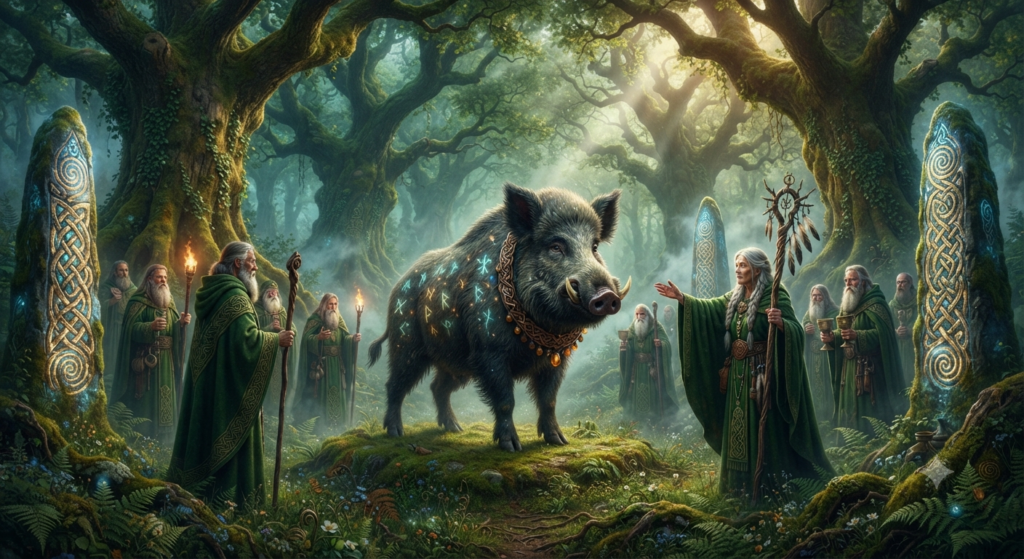
The boar occupies a remarkable place in Celtic mythology, where it stands at the meeting point of wilderness, warfare, kingship, and fate. Across Irish and Gaulish traditions, the animal appears not merely as game or prey, but as a force of untamed vitality, a creature whose power could bless, test, or destroy those who encountered it. In Celtic imagination, the boar was large, dangerous, and fiercely independent, qualities that made it a fitting emblem for warriors and rulers who sought to embody courage and authority.
Because Celtic religion was preserved unevenly in later literary sources, especially Irish saga and scattered classical references to the Gauls, the boar’s meaning must be pieced together from several traditions. Even so, a consistent pattern emerges: the boar signals strength, abundance, and sacred risk. It can appear as a prize of the hunt, a token of sovereignty, a herald of doom, or a guardian of otherworldly power, and that flexibility is part of what made it so enduring in Celtic myth.
The boar as a symbol of strength in Celtic lore
The boar in Celtic lore is most often associated with raw force. Unlike the domesticated pig, the wild boar represented untamed power in the woods and mountains, and its charge was feared throughout ancient Europe. In Celtic stories and material culture, that energy made the boar an ideal sign of ferocity, resilience, and masculine prowess. It was not a gentle emblem of fertility alone, but a creature whose strength could be admired precisely because it was dangerous.
This symbolic force appears especially clearly in warrior culture. Boar imagery could communicate a fighter’s readiness to meet violence with violence, and in some Irish tales boar-feeding or boar-hunting marks heroic status. The animal was respected not because it was easy to control, but because it was not. That tension between admiration and fear gives the boar its mythic weight.
Boar hunting and warrior prestige among the Celts
Boar hunting carried prestige in Celtic society because it was an elite pursuit demanding skill, courage, and coordination. Classical writers on the peoples of Gaul and Britain describe hunting as a serious masculine activity, and later Irish literature turns boar hunts into scenes of danger and honor. To pursue a boar meant entering the animal’s own terrain, where the hunter risked wounds or death, and that risk elevated the act into a measure of worth.
In heroic narrative, the successful hunter often gains more than meat. He wins reputation, demonstrates fitness for leadership, and proves his ability to confront chaos without hesitation. A boar hunt could therefore function almost like a trial of nobility. The quarry itself mattered too: the boar was not an ordinary animal, but one whose defeat confirmed the hunter’s superiority over a force that symbolized wild resistance.
Sacred boars in myths of kingship and sovereignty
In several Celtic traditions, the boar is linked to kingship and sovereignty, where power is understood as something granted, tested, or withdrawn by the land itself. Irish saga often connects rulers with the successful mastery of extraordinary animals, and boars belong to that sphere of potent encounters. The hunt, in these stories, is not only an athletic contest but a political and cosmological one, because the right to rule can be reflected in the ability to control what is wild.
Sovereignty in Celtic myth frequently appears as a relationship with the land personified through animals, women, or sacred places. The boar fits this pattern because it is both terrestrial and elusive, a creature of the forest that resists settlement yet remains tied to abundance. When boars are associated with rulers or royal feats, they express the idea that legitimate power requires contact with dangerous, untamed vitality rather than mere inheritance.
Wild boar imagery in Gaulish and Irish sources
Gaulish evidence for the boar comes largely from archaeology and classical testimony rather than surviving native myth texts. Yet boar imagery is abundant: on helmets, standards, sculpture, and coins, the animal often marks martial identity and divine or tribal symbolism. Classical observers note the importance of animal emblems among Celtic peoples, and the boar’s presence in that visual field suggests it held more than decorative value.
Irish sources preserve the boar more explicitly in narrative form. Tales such as the Táin Bó Cuailnge and related heroic cycles feature boars as formidable creatures, sometimes tied to curses, metamorphosis, or supernatural hunting. In these texts, the boar is not simply a beast in the landscape. It is a narrative agent, one that can trigger journeys, tests, and tragic outcomes.
The boar as guardian, challenger, and omen
The boar often functions in Celtic stories as a threshold creature, guarding a place, challenging a hero, or marking an event as ominous. Its appearance can signal that ordinary rules no longer apply. In this role, the boar is not just an enemy; it is a boundary-maker, standing between the human world and something deeper, older, or more perilous.
As an omen, the boar’s meaning depends on context. A hunted boar may promise honor, but a boar encountered at the wrong moment can foretell disaster. Celtic narrative frequently uses animals this way, not as random symbols but as charged signs whose behavior reveals the state of fate itself. The boar’s combination of force and unpredictability made it especially suited to such scenes.
Cú Chulainn and the fatal boar of prophecy
One of the best-known boar narratives in Irish tradition involves Cú Chulainn and the fatal beast connected to his prophecy of death. In one widespread version of the tale, Cú Chulainn is foretold that he will die when a certain series of impossible events align, and the boar becomes part of that fulfillment. The story belongs to the larger Ulster Cycle, where heroic destiny is often inescapable once pronounced.
The exact details vary among sources and tellings, but the central idea remains stable: the boar is not merely a hunted animal but an instrument of fate. Cú Chulainn’s death is bound up with the moral and cosmic logic of prophecy, and the boar serves as the final agent through which that logic is enacted. This is one reason the animal carries such power in Celtic myth: it can represent not only strength, but the unstoppable approach of destiny.
Animal symbolism in Celtic art and bronzework
Celtic art frequently transforms the boar into a stylized emblem of movement and force. On metalwork, weapon fittings, and decorative objects, boar heads and boar-like forms appear with the sharp energy characteristic of La Tène art. These images are rarely naturalistic in a modern sense; instead, they capture the animal’s essence through curves, horns, snouts, and compressed power.
Bronzework and related media suggest that the boar was not confined to storytelling. It was part of lived visual culture, worn, displayed, and perhaps ritually meaningful. Such objects may have marked social rank or martial identity, but they also helped create a shared symbolic world in which the boar stood for prestige, ferocity, and protection. The animal’s image could therefore travel from myth into the everyday symbolism of elite Celtic life.
Boar sacrifices and ritual feasting in ancient Gaul
Direct evidence for boar sacrifice in ancient Gaul is limited, and care is needed not to overstate what the sources can support. Still, the broader sacrificial culture of the ancient Celts included animals in ritual settings, and the boar’s status as a valued and powerful creature makes it a plausible candidate for ceremonial use in some contexts. Feasting, sacrifice, and political gathering were closely related in many ancient societies, and the boar would have been an especially prestigious animal for such occasions.
Feasting on boar may have carried more than nutritional significance. In a ritual or aristocratic context, the consumption of a dangerous animal could symbolize mastery over wild power and the redistribution of that power through communal meal and elite display. Even where the sources remain silent on specific rites, the boar’s place in Celtic sacrificial imagination is consistent with its broader role as a creature of heightened importance.
Regional variations in Celtic boar traditions and tales
Celtic boar traditions were not uniform across the ancient world. Irish literature presents the boar with narrative richness, especially in heroic cycles, while Gaulish evidence emphasizes iconography and outside testimony. In Britain and the wider Atlantic fringe, boar symbolism appears in place-names, imagery, and later folklore, though the surviving mythic record is fragmentary. Regional difference should therefore be expected, not seen as a contradiction.
This variation reflects the diversity of Celtic-speaking cultures rather than a single centralized mythology. Some communities stressed the boar as a warrior emblem; others seem to have emphasized its sacrificial or protective qualities. Across these regions, however, the same core association persists: the boar is a potent animal, difficult to tame, closely tied to the dangerous prestige of those who confront it.
Why the boar remained a potent mythic emblem
The boar endured in Celtic mythology because it condensed several powerful ideas into one unforgettable animal. It was fierce enough to symbolize war, elusive enough to represent the wild, and significant enough to mark sovereignty, prophecy, and ritual. Few creatures could move so easily between the hunt, the battlefield, and the otherworldly edge of fate.
Its lasting appeal also lies in its ambiguity. The boar can be prize, threat, guardian, or omen depending on the story being told. That flexibility made it a durable mythic emblem in cultures that understood power as something both desired and perilous. In Celtic tradition, the boar remained a figure of deep significance because it did not merely reflect human strength; it reminded people that true strength always came with danger attached.
In Celtic mythology, the boar is far more than a wild animal. It is a symbol of force, a test of courage, a marker of royal legitimacy, and a messenger of fate. Whether appearing in Irish heroic tales, Gaulish art, or the broader symbolic language of ancient Celtic culture, the boar stands for the untamed energies that could elevate a warrior or end him.
That enduring presence explains why the boar never lost its mythic power. It embodied the central Celtic conviction that greatness is inseparable from peril, and that the wild world is not something to be ignored, but something to be faced with skill, honor, and respect.

Orin Vale has spent the better part of two decades tracing the threads that connect the world’s oldest stories — from the halls of Asgard to the banks of the Nile, from Olympus to the jungles of the Maya. What began as a childhood fascination with flood myths and trickster gods grew into years of independent study across comparative mythology and ancient religion, always chasing the same question: what did these stories mean to the people who first told them? Orin writes for readers who want more than trivia — the ones looking for the beliefs, fears, and truths that myths were built to carry.