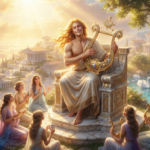
When people ask which Greek goddess represents springtime, the answer is usually Persephone—though the myth is more layered than a single name. In Greek tradition, spring is not embodied by a goddess in a simple, fixed way, but by a seasonal pattern: the return of life after loss, the stirring of grain, flowers, and fertility after the winter months. Persephone, Demeter, and in some later or adjacent traditions figures such as Flora and Chloris all belong to that sacred language of renewal. The Greeks did not imagine spring as a detached abstraction; they understood it through divine movement, agricultural rhythm, and the recurring presence of blossoms in the world.
Which Greek goddess represents springtime in myth?
Persephone is the figure most often associated with springtime in Greek myth because her annual return from the underworld marks the earth’s renewal. In the Homeric Hymn to Demeter, her descent and eventual restoration to her mother are tied directly to the cycle of growth and barrenness. When Persephone is with Hades, the earth grieves; when she returns, life begins again. That pattern made her a natural symbol of the vernal season, even if the sources do not always name her as a “spring goddess” in the modern sense.
At the same time, spring in Greek religion was never confined to Persephone alone. Demeter, as goddess of grain and cultivated fertility, is equally central to the season’s meaning. Ancient myth tends to present spring as a shared divine event: the daughter’s return, the mother’s joy, the field’s awakening, and the first promise of harvest. For that reason, the goddess who represents springtime depends on whether one means the blooming earth, the rebirth of crops, or the mythic return from deathlike absence.
Persephone and the seasonal return from Hades
Persephone, also called Kore, is the clearest mythic figure of seasonal return. Her abduction by Hades and the compromise that requires her to spend part of the year below ground are described most influentially in the Homeric Hymn to Demeter, though later authors preserve variations in detail. The essential point remains the same: her absence explains the earth’s sterility, and her return explains its renewed abundance. Spring is therefore not just weather in Greek myth, but a divine homecoming.
Her connection with spring is strengthened by the imagery surrounding her in ancient literature and ritual. Persephone is often imagined as a maiden of flowers, associated with narcissus, meadow growth, and the first tender vegetation that rises after winter rains. Yet her identity is never purely cheerful or pastoral. She is also queen of the dead, which gives spring in Greek thought a solemn edge: life returns because it has passed through darkness. That tension is one reason her myth has endured so powerfully.
Demeter, harvest rites, and the growth of grain
If Persephone represents the return of spring, Demeter represents the productive earth that spring awakens. She is the goddess of grain, agriculture, and the sustaining cycle of cultivation, and her most famous myth in the Homeric Hymn to Demeter explains why wheat, barley, and human survival depend on divine favor. The earth’s fertility is not merely decorative in Greek religion; it is the basis of civilization. Spring, in Demeter’s domain, means the first movement toward harvest.
Demeter’s rites also connect her to seasonal renewal through the Eleusinian Mysteries and local agricultural festivals. Ancient worship of Demeter marked stages in the farming year, especially sowing and growth, so her presence was felt not only in autumnal preparation but in the promise that follows winter. In this sense, Demeter is not always the poetic emblem of spring, yet she is the power behind spring’s practical meaning: shoots rise, fields green, and the human community anticipates bread.
Flora and Chloris in Greek and Roman tradition
Strictly speaking, Flora is Roman rather than Greek, but she belongs to the broader Mediterranean vocabulary of spring. In Roman religion, Flora was the goddess of flowers, blooming, and youthful fertility, and her festival, the Floralia, celebrated abundance in late April and early May. Because of her strong association with blossoms, she is often mentioned in discussions of springtime deities, even though she is not a figure from classical Greek mythology in the same way as Persephone or Demeter.
Chloris is the more relevant Greek counterpart, though her profile is much less prominent in surviving sources. In later poetic and artistic traditions, she becomes associated with flowers and the fresh greening of the earth, and Roman writers often blended Greek and Roman names in ways that can blur the distinctions. The important point is that the ancient world did personify blooming itself, but these figures do not replace Persephone in Greek myth. Rather, they stand beside her as later or related expressions of spring’s floral side.
The Eleusinian Mysteries and spring renewal
The Eleusinian Mysteries centered on Demeter and Persephone, and they offered initiates a religious experience tied to life, death, and renewal. Ancient testimony, including references from authors such as Pausanias and later commentators, makes clear that the rites were considered deeply sacred and not to be openly revealed. What can be said with confidence is that the Mysteries presented a vision of divine return and human hope, which naturally resonated with the seasonal rebirth of the land.
Although the central festival calendar was not simply a “spring festival,” the Eleusinian religious atmosphere is inseparable from springtime symbolism. The myth at its heart explains why the earth can be fruitful again after loss, and that idea echoed through ritual, procession, and sacred storytelling. For ancient worshippers, the renewal of grain and the renewal of the soul were not entirely separate. Spring, in this context, was both agricultural fact and spiritual promise.
Ancient sources on the goddess of the vernal earth
The principal ancient source for Persephone’s seasonal significance is the Homeric Hymn to Demeter, which gives the most influential account of her abduction and return. Later mythographers such as Apollodorus preserve the same basic framework, while poets and dramatists expand its imagery. Hesiod also contributes to the wider divine genealogy that places Demeter and Persephone within the Olympian order, though he is less explicit about the seasonal symbolism itself. Together, these sources establish the mythic foundation for spring’s association with the goddess.
Other ancient writers help clarify how Greeks understood the relationship between goddess and season. Pausanias records local cults and sacred sites where Demeter and Persephone were honored in ways that varied by region, showing that the myth was not fixed in one form. In the Roman world, Ovid’s Fasti gives spring more florid literary treatment, especially through floral divinities, but that should not be read back into Greek religion without caution. The consensus of the sources still places Persephone and Demeter at the center of spring renewal.
Flowers, blossoms, and the language of rebirth
In Greek myth, flowers often signal a threshold between innocence and transformation. Persephone is famously gathering blossoms when she is seized by Hades in many versions of the story, and that opening scene makes the meadow itself part of the drama. Flowers are not only decorative; they mark the moment just before change. Their beauty is brief, and that brevity suits the season of spring, when life appears suddenly and then passes into fullness.
The language of rebirth in Greek myth is therefore floral as much as agricultural. Blossoms suggest the return of color, scent, and softness to the world, while also reminding the listener that spring is temporary and must be preserved through memory, rite, and story. Persephone’s association with flowers deepens her symbolic role: she is the maiden of the meadow, the hidden queen beneath the earth, and the figure through whom the cycle of blooming becomes intelligible. Spring is her return, but also the earth remembering how to open.
Persephone’s descent and the cycle of the seasons
Persephone’s descent into Hades is one of the most enduring seasonal myths in the classical world. In the traditional account, her time below ground corresponds to the earth’s barrenness, while her ascent corresponds to growth and fertility. Ancient audiences would not have treated this as a mere allegory; it was a religious explanation for the felt reality of seasonal change. The story gives meaning to winter’s absence and spring’s arrival in one continuous divine pattern.
Different ancient sources preserve different details about how long she remains in the underworld and what precisely she eats there. The pomegranate is the best-known element, though even its meaning is handled with variation across traditions. What stays constant is the cycle itself: descent, loss, return, and renewed life. That structure made Persephone the most fitting answer to the question of springtime in Greek myth, because she does not simply govern the season; she embodies its rhythm.
Springtime symbols in Greek art and festival practice
Greek art often expresses spring through young figures, flowers, and scenes of divine emergence rather than through a single identifiable icon. Persephone appears in vase painting and relief sculpture as a maiden or queen, sometimes in the company of Demeter or in a chariot scene that suggests her movement between worlds. The visual language is restrained but effective: blossoms, torches, grain, and youthful posture all contribute to the season’s symbolism. Spring is not illustrated as a landscape alone, but as a divine condition.
Festival practice reinforced these images. Rites for Demeter and Persephone, local agricultural observances, and seasonal offerings gave the renewal of the earth a public, communal shape. Even where festival dates did not align exactly with the modern idea of spring, the religious calendar preserved the sense that fertility was something to be ritually awakened and maintained. Greek springtime was therefore lived through ceremony as much as through myth, with the gods present in the fields, the hearth, and the collective memory of the city.
Why spring in Greek myth is tied to fertility
Spring in Greek myth is tied to fertility because the ancient world understood nature, agriculture, and divine power as inseparable. The return of warmth meant the return of grain, blossoms, animals, and human expectation. A goddess of spring could not be only a figure of beauty; she had to stand for continuity, regeneration, and the survival of the household and polis. That is why Demeter and Persephone dominate the question more than any single floral deity.
The deeper mythic logic is one of preservation through change. Fertility in Greek thought does not mean static abundance, but a repeated passage through absence and return. Persephone’s yearly movement between worlds, Demeter’s grief and restoration, and the blossoming of the earth all belong to the same sacred pattern. So when asking which Greek goddess represents springtime, the most accurate answer is Persephone, with Demeter as her inseparable counterpart and the whole cycle of earth’s renewal as the true divine image.

Orin Vale has spent the better part of two decades tracing the threads that connect the world’s oldest stories — from the halls of Asgard to the banks of the Nile, from Olympus to the jungles of the Maya. What began as a childhood fascination with flood myths and trickster gods grew into years of independent study across comparative mythology and ancient religion, always chasing the same question: what did these stories mean to the people who first told them? Orin writes for readers who want more than trivia — the ones looking for the beliefs, fears, and truths that myths were built to carry.