In Greek mythology, horses are rarely ordinary animals. They appear as sacred creatures tied to divine power, heroic travel, and the boundary between earth and sky. When people ask about the divine horses of Greek mythology, they are usually referring to the extraordinary steeds connected with the gods, especially Poseidon, Helios, Eos, and a few famous heroes whose horses seem almost beyond nature.
Divine horses in Greek myth and sacred power
Greek myth treats the horse as a creature of speed, nobility, and supernatural force. The Greeks admired horses not only as animals of war and chariot travel, but also as signs of wealth, status, and divine favor. In Homer and later tradition, the finest horses often belong to kings, heroes, or gods, and their splendor mirrors the power of their masters. A “divine horse” in this setting may be a horse born from a god, gifted by a god, or so extraordinary that it seems to stand above ordinary breeding.
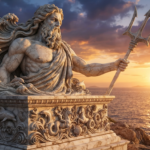
The idea of sacred horse power also reaches into ritual and cult. Poseidon was not only god of the sea but also linked to horses and often called Hippios, “of horses.” In this way, the horse became an animal that joined two realms of force: the depth and violence of the sea, and the speed and mastery of the battlefield. Greek myth does not offer one single category of divine horse, but rather a network of figures, names, and symbols that reveal how closely horses were associated with the gods.
The immortal steeds of Poseidon’s sea realm
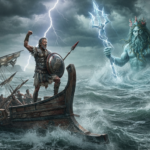
Poseidon’s connection to horses is one of the oldest and most important in Greek religion. Ancient sources describe him as the creator or lord of horses, and mythology often places him near the origin of the horse itself. In some traditions, Poseidon produced the first horse by striking the earth, an act that links his power over land and sea with the sudden emergence of living force. His horses are not always individually named, but they are imagined as majestic and uncontrollable, suited to the god who rules storms, earthquakes, and the deep waters.
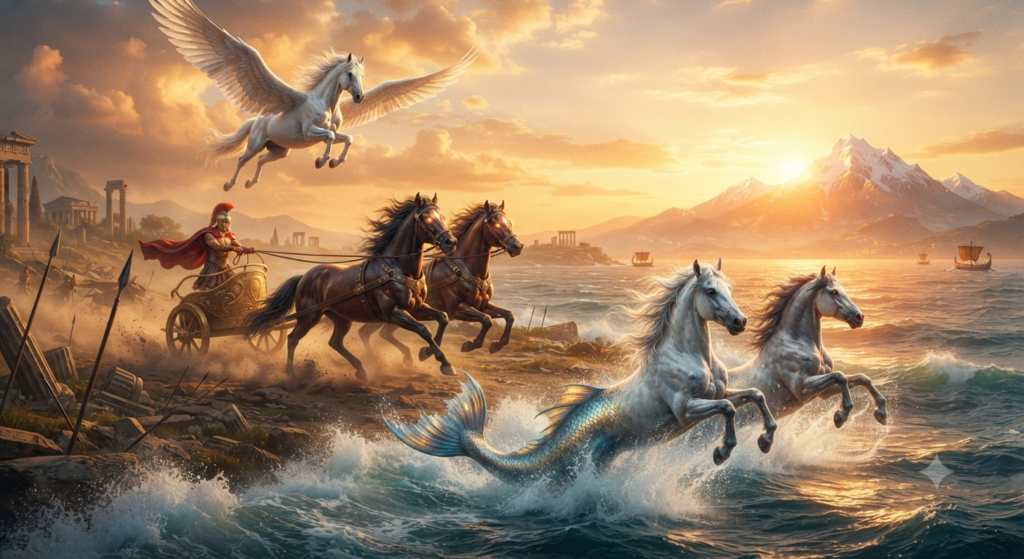
When Poseidon travels, he is often drawn by sea horses or by a chariot of creatures that belong to the oceanic world. Later artistic and poetic traditions present him with bronze-hoofed or wave-bearing steeds, reflecting his lordship over fluid movement and force. These divine horses are less about domestic usefulness than about raw elemental power, embodying the speed and instability of the sea itself. In mythic language, to ride with Poseidon is to move with a power that cannot be fully restrained.
Xanthos and Balios among heroic horse names
Among the best-known divine or near-divine horses in Greek myth are Xanthos and Balios, the immortal steeds given to Achilles. Homer presents them as extraordinary horses, born from divine ancestry rather than ordinary mortal breeding. Their father is the West Wind, Zephyrus, and their mother is the Harpy Podarge, making them creatures of a strange and elevated lineage. They stand at the edge of the human and divine worlds, serving one of the greatest heroes of the Trojan War.
In the Iliad, Xanthos and Balios are more than decoration; they participate in the poem’s tragic atmosphere. Achilles’ horses are deeply connected to fate, loss, and divine speech. One of them, Xanthos, is granted a moment of speech by Hera and foretells Achilles’ death, a scene that emphasizes how close these horses are to prophecy and divine will. Their names, especially Xanthos, often noted for its color, and Balios, preserve the poetic habit of naming horses as if they were heroic companions rather than mere animals.
Pegasos and the winged horse tradition
Pegasos is the most famous winged horse in Greek mythology, and his story belongs to a different mythic register from that of Achilles’ steeds. He is born from the blood of Medusa after Perseus beheads her, according to Hesiod and later mythographers. From the beginning, Pegasos is marked by miraculous origin. He is not simply divine in status; he is literally a creature of mythic transformation, emerging from a monstrous death into a new, elevated form.
Pegasos later becomes associated with Bellerophon, who uses the horse to defeat the Chimera. In some versions, Pegasos is finally taken to the company of Zeus, where he serves by carrying thunder and lightning. This makes him one of the clearest examples of a horse crossing into divine service. The winged horse tradition that grows around him is not just decorative fantasy; it reflects a Greek fascination with ascent, vision, and the possibility that a horse can carry a hero beyond the ordinary human world.
Helios, Eos, and the chariot of the sky
The sky-gods of dawn and sun also depend on horses in Greek imagination. Helios, the sun god, drives a chariot across the heavens each day, pulled by powerful horses whose movement explains the rising and setting of the sun. The exact names of these horses vary in later literature and artistic tradition, and the sources are not always consistent. What matters is the image: celestial horses become the mechanism by which cosmic order is made visible.
Eos, goddess of dawn, is similarly linked with horse imagery. She is often described as “rosy-fingered” and associated with the arrival of light, but she also appears as a charioteer in early Greek poetry. Her horses belong to the threshold between night and day, carrying the first light into the world. In both cases, the divine horses do not merely travel through the sky; they are part of the structure of time itself, moving heaven into motion with each new day.
Odysseus, Achilles, and divine equine signs
Divine horses often serve as signs of heroic destiny rather than simply as mounts. Achilles’ horses, as noted in Homer, express the hero’s nearness to death and divine judgment. Their refusal, grief, or prophetic speech gives them a moral and emotional weight that is unusual even by epic standards. They reflect the intimate relationship between a great warrior and the supernatural world that supports him.
Odysseus is not usually linked to famous divine horses in the same way, but his story still belongs to the larger horse tradition of Greek epic. The horse of Troy, built by divine inspiration in some versions and by human cunning in others, is the most famous horse in his orbit. Though not a living divine horse, it is a sacred sign of deception, fate, and the gods’ indirect involvement in war. Greek mythology often blurs the line between horse as creature and horse as omen, and epic heroes are continually judged by the kinds of equine signs that appear around them.
Horses in Homeric epic and early Greek lore
Homer is one of the main sources for the elevated status of horses in Greek myth. In the Iliad, horses accompany kings, speak in moments of divine intervention, and take part in scenes of glory and mourning. The epic world assumes that horses belong to the highest ranks of human and divine life. They are a marker of aristocratic identity, but also of sacred proximity, since many are associated with gods or inherited from divine ancestry.
Early Greek lore, including Hesiod and later mythographers, expands this world by attaching horses to broader cosmogonic and genealogical patterns. Horses may emerge from sea gods, wind gods, monsters, or miraculous births. They are not random additions to stories of war and travel; they are woven into the fabric of mythic genealogy. In that sense, the divine horse is a recurring language of prestige and power, appearing wherever Greek myth wishes to show movement beyond the human scale.
Sacred mares, stallions, and cult symbolism
Greek religion did not separate sacred meaning from animal life as sharply as modern readers might expect. Horses, mares, and stallions could carry religious significance, especially when associated with local cults of Poseidon, Demeter, or heroic foundations. In some traditions, mares are tied to the fertility and wildness of the land, while stallions embody force, virility, and speed. Such symbolism often overlaps with ritual practice and local myth.
Pausanias records many regional traditions in which horses play a role in cult or legend, showing that sacred horse imagery was not limited to famous epic stories. Sometimes a divine horse is implied through offerings, processions, or a god’s epithet rather than through a named mythic animal. The Greeks often understood sacred animals through context rather than through a single universal doctrine. Horses, in this environment, could stand for divine arrival, control over nature, and the tense relationship between civilization and untamed strength.
Mortals, gods, and the gift of horse breeding
Greek mythology often presents horse breeding as a gift that depends on divine favor. Gods may sire extraordinary horses, but mortals also learn from divine models. Heroes such as Achilles, and noble houses more broadly, are associated with superior horse lines, suggesting that excellence in breeding was imagined as part of inherited prestige. The horse becomes a bridge between the human skill of husbandry and the unpredictable generosity of the gods.
This matters because horses were costly and difficult to maintain in the ancient world. Their presence in myth reflects real social conditions: only the wealthy could keep them, and only a ruler or hero could command them in large numbers. Myths that connect horses to gods therefore dignify a practical reality. They say, in effect, that true mastery of horses is never merely technical. It is bound to ancestry, destiny, and the favor of powers larger than the human household.
Why divine horses mattered in Greek religion
Divine horses mattered because they expressed ideas central to Greek religion: power, speed, mediation, and the boundary between mortal and immortal life. A horse could carry a hero into battle, a god across the sky, or a soul-symbolic charge into the realm of myth. Whether they belonged to Poseidon, Helios, Eos, Achilles, or the broader tradition around Pegasos, these animals helped the Greeks imagine divine action in visible, moving form.
They also reveal how closely the Greeks linked beauty with force. A divine horse is not gentle by nature; it is brilliant, swift, and difficult to master. That combination made it an ideal sacred creature. In myth, the horse is one of the clearest signs that the gods are near, not because it is tame, but because it is powerful enough to suggest a world beyond human control. The divine horses of Greek mythology remain memorable for exactly that reason: they race at the edge of the mortal world, carrying with them the presence of the gods.
Greek mythology does not define divine horses through a single list or doctrine. Instead, it offers a constellation of sacred steeds: Poseidon’s horse-linked power, Achilles’ immortal pair, Pegasos the winged marvel, and the chariot horses of sun and dawn. Together they show that horses were never merely animals in the Greek imagination. They were emblems of divine motion, heroic fate, and the strange beauty of forces that cannot be fully contained.

Orin Vale has spent the better part of two decades tracing the threads that connect the world’s oldest stories — from the halls of Asgard to the banks of the Nile, from Olympus to the jungles of the Maya. What began as a childhood fascination with flood myths and trickster gods grew into years of independent study across comparative mythology and ancient religion, always chasing the same question: what did these stories mean to the people who first told them? Orin writes for readers who want more than trivia — the ones looking for the beliefs, fears, and truths that myths were built to carry.