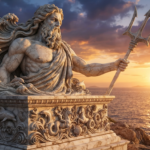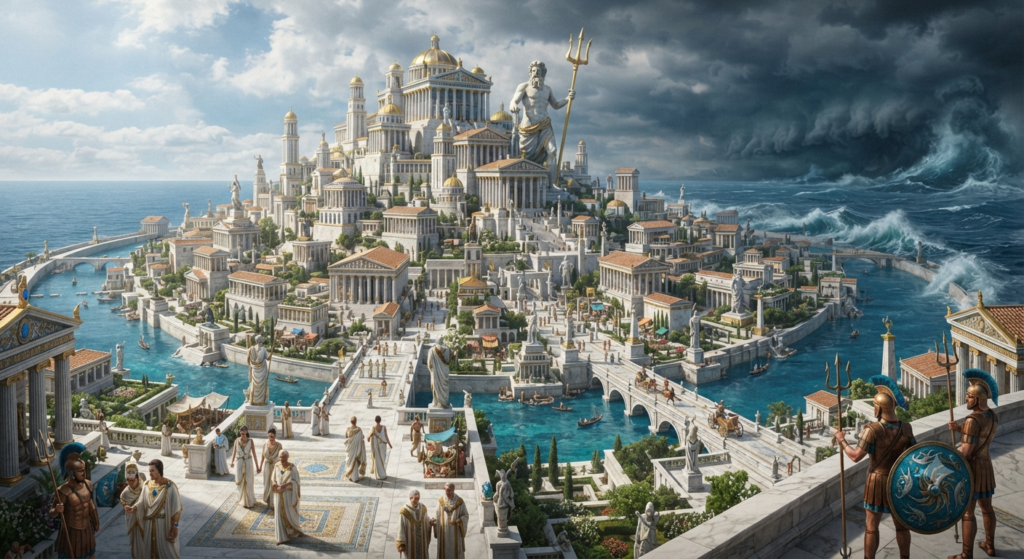
In Greek mythology, the name Atlanteans does not point to a single tribe or nation in the modern sense. It refers instead to the family descended from Atlas, the Titan condemned to bear the heavens, and to the many figures who sprang from his line in different ancient traditions. These Atlanteans appear as nymphs, stars, and divine or semi-divine beings whose stories are scattered through Homer, Hesiod, Apollodorus, and later writers. Their importance lies not in political power but in genealogy, cosmic symbolism, and their place at the margins of the mythic world.
Atlanteans in Greek Myth and Titan Lineage
The Atlanteans belong to the vast mythic household of Atlas, a figure of Titan ancestry who survived the war of the gods and became one of the great names attached to the western edge of the world. In Greek myth, “Atlantean” is best understood as a genealogical label: it identifies those connected to Atlas by birth, whether directly as daughters or more broadly through descendants associated with his line. Because Atlas himself was a Titan, his offspring often occupy a threshold between divine power and the more local, mortal world of heroes and nymphs.
This lineage is important because Greek myths often explain the order of the cosmos through family trees. Atlas stands at a boundary, and his children inherit that symbolic position. Some are star-related nymphs, some dwell on remote mountains or islands, and some become mothers of kings or heroes. The Atlanteans are therefore not a single collective in the historical sense, but a cluster of related beings whose stories reflect the Greek imagination of the far West, the sky, and the origin of sacred and heroic bloodlines.
Atlas, the Titan King of Mauretania
Atlas is the central figure from whom the Atlantean family takes its name. In Homer and Hesiod, he is a mighty being associated with the ends of the earth, and in later tradition he is often placed in the far western regions, near Mauretania, the Atlas Mountains, or the ocean beyond the known world. Hesiod describes him as one who “stands” apart, bearing the heavens on his shoulders, a punishment tied to the Titan war and his role among the defeated older gods.
The title “king of Mauretania” belongs more to later mythographic and geographic imagination than to the earliest surviving poems. Greek writers increasingly linked Atlas with North Africa and the mountain range that still bears his name. In this setting, Atlas becomes a ruler of a remote and extraordinary landscape, a father of daughters whose names are tied to stars and natural phenomena. His domain is not merely a political kingdom but a mythic frontier where heaven, earth, and ocean seem to meet.
The daughters of Atlas in ancient sources
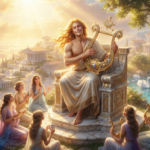
Ancient authors are not always consistent about Atlas’s children, but the most famous among them are his daughters, often called the Atlantides. Hesiod’s Theogony names the Pleiades, Hyades, and Hesperides in the orbit of Atlas’s family, while later sources expand or vary the list. These daughters are sometimes presented as nymphs, sometimes as star figures, and sometimes as mothers of important divine or mortal lineages. Their identities shift depending on the author, which is typical of Greek myth rather than a sign of uncertainty.
The daughters of Atlas matter because they connect the Titan’s far western realm with the heavens. Some become stars through metamorphosis, some are linked to rain and seasonal change, and others guard sacred places at the edge of the world. In mythographic tradition, their names often become anchors for ancient astronomical knowledge. A family of daughters thus becomes a map of the sky, the sea, and the horizon where Greek cosmology imagined the limits of human experience.
The Pleiades and Hyades among Atlanteans
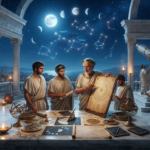
The Pleiades are the best-known daughters of Atlas. In Hesiod, they are the seven daughters of Atlas and Pleione, transformed into stars and pursued by the hunter Orion in later myth. Their names recur in Greek and Roman poetry as a marker of seasonal sailing and agriculture, since their rising and setting helped ancient observers track the year. The Pleiades are not merely decorative constellations; they are embedded in myth, labor, and timekeeping.
The Hyades are also linked to Atlas, though their exact number and names vary by source. Some ancient authors treat them as sisters of the Pleiades, and later tradition often connects them with rain, mourning, and the nurturing of Dionysus. In one strand of myth, they are transformed into stars after grief or service to the gods. Together, the Pleiades and Hyades show how the Atlantean family was interpreted as celestial: daughters of Atlas became visible signs in the night sky, turning genealogy into astronomy.
Calypso, Maia, and other Atlas-born figures
Among Atlas’s daughters, Calypso occupies a special place in Homer’s Odyssey. Homer calls her “divine Calypso” and places her on the island of Ogygia, but he does not always make her parentage explicit in the poem itself. Later tradition, including Apollodorus, identifies her as a daughter of Atlas. This connection deepens her significance: the nymph who detains Odysseus is not just a solitary island figure but part of a Titan-descended line associated with remote places and hidden knowledge.
Maia, mother of Hermes by Zeus, is another daughter of Atlas in Hesiod and later sources. She lives in a cave on Mount Cyllene, far from the political world of gods and kings, yet she gives birth to one of the most agile and boundary-crossing Olympians. Other Atlas-born figures appear in various traditions, including nymphs and local ancestral mothers, though the lists differ. What unites them is their position as mediators: they bring divinity into contact with landscape, kinship, and mortal history.
Atlantes in Homer, Hesiod, and Apollodorus
The oldest literary sources do not use “Atlanteans” as a formal category, but they provide the raw material from which later mythographers built it. In Homer, Atlas appears as a figure who “knows the depths of the sea and keeps the tall pillars which hold heaven and earth apart,” a description that gives him cosmic authority. Homer also preserves Calypso’s world at the edges of the sea, reinforcing the sense that Atlas and his descendants belong to the distant margins of the known world.
Hesiod is more explicit about Atlas’s family. In the Theogony, he names Atlas’s daughters among the divine offspring of the Titan line, establishing the Pleiades, Hyades, and Maia within a broader genealogical framework. Apollodorus, writing much later, gathers and systematizes these traditions, often identifying Atlas’s children more directly and relating them to heroic and divine stories. Together, these sources show how the Atlanteans were assembled from poetic, astronomical, and mythographic traditions rather than from one fixed canon.
Mount Atlas and the edge of the world
Mount Atlas became one of the clearest geographical symbols in Greek myth. Ancient Greeks imagined it as a vast western boundary, a place where the sky seemed to rest and where the sun, sea, and earth met in an almost uninhabitable expanse. The association between the Titan Atlas and the mountain range likely developed through a combination of etymology, local geography, and mythic logic. The name of the place and the name of the Titan became inseparable in the Greek imagination.
This western edge was not just a cartographic limit but a mythic zone. Monsters, nymphs, and divine treasures were often placed there, as were the ends of journeys undertaken by heroes and gods. Atlas’s mountain belonged to the same symbolic landscape as the Garden of the Hesperides and the Ocean that encircled the world. The Atlanteans, in this sense, are part of a larger vision of boundary and threshold: they live where the familiar world gives way to wonder.
Atlantis and the later confusion of names
The similarity between Atlas, Atlantean, and Atlantis has caused lasting confusion, though the mythic traditions are distinct. Atlantis is not a classical Greek myth in the same sense as the stories of Atlas’s daughters. It appears in Plato’s dialogues as a powerful island civilization destroyed in antiquity, serving philosophical and political purposes rather than belonging to the old heroic myth cycle. Later readers often blurred the two because of the shared root in Atlas’s name.
This confusion has persisted in modern popular culture, where “Atlantean” may refer to imagined inhabitants of Plato’s island rather than the descendants of the Titan Atlas. Classical sources do not support that identification. In Greek mythology, the Atlanteans are the family of Atlas and the beings associated with his western and celestial domain. Atlantis belongs to a different literary and philosophical tradition, even if the names seem to invite comparison.
Divine ancestry and heroic descent from Atlas
Atlas’s family mattered because descent from a Titan could confer grandeur, antiquity, and a sense of cosmic proximity. The daughters of Atlas appear as mothers of gods, constellations, and local dynasties, linking divine ancestry to heroic descent. Maia’s son Hermes is the clearest example, but other traditions connect Atlas’s line to kings, founders, and island figures whose bloodline explains their unusual stature or sanctity. Such genealogies were central to Greek myth, where family trees often carried the weight of cultural memory.
This descent also helped explain why Atlas’s descendants occupied so many liminal spaces. They were not always rulers in a political sense, but they governed boundaries of sky, sea, and season. A daughter turned star, a nymph on a remote island, a mother in a cave, or a guardian at the edge of the world all fit the pattern. The Atlanteans are thus less a people than a mythic family whose members embody the reach of the Titan age into the world of gods and mortals.
Atlantean myths in art, cult, and memory
Atlantean figures appear frequently in Greek and Roman art, especially the Pleiades, Hyades, and the image of Atlas supporting the heavens. Vase painting, sculpture, and later astronomical imagery preserved their names and forms, turning myth into a visual language. The daughters of Atlas were especially suited to art because they could be represented both as beautiful maidens and as stars, allowing artists to link narrative, nature, and celestial symbolism.
Their memory also survived through cult and local tradition. Maia was honored in ways tied to Hermes, and the Pleiades and Hyades remained important in seasonal observation and poetic language. Atlas himself continued to live in geography, in mountain names, and in the later literary imagination. The Atlanteans endure because they join genealogy to cosmology: they are family members of a Titan whose punishment became a map of the sky, and whose daughters still shine through the oldest layers of Greek myth.
The Atlanteans in Greek mythology are best understood as the descendants and associated figures of Atlas, not as a single nation or lost civilization. Their stories gather around the Titan’s cosmic punishment, the western edge of the world, and the transformation of family into stars, nymphs, and divine mothers. From the Pleiades and Hyades to Maia and Calypso, the Atlantean line reflects one of Greek myth’s most enduring patterns: the idea that ancestry can shape the heavens, the landscape, and the memory of the ancient world.

Orin Vale has spent the better part of two decades tracing the threads that connect the world’s oldest stories — from the halls of Asgard to the banks of the Nile, from Olympus to the jungles of the Maya. What began as a childhood fascination with flood myths and trickster gods grew into years of independent study across comparative mythology and ancient religion, always chasing the same question: what did these stories mean to the people who first told them? Orin writes for readers who want more than trivia — the ones looking for the beliefs, fears, and truths that myths were built to carry.