In the vast and intricate tapestry of Greek mythology, the Pygmies represent one of the most enduring and enigmatic tribes of legendary beings. The Pygmies were a mythical race of diminutive humans, their very name derived from the ancient Greek word pygmê, which referred to the length of a forearm from the elbow to the knuckles—a measure of approximately one and a half feet . They were not merely a footnote in ancient tales but inhabited a distinct space in the Greek cosmological imagination, dwelling at the edges of the known world. According to the earliest myths, their homeland was situated on the southern shores of the great earth-encircling river Oceanus, a location that placed them at the outermost limits of existence, yet they were intimately connected to the world of men through their legendary struggles .
Understanding who the Pygmies in Greek mythology are requires exploring their role as more than just a curious oddity. They were a central element in a well-known epic cycle that captured the Greek imagination for centuries, most famously for their perpetual war with migrating cranes . This conflict, vividly described in Homer’s Iliad, served as a powerful simile for the clamour and chaos of war, framing these tiny warriors as formidable opponents against the natural world. The Pygmies, therefore, represent a fascinating intersection of mythology, early ethnography, and moral storytelling, reflecting how the ancient Greeks understood the world’s diversity and their own place within it.
Origins and Mythological Background
The origins of the Pygmies are deeply embedded in the genealogical traditions of Greek mythology, linking them to the broader family of gods and legendary peoples. Hesiod, the great epic poet who lived around the same time as Homer, traced their lineage to Epaphus, a son of Zeus and the Egyptian princess Io . According to this tradition, Epaphus was the ancestor of several African peoples, including the “dark Libyans,” the “high-souled Aethiopians,” and the “feeble Pygmies” . This genealogical connection firmly placed the Pygmies within the mythological geography of Africa, specifically associating them with the southern reaches of the known world.
This mythological origin is further elaborated by Stephanus of Byzantium, who mentions that the tribe was descended from Pygmaios, a son of Doros and grandson of Epaphus . This patriarchal lineage establishes them not as isolated creatures but as part of a human family, albeit one of extraordinary diminutive stature. The early poets thus presented the Pygmies as a real, albeit strange, race of people, integrating them into the epic worldview as part of the diverse human landscape that bordered the mystical river Oceanus. Their placement in these distant lands made them both exotic and familiar, a people whose existence, while unusual, was a testament to the vastness and variety of the earth.
The War with the Cranes
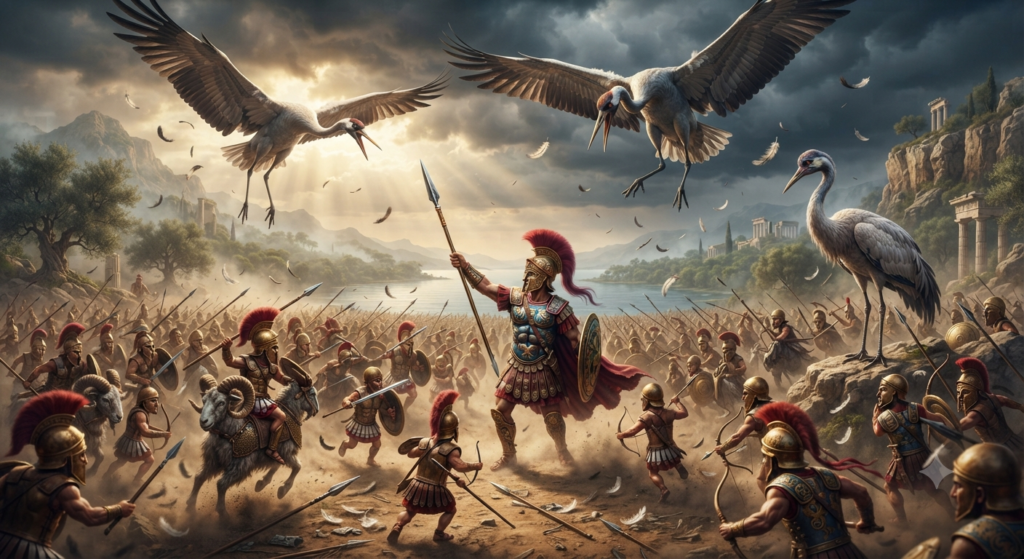
The most defining characteristic of the Pygmies in mythology is their legendary, never-ending war with the cranes, a theme that was immortalized by Homer. In the Iliad, the poet compares the Trojans’ advance to the clamour of cranes fleeing the winter storms, winging their way to the Oceanus, where they bring “bloodshed and destruction” to the “Pygmaian men” . This vivid simile established the conflict as a fundamental law of nature, a seasonal event akin to the migration of birds itself. The war was so central to their identity that the ancient Greeks even coined a term for it: geranomachia, meaning “the battle with the cranes” .
Later writers expanded on the details of this epic struggle. Aristotle, in his History of Animals, insisted that the existence of the Pygmies was not a fable but a reality, locating them near the sources of the Nile and describing them as a people who lived in caves . Pliny the Elder added further colour to the legend, describing the Pygmies as “Three-Span” tall, meaning they were no more than 27 inches in height . He also recounted that they rode on the backs of rams and goats when they went to war, and that they would descend to the sea to destroy the cranes’ eggs and chicks to protect themselves from the growing flocks . This annual campaign transformed the Pygmies from passive victims into active, determined warriors defending their livelihood.
The Queen Gerana and the Origin of the Conflict
An etiological myth, or a story that explains the origin of a custom or conflict, was crafted to explain the ancient enmity between the Pygmies and the cranes. This tale, recounted by the Hellenistic poet Boeus, centres on the tragic figure of Queen Gerana . The story goes that Gerana was a beautiful Pygmy queen who was worshipped by her people. However, her pride swelled to such an extent that she considered herself superior to the gods, particularly the goddesses Hera and Artemis .
This act of hubris, or excessive pride, angered Hera, the queen of the gods. As punishment, Hera transformed Gerana into a crane, a bird considered ugly . In her new form, Gerana was unable to care for her infant son, Mopsus, and she fluttered around her city, longing to be near him. The Pygmies, horrified or enraged by her transformation, chased her away, thus sparking the eternal war between the tribe and the birds . According to some versions, Gerana’s beauty was so great that she even dared to compare herself to the goddesses, while another version suggests she boasted of surpassing them all . This story served as a powerful cautionary tale about the dangers of pride and the severe consequences of challenging the divine order.
Encounters with Heracles
Another famous episode in the mythology of the Pygmies involves their encounter with the legendary Greek hero Heracles (Hercules), a story that highlights their comic and audacious nature. According to the myth, after Heracles had killed the giant Antaeus in Libya, he lay down to rest . The Pygmies, who were the brothers of Antaeus and fiercely protective of their kin, saw this as an opportunity for vengeance. They gathered their entire army and launched an attack on the sleeping hero .
Ancient descriptions of this event, such as those by Philostratus, portray the Pygmies as a determined army laying siege to a massive fortress. Their forces swarmed over his body, with one phalanx attacking his left hand and another his right, while archers and slingers besieged his feet . The Pygmy king even led the assault on his head, bringing up “engines of war” to set his hair on fire and “mattocks” to dig out his eyes . However, their grand plans were comically thwarted. Heracles awoke, laughed at the tiny warriors, and scooped them all up into his lion skin, presumably to carry them back to King Eurystheus . This story, which later inspired Jonathan Swift’s Gulliver’s Travels, showcases the Pygmies as proud, foolhardy, and utterly lacking in self-awareness.
Artistic Representations and Cultural Legacy
The story of the Pygmies was a popular subject in ancient Greek art, serving as a visual testament to their enduring presence in the cultural imagination. One of the earliest and most famous depictions of the geranomachia is found on the François Vase, dating to around 570 BC, which shows the pygmies battling cranes with clubs, slings, and while riding goats . This iconographic tradition continued for centuries, with the figures often depicted as pudgy, grotesque, or comical figures on Archaic and Classical vases . Their depiction evolved, sometimes appearing as fully armed warriors in Roman-era paintings and at other times as deformed figures in humorous Nilotic scenes, fighting crocodiles and hippopotami .
The legacy of the Greek Pygmies extends far beyond antiquity, leaving a profound and lasting impact on both language and ethnography. The term “Pygmy” itself, derived from the Greek word for their small stature, was adopted by 19th-century European explorers to describe the short-statured hunter-gatherer peoples they encountered in the rainforests of Central Africa . While modern anthropologists and the people themselves use this term—and it is even employed by Pygmy rights organizations—the name remains rooted in the ancient Greek myth . This connection demonstrates how a mythological story, born from a blend of observation, imagination, and prejudice, transformed into an ethnographic label that has shaped the identity and understanding of entire populations for millennia .
Frequently Asked Questions About Who are the Pygmies in Greek mythology?
What does the word “Pygmy” mean in Greek?
The word “Pygmy” comes from the Greek word pygmê, which signified a unit of measurement. It referred to the distance from a man’s elbow to his knuckles, or the length of the forearm, which is approximately one and a half feet. This term was used to describe the tribe’s diminutive stature .
Where did the Greek Pygmies live?
According to Greek mythology, the Pygmies lived at the outermost edges of the world, on the southern shores of the river Oceanus, which was believed to be a great river encircling the earth . Later writers attempted to place them in more defined geographical locations, often associating them with the sources of the Nile in Africa or parts of India .
Why did the Pygmies fight the cranes?
The Pygmies were engaged in a perpetual war with cranes. Homer described this as a seasonal conflict where the cranes would migrate south for the winter and bring destruction to the Pygmy people . Later myths explained this war as a result of Hera’s punishment of Queen Gerana, who was transformed into a crane, creating an eternal enmity between the two .
What was the story of Gerana in Pygmy mythology?
Gerana was a beautiful and proud queen of the Pygmies. She was worshipped by her people but refused to honour the goddesses, particularly Hera, and often boasted of her own superiority . As punishment for her hubris, Hera transformed Gerana into an ugly crane. In this form, she was rejected by her people, leading to the long-lasting war between the Pygmies and the cranes .
How were Pygmies depicted in ancient Greek art?
In ancient art, Pygmies were often portrayed as small, pudgy, and comical dwarfs. They were famously depicted in scenes of the geranomachia (the battle with the cranes), where they were shown armed with spears and slings, and sometimes riding on the backs of goats and rams . These depictions were popular on vases and other artworks from the Archaic period onwards .
Conclusion
The Pygmies of Greek mythology represent a unique and enduring archetype, embodying the ancient Greek fascination with the exotic, the marginal, and the natural world. Who are the Pygmies in Greek mythology? They are the diminutive and formidable warriors, locked in an eternal struggle against the cranes, a battle that symbolizes the persistent and often comical conflict between man and nature . Their mythological identity, rooted in epic poetry and embellished by later writers, places them at the edges of the world, yet their stories, from the hubris of Queen Gerana to their audacious attack on Heracles, strike a universal chord .
The legacy of the Pygmies extends far beyond their mythical battles, as their very name was adopted by modern explorers and persists as an ethnographic label for real ethnic groups in Central Africa . This transformation of a Greek myth into a contemporary identity demonstrates the profound and sometimes problematic power of storytelling. The Pygmies, therefore, are not just a curious legend of the ancient world; they are a testament to how ancient narratives can shape our understanding of human diversity and continue to resonate in the modern world, reminding us of the complex interplay between myth, history, and identity.

Orin Vale has spent the better part of two decades tracing the threads that connect the world’s oldest stories — from the halls of Asgard to the banks of the Nile, from Olympus to the jungles of the Maya. What began as a childhood fascination with flood myths and trickster gods grew into years of independent study across comparative mythology and ancient religion, always chasing the same question: what did these stories mean to the people who first told them? Orin writes for readers who want more than trivia — the ones looking for the beliefs, fears, and truths that myths were built to carry.