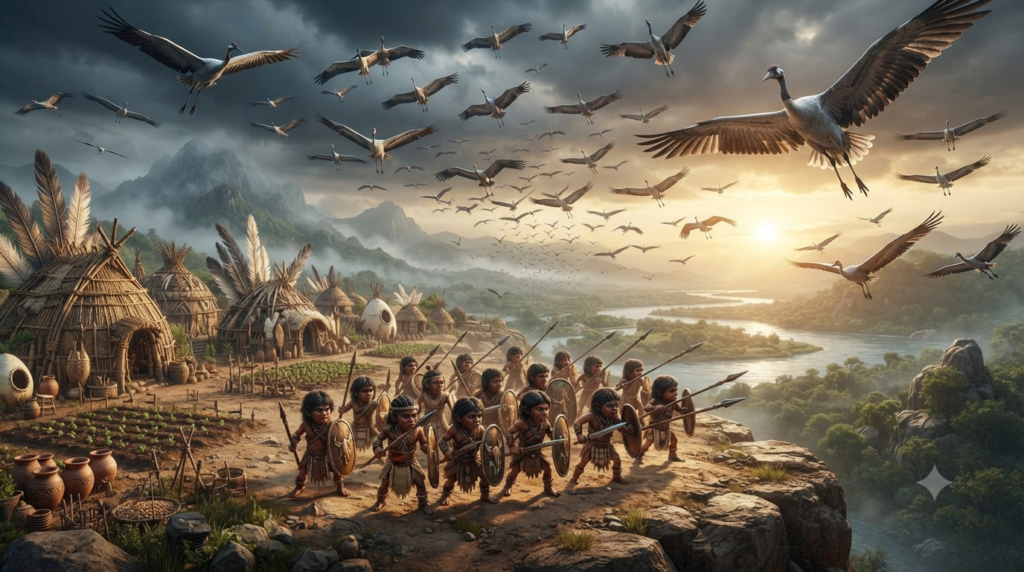
The Pygmies occupy a genuinely distinctive place within Greek mythology, remembered as a legendary tribe of remarkably diminutive humans whose entire existence became defined by one of antiquity’s most enduring and vividly imagined conflicts. Anyone asking who are the Pygmies in Greek mythology is uncovering a people described as standing roughly one cubit tall, approximately twenty-one inches, who inhabited the far southern reaches of the ancient Greek world and became permanently associated with their perpetual, seasonal war against migrating cranes.
This remarkable conflict, known formally as the Geranomachy, or “crane-battle,” appears remarkably early within Greek literary tradition, receiving direct mention in Homer’s Iliad itself, one of the oldest and most authoritative sources within the entire Greek mythological canon. This early literary attestation confirms that the Pygmies held genuine cultural significance within ancient Greek storytelling from its very earliest recorded stages.
Beyond their famous conflict with cranes, the Pygmies also appear within a separate, less widely known mythological tradition connecting them directly to Heracles, one of Greek mythology’s most celebrated heroes, through their relationship to the giant Antaeus. This additional connection demonstrates how thoroughly the Pygmies became woven into broader Greek heroic and mythological narratives beyond their own more famous, independent conflict.
What follows examines where the Pygmies lived according to ancient sources, the details of their legendary war against the cranes, the specific origin myth explaining how this conflict began, ancient descriptions of their daily life and culture, their remarkable encounter with Heracles, and how their mythological name eventually found its way into later, more problematic historical usage.
Where Did the Pygmies Live?
Ancient Greek sources consistently placed the Pygmies at the far southern edge of the known world, most commonly locating them near the sources of the Nile River within the region ancient Greeks referred to as Ethiopia, though this designation covered a considerably broader and more loosely defined territory than the modern nation bearing this same name. This distant, largely unexplored location reinforced the Pygmies’ mythological status as inhabitants of a remote, exotic realm beyond ordinary Greek experience.
Other sources instead describe the Pygmies dwelling along the southern shores of Oceanus, the great river ancient Greeks believed encircled the entire known world, further reinforcing their association with the very edges of geographical reality as understood within ancient Greek cosmology. This alternative location similarly positioned the Pygmies within a genuinely liminal, boundary-marking space within the broader Greek mythological worldview.
Regarding their genealogical origins, ancient sources specifically traced Pygmy ancestry back to a figure named Pygmaeus, identified as the son of Dorus and grandson of Epaphus, connecting this diminutive tribe to a broader, established mythological family line despite their own physically distinctive characteristics. This genealogy gave the Pygmies a legitimate place within Greek mythology’s broader genealogical framework rather than positioning them as entirely disconnected, isolated figures.
Understanding this distant, boundary-marking location provides essential context for who are the Pygmies in Greek mythology, establishing them firmly within the broader category of peoples ancient Greeks imagined inhabiting the furthest, most exotic reaches of their known world, appropriately positioned for the equally extraordinary conflict that would come to define their entire mythological identity.
The Geranomachy: The Endless War Against the Cranes
The defining feature of Pygmy mythology centers entirely on the Geranomachy, their perpetual, seasonally recurring war against migrating cranes, a conflict significant enough to earn direct mention within Homer’s Iliad through one of the poem’s most memorable extended similes. Homer specifically compares the clamorous approach of the Trojan army to the distinctive calls of cranes flying south each winter specifically to wage battle against the Pygmies.
This literary comparison carries genuine significance given the Iliad’s foundational status within Greek literature, confirming that audiences would have immediately recognized and understood this reference to the Pygmy-crane conflict without requiring additional explanation, suggesting the myth already held widespread cultural familiarity by the time Homer composed his epic. This early, casual reference demonstrates the conflict’s deep embedding within Greek popular imagination.
Ancient sources describe this war as genuinely cyclical and seasonal in nature, directly tied to the cranes’ own natural migratory patterns, with the birds descending upon Pygmy territory specifically during their annual journey toward warmer southern regions. This connection between mythological conflict and observable natural migration patterns gave the Geranomachy a genuinely grounded, almost naturalistic quality despite its otherwise fantastical premise involving a tiny human population locked in permanent warfare against birds.
This foundational conflict provides the clearest and most historically significant answer to who are the Pygmies in Greek mythology, establishing that their entire mythological identity became inseparably bound to this remarkable, recurring war, a conflict distinctive enough to earn recognition within some of Greek literature’s earliest and most influential surviving texts.
Queen Gerana and the Origin of the War
Ancient mythology traces the specific origin of the Geranomachy to Queen Gerana, also known by the alternative name Oenoe in certain sources, who served as wife to the Pygmy king Nicodamas and mother to their son Mopsus. Gerana’s own personal story provides the crucial explanatory mythology behind why the Pygmies found themselves locked in permanent conflict against cranes specifically.
According to this tradition, Gerana committed a genuine act of hubris by boasting that her own beauty surpassed that of the goddess Hera herself, while additionally claiming that her son Mopsus possessed greater handsomeness than the god Apollo. This dangerous comparison between mortal and divine qualities represented exactly the kind of prideful overreach that consistently provoked severe consequences throughout Greek mythological tradition.
In direct response to this offensive boasting, Hera transformed Gerana into a crane, permanently altering her physical form while apparently preserving some aspect of her original consciousness, since ancient sources describe her subsequently hovering persistently around the dwelling where her son Mopsus lived, seemingly still driven by maternal attachment despite her transformation. This lingering presence eventually led to her own death at the hands of the Pygmies themselves, an event specifically credited as the origin point launching their subsequent, permanent war against cranes as a species.
This origin story provides essential mythological grounding for who are the Pygmies in Greek mythology, transforming their seemingly arbitrary conflict against cranes into a coherent narrative rooted in themes of hubris, divine punishment, and tragic transformation entirely consistent with broader patterns found throughout Greek mythological storytelling.
Pygmy Life and Culture According to Ancient Writers
Beyond their famous conflict, ancient Greek writers provided surprisingly detailed descriptions of Pygmy daily life and culture, portraying them as a genuinely pastoral and agricultural people who harvested grain using axes specifically sized for their diminutive stature. This detailed cultural imagination extended their mythology well beyond simple conflict narrative into a more complete, imagined society.
Ancient sources specifically describe Pygmies riding into their seasonal battles mounted upon goats and rams, armed with spears and slings appropriately scaled to their own small size, creating a genuinely vivid visual image that ancient Greek artists frequently depicted across various forms of pottery and other decorative arts. Their homes, according to these same sources, were constructed from mud, feathers, and eggshells, materials reflecting both their modest scale and their close, ongoing relationship with the very birds they perpetually battled.
Remarkably, ancient sources describe the Pygmies conducting a specific annual preemptive expedition lasting approximately three months, during which they traveled to the sea specifically to destroy crane eggs and young chicks before they could mature into fully grown threats, representing a genuinely strategic approach to managing their ongoing seasonal conflict. Aristotle himself, in his History of Animals, notably treated this entire tradition as genuinely factual rather than purely mythological, describing an actual race of diminutive people living in caves alongside correspondingly small horses.
This detailed cultural portrait adds substantial richness to who are the Pygmies in Greek mythology, revealing a people imagined with genuine depth and internal logic rather than existing merely as a simple plot device within their famous crane conflict, complete with their own distinctive customs, strategies, and material culture appropriate to their extraordinary circumstances.
The Pygmies and Heracles
Beyond their conflict with cranes, the Pygmies appear within a separate, less widely known mythological tradition connecting them directly to Heracles through their relationship to Antaeus, a giant of extraordinary size identified as their own brother despite his dramatically contrasting physical stature. Antaeus, son of the earth goddess Gaia, possessed remarkable invincibility as long as he maintained physical contact with the ground, a power that ultimately proved insufficient against Heracles’s own cleverness.
Heracles successfully defeated Antaeus by lifting him entirely off the ground, severing his connection to his mother Gaia’s sustaining power and allowing the hero to crush him while suspended in the air. According to one particular tradition, the Pygmies subsequently sought vengeance for their brother’s death, organizing themselves strategically to attack Heracles while he slept, with different groups specifically assigned to different portions of his massive body.
Despite this coordinated assault, Heracles awoke during the attack and easily overcame his diminutive attackers, subsequently gathering the Pygmies together and wrapping them within his own lion skin before transporting them to King Eurystheus, the ruler who had originally assigned Heracles his famous Twelve Labors. This encounter, along with an alternative, gentler version describing Pygmies simply climbing over a sleeping Heracles in attempted restraint, later inspired Jonathan Swift’s famous Lilliputians within Gulliver’s Travels.
This encounter with Heracles provides an important additional dimension to who are the Pygmies in Greek mythology, demonstrating how thoroughly this diminutive tribe became woven into broader Greek heroic mythology beyond their own independent, defining conflict against the migrating cranes.
From Myth to Modern Misuse of the Name
The mythological name “Pygmy” eventually found its way into considerably more consequential historical usage during the nineteenth century, when European explorers specifically borrowed this ancient Greek term to describe actual ethnic groups of unusually short stature encountered within Central Africa. This historical borrowing directly connected an ancient mythological tradition to real, living human populations in a manner carrying genuine lasting consequences.
Some scholars have suggested that the original Greek mythology surrounding the Pygmies may itself have emerged from earlier, indirect encounters or reports regarding actual communities of shorter-statured peoples, with historical writers like Herodotus documenting interactions with such groups even without using the specific term “Pygmy” himself. This possibility suggests a genuinely complex relationship between ancient mythological imagination and actual historical and ethnographic reality.
This historical connection between ancient Greek mythology and later ethnographic terminology represents an important, if complicated, aspect of the Pygmies’ broader legacy, illustrating how mythological names and concepts could eventually intersect with genuine historical populations in ways the original ancient storytellers could never have anticipated.
Acknowledging this historical trajectory completes a full answer to who are the Pygmies in Greek mythology, confirming that this ancient mythological tradition carries a lasting legacy extending well beyond its original storytelling context into considerably more complex later historical usage worth understanding within its proper context.
Frequently Asked Questions
Why did the Pygmies fight the cranes?
According to myth, the war began after Queen Gerana boasted her beauty surpassed Hera’s own, prompting the goddess to transform her into a crane, an event that ultimately sparked the permanent conflict between the two groups.
How tall were the Pygmies in Greek mythology?
Ancient sources describe the Pygmies as standing approximately one cubit tall, roughly twenty-one inches or fifty-three centimeters in height.
Did the Pygmies really fight Heracles?
Yes, according to a lesser-known myth, the Pygmies attacked a sleeping Heracles in an attempt to avenge their brother Antaeus, whom the hero had previously defeated.
Conclusion
The Pygmies stand as a genuinely distinctive and enduring feature within Greek mythology, their remarkable stature and perpetual war against migrating cranes securing their place within some of the tradition’s earliest surviving literary sources, including Homer’s own Iliad. From Queen Gerana’s tragic transformation to their unexpected encounter with Heracles, the Pygmies’ mythology reveals a richly imagined people whose small physical size never diminished their genuine significance within the broader landscape of ancient Greek storytelling.

Orin Vale has spent the better part of two decades tracing the threads that connect the world’s oldest stories — from the halls of Asgard to the banks of the Nile, from Olympus to the jungles of the Maya. What began as a childhood fascination with flood myths and trickster gods grew into years of independent study across comparative mythology and ancient religion, always chasing the same question: what did these stories mean to the people who first told them? Orin writes for readers who want more than trivia — the ones looking for the beliefs, fears, and truths that myths were built to carry.